

UN Insists 100% Gaza Belongs to Palestinians as Netanyahu Targets 70% Control
The Middle East is at a very delicate crossroads with two conflicting views regarding Gaza’s future becoming clear. On the 28th of May 2026, UN spokesman Stéphane Dujarric declared that
“100% of Gaza should belong to the Palestinian people”
in reaction to Israeli Prime Minister Benjamin Netanyahu declaring that Israel will take full military control of 70 percent of Gaza Strip. This represents one of the clearest statements that have ever been made by international organizations regarding the situation, at least since the onset of this particular crisis.
The timing of such statements is laden with significance. While giving his statement at a meeting held in the occupied West Bank, Netanyahu stated that at present, 60 percent of Gaza was under Israeli control and orders have been given to raise the total percentage of territory in Israeli control. The Prime Minister seemed to hint that this was just the first stage as he said
“my order is to start, step by step, towards 70 percent, Let’s start there,”
and clearly stated that he would not rule out taking full control when his audience demanded Israel should take control of all the area.
Netanyahu’s Military Directive: Numbers and Intentions
Benjamin Netanyahu’s announcement represents a significant escalation in Israel’s military campaign in Gaza. Speaking at the West Bank conference on Thursday, May 28, 2026, the Israeli Prime Minister provided specific territorial measurements that illuminate the scale of his ambitions.
“Currently, we hold complete control over 60 percent of the Gaza Strip… and my order is to achieve… 70 percent,”
Netanyahu stated with characteristic directness. What makes this statement particularly noteworthy is his reluctance to provide a timeframe for achieving this objective, suggesting either operational uncertainty or strategic ambiguity about the campaign’s duration.
The progress made so far by Israel highlights the gravity of this directive. As per reports, the Israeli army has extended its control of Gaza territory by 11% since recent activities, achieving the target of having control of 60% of the region. The increase in the control of Israeli forces was achieved through military actions against Hamas, as well as other militant organizations in the area, which were successfully squeezed from all sides, as stated by Netanyahu.
Netanyahu’s phrasing deliberately emphasizes incremental progress while maintaining strategic flexibility.
“We’re in possession of 60% of the Gaza Strip’s territory. My directive is to move to 70%,”
he declared, notably without giving a timeframe for this objective.
This ambiguity in terms of time frame gives military planners from Israel latitude, while at the same time indicating to both internal and external audiences that the mission is still continuing and can be expanded. Moreover, the fact that the venue for announcing this decision was in the disputed territories of the West Bank is significant in itself.
The UN’s Unambiguous Position on Palestinian Sovereignty
Stéphane Dujarric’s response to Netanyahu’s announcement crystallized the United Nations’ long-standing position on Gaza’s political future with remarkable clarity. The UN spokesperson’s statement
“100% of Gaza should be for the Palestinian people, right? That’s what we want to see”,
eliminated any ambiguity about the international body’s stance. This declaration represents more than diplomatic rhetoric; it constitutes a formal position that directly contradicts Israel’s military expansion plans and challenges the legitimacy of prolonged foreign military occupation.
Dujarric’s comments went further than the mere proclamation of sovereignty for Palestine. He made it clear that the United Nations wished to see Gaza as part of Palestinian territory, and he called on Israel to evacuate from areas outside the present day ceasefire zones. The stance held by Dujarric is consistent with international laws governing the rights of occupied peoples, and is also in line with numerous resolutions passed by the UN General Assembly throughout many years past.
It is significant that such a statement comes from an organization which, as the primary international body that is charged with upholding global peace and security, holds an especially influential voice. In making his statement, Dujarric did not offer just a personal perspective but rather the institutional stand of an organization that has helped shape international law through its many resolutions regarding occupation and self-determination over the years. With
“100 percent of Gaza [to be] for the Palestinian people,”
the United Nations took a clear stand for sovereignty against military occupation, thereby setting the stage for future diplomacy.
The Ceasefire Context and Breaking of Agreements
The backdrop to this confrontation includes a fragile ceasefire that took effect in October 2025, making Netanyahu’s expansion order particularly contentious. Israeli Prime Minister Netanyahu’s directive to seize 70 percent of Gaza comes in defiance of the terms of the ceasefire that had temporarily reduced violence and created expectations for de-escalation. This context transforms what might otherwise appear as routine military operations into a potential violation of international agreements and diplomatic commitments.
The delicacy of the ceasefire became increasingly evident due to Israel increasing their territorial holdings by 11 percent prior to the declaration by Netanyahu. Every expansion made not only indicated progress in terms of the military front but also posed a threat to the diplomatic process that managed to prevent all-out conflict from erupting. The fact that Netanyahu chose to announce the ceasefire when he did, prior to the formation of any peace and following his territorial gains, implies some strategic thinking on his part.
Observers from the international community agree that there were violations of the agreement from both sides. Although technically following the agreement, Israel and Hamas have been found holding some positions that contravened the spirit of the agreement. By making this declaration, Netanyahu has recognized this fact through an agreement that is simply a pause and not binding at all. Nevertheless, the strong response from the UN gives a hint that if this continues, Israel might be in for much bigger problems.
International Implications and Diplomatic Repercussions
The exchange between Netanyahu and the UN represents more than a diplomatic disagreement; it constitutes a fundamental clash over the future governance of contested territory. The confrontation highlights growing international attention on Israel’s military strategy in Gaza and the debate over the territory’s future governance. As major powers monitor developments closely, the international community faces pressure to choose between supporting Israel’s security concerns or endorsing the UN’s position on Palestinian sovereignty.
The timing of this showdown is crucial within the larger framework of geopolitics. Tensions are still high throughout the region, with many countries such as Iran and other groups including Hezbollah, monitoring the situation in Gaza very closely. An expansion by Israel may lead to an escalation throughout the region, involving even more parties with a stake in the outcome of this conflict. The statement by the UN is a bid to set some parameters for diplomacy before any further military action takes place.
Diplomatic repercussions will likely extend beyond immediate condemnation. UN member states may face pressure to sponsor resolutions condemning Israel’s expansion plans, potentially triggering vetoes in the Security Council and further diplomatic friction between Israel and its traditional allies. The economic implications could prove equally significant, with potential sanctions, boycotts, or trade restrictions emerging if Israel proceeds with expansion despite international opposition. The financial markets have already shown sensitivity to Middle East developments, and prolonged uncertainty could trigger broader economic consequences.
Strategic Calculations and Future Scenarios
The strategic rationale of Netanyahu seems to be an equilibrium between his domestic politics and external diplomacy. The gradual strategy of moving from 70 percent to more settlements serves as a way for the Prime Minister to present some form of success in military terms and keep open options for diplomatic negotiations in the future. Nevertheless, such a strategy may eventually trap the country in a situation where diplomatic options become practically impossible because of military realities.
The UN’s position, while diplomatically clear, faces implementation challenges that complicate its practical impact. Without enforcement mechanisms or leverage over Israeli military operations, the UN’s declaration represents moral authority rather than practical constraint. The gap between diplomatic statements and military reality creates a dangerous dynamic where international condemnation may prove insufficient to prevent further escalation, potentially undermining the UN’s credibility if its positions fail to influence actual outcomes.
Scenarios for the future could include negotiations to resolve issues such as Israeli security needs along with the Palestinian desire for self-determination or a further continuation of the use of military power and its unforeseeable consequences in the region. The threshold that Netanyahu has set out, which is 70 percent, could either be a real turning point in the conflict or yet another step toward more territorial claims, depending on the outcome of the military actions and increasing international pressure.
The Human Dimension and Regional Stability
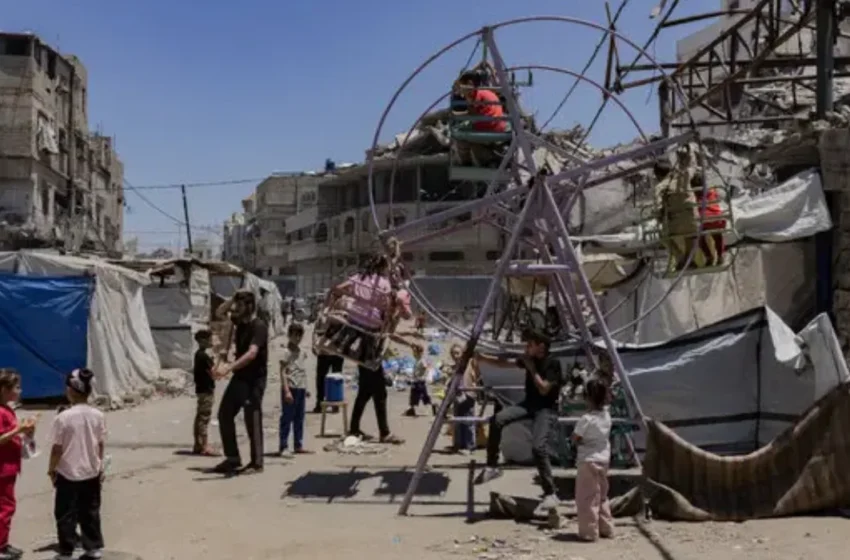
Beyond geopolitical calculations, these developments carry profound human consequences for Gaza’s 2.3 million residents who have endured years of conflict, blockade, and displacement. Each percentage point of territorial expansion represents homes destroyed, families displaced, and communities fragmented. The UN’s insistence on Palestinian sovereignty reflects recognition that military occupation cannot provide sustainable solutions for populations requiring self-determination, economic opportunity, and political representation.
The fate of regional stability is at stake as these tensions continue to escalate. There has been a certain degree of peace seen in the region in comparison to past crises; however, this has not come without conditions that must be met before this period of relative calm can be maintained. If there is no resolution reached over the conflicting interests between the desire for safety in Israel and independence in Palestine, it could result in a fire that would extend well beyond the Gaza Strip.

