

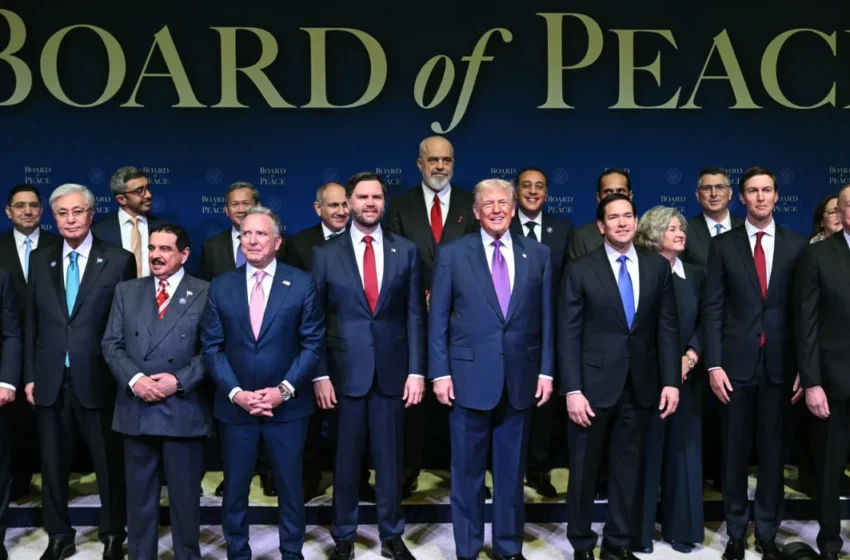
Trump’s Board of Peace immunity plan sparks alarm
With the recent leak of draft papers on the Board of Peace, the immunity proposal put forward by Trump is coming into the limelight. The proposal has raised further concerns regarding the accountability and supervision of such an initiative and whether the proposed peace mechanism aimed at bringing stability in Gaza will be built up with extensive legal protection.
The report, published on June 27, 2026, states that according to the draft resolution, the Board of Peace along with individuals acting under its authority would receive legal protection against any future prosecution related to the work done in Gaza. The matter carries political significance as the Board of Peace had been receiving criticisms for its excessive powers and mandate.
What the draft appears to do
The most significant part of the proposal described above lies in its immunity clause. It appears that according to the text, members of the Board of Peace, as well as its security forces, could have immunity regarding their actions during the management of Gaza. In other words, the implementation of such immunity would complicate the investigation of actions taken by the board. Thus, what originally was a purely legal question became political. The defenders of the proposed legislation might point out the necessity of such measures for international organizations dealing with maintaining peace in regions where there is no peace. However, the opponents of the initiative would probably regard it as yet another attempt to put the board above the law.
The concern is not only about immunity itself, but about the scale of it. The Guardian described the draft as giving the board “sweeping immunity,” language that signals a far broader shield than routine operational protections normally associated with international missions. The report suggests the protections are not limited to basic diplomatic cover, but could extend to prosecution risks arising from mission-related conduct in Gaza.
Why this story matters now
The report comes as another controversial development within an ongoing discussion about the nature of the Board of Peace. While the concept was introduced early in 2026, it has been characterized as a Trump-led international organization associated with overseeing the cease-fire in Gaza as well as its reconstruction. The initiative, however, was criticized for potentially centralizing power.
The reason why this original controversy is important is due to the fact that the current immunity issue has added one more dimension to the same problem. When the board acts in a general way, and when the individuals working under it are also able to claim a general immunity, there is a real chance that the accountability process of the institution may not work effectively.
The political symbolism is also significant. Trump has repeatedly presented himself as a global dealmaker and peace broker, but his opponents have argued that the Board of Peace resembles an imperial-style arrangement rather than a neutral international body. The immunity draft plays directly into that critique by reinforcing the impression of a system designed to protect itself first and answer questions later.
What earlier reporting showed
Earlier accounts of the Board of Peace had highlighted an organization whose form already seemed very centralized. The charter account had made it clear that Trump would head the board and exercise considerable influence over the organization. It had been pointed out that the structure itself would make it difficult to distinguish between the organization’s peace mission and its political objectives. Another aspect of the board that was distinctive had been the breadth of its mandate. While it was Gaza that would serve as the immediate target of attention, the charter account had made it clear that the board was not restricted to Gaza alone but intended to play a worldwide role in conflict resolution.
The charter story also reported a notable membership formula. Countries contributing more than USD 1 billion in cash during the first year could receive permanent membership, rather than a temporary term. That detail suggested the board might combine political influence with financial power, giving wealthy backers exceptional status in the new system.
These earlier elements now matter because the immunity draft does not appear in isolation. It sits on top of a structure that was already being criticized as overly powerful, under-checked, and unusually favorable to insiders.
Legal and political stakes
The legal consequences could be quite significant as well. There have been cases where mission immunity has been granted and there are even times when such an immunity has been justifiable considering the dangerous environment that could necessitate protection from harassment or politically motivated suits. However, the scope of the immunity becomes important.
That is where this proposal becomes controversial. The report suggests the draft could protect not only board officials but also security personnel working under its authority. If true, that could create a wide legal shield covering a large chain of command. Such a model would likely concern human rights advocates, international law experts, and anyone worried about civilian harm or misuse of authority.
However, advocates for immunity could state that it would be impossible to conduct peacekeeping missions without immunity because each action taken could always be subject to legal process. The need for immunity could come from the requirement to take fast decisions in an unstable environment and avoid being paralyzed by the threat of being sued. This argument makes sense in the case of limited, temporary, and controlled immunity. Otherwise, immunity would be considered an exemption rather than protection.
The Gaza context
The Gaza dimension is essential to understanding the reaction. Any governing or security role connected to Gaza sits inside one of the world’s most politically sensitive and legally contested environments. That means even modest institutional protections can attract intense scrutiny, especially if they appear to reduce transparency or block legal recourse.
The Board of Peace was initially proposed within the context of the implementation of the cease-fire and the plan for rebuilding. This gave it humanitarian and stabilizing justification. But when news circulated about the potential expansion of the board outside Gaza and about its charter giving extraordinary powers to Trump, the initiative began to appear more as a geopolitical instrument than as a temporary mechanism of peace. This is even truer with respect to the issue of immunity. A body working in Gaza would already have claims for accountability due to the extent of destruction, displacement, and political conflict. If this body also wants immunity, there is every reason to view it as such.
Reactions and criticism
The strongest criticism yet is that the Board of Peace is constructing a wall of law around itself before it is able to establish any form of legitimacy at all. There are two components to this criticism. One is that the board is set up in such a way that it gives Trump a great deal of direct control. The second component is that the proposal for immunity will prevent anyone working within that system from facing any form of legal penalty. Taken together, this has led some analysts to refer to the board as a “parallel authority,” which can coexist with or even exist above regular multilateral institutions.
There is also concern about optics. Even if the intent is administrative efficiency, the phrase “sweeping immunity” creates a powerful impression. It suggests a body that expects controversy and wants to preempt it. In diplomacy and post-conflict governance, perception matters almost as much as formal legal language, and this proposal risks being read as evidence of overreach.
The next phase will likely depend on whether the draft is revised, formally adopted, or opposed by governments and legal experts. If the immunity language is softened, limited to specific functions, or tied to independent oversight, some criticism may ease. If it remains broad, the controversy is likely to grow.
The bigger question is whether the Board of Peace can convince skeptics that it is a legitimate peace mechanism rather than a political vehicle with special protections. That will require clearer rules, tighter boundaries, and visible accountability. Without those, the immunity proposal will probably dominate the public conversation and overshadow the board’s stated purpose.
For now, the report has sharpened a central concern: a body meant to help manage peace in Gaza appears to be seeking legal protection that could make it harder to scrutinize its own actions. That tension may define the Board of Peace debate for months to come.

