

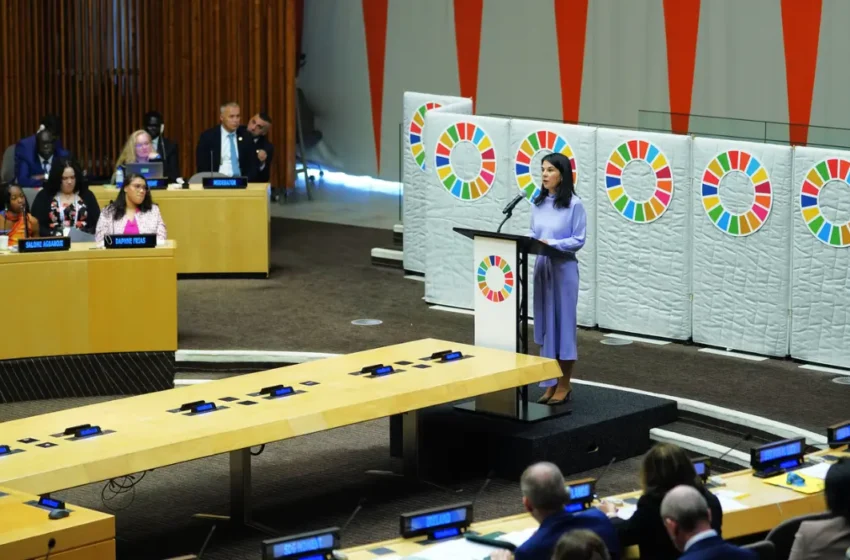
South Korea Initiates Drafting of UN SDGs Implementation Report
As part of South Korea’s commitment to global sustainability, the country has made a monumental step forward by beginning the drafting of its second Voluntary National Review (VNR) report on how it has implemented the United Nations’ Sustainable Development Goals (SDGs).
This announcement was made in early May 2026 and marks South Korea’s first comprehensive update since submitting its first VNR report to the United Nations (UN) in 2016. The Bureau for Sustainable Development, which is under the Office for Government Policy Coordination, recently held a meeting to begin this process.
The VNR report will be drafted and submitted by 2027 and will give an in-depth assessment of South Korea’s overall progress, including accomplishments, obstacles, and insights connected to achieving the SDGs, as well as how it will facilitate greater cooperation with other countries around the world. This news demonstrates South Korea’s active involvement with UN-related initiatives, but it also raises broader questions regarding the rate of worldwide progress on the SDGs.
Strategic Importance of the 2027 VNR Process
The VNR process serves as the foundation for the UN’s High-Level Political Forum on Sustainable Development. Member countries present their voluntary progress regarding the implementation of the SDGs every four to five years. This 2027 report for South Korea is particularly crucial; it is the first report that builds off the 2030 Agenda, adopted in 2015 by world leaders, which set forth the 17 SDGs that will ensure countries around the world will make strides towards eradicating poverty, ensuring zero hunger, achieving good health, providing quality education, achieving gender equality, having clean water, affordable energy, and providing decent work to people; innovative and sustainable approaches to reduce inequalities and build sustainable cities; and responsible consumption and production as well as action on climate change, and protecting marine life and terrestrial ecosystems; achieving peace and justice; and building global partnerships.
At the core of this effort, according to officials with the Bureau for Sustainable Development, is the government’s goal to
“check on Korea’s sustainable development situation in a comprehensive way”
and to
“share both the achievements and lessons learned with the international community”.
This quote illustrates the two-fold with domestically reflecting upon progress as well as globally dialoguing about it, therefore the report will be used as a way to promote strengthening partnerships. This VNR process will be completed with the involvement of the central government, regional governments and civil society organizations by developing “exemplary policy cases” that will serve as “objective and vivid content”.
This level of inclusivity not only adheres to UN policy guidelines but also invites questions regarding whether or not the opinions from stakeholders are actually taken into account during the development of this report or if the inclusion of such policies will merely be for formalities only.
Korea’s K-SDGs Framework and Progress Metrics
South Korea has tailored the UN SDGs into its domestic K-SDGs framework, comprising four strategies, 17 goals, 119 targets, and 236 indicators. This adaptation demonstrates a nuanced localization of global objectives, incorporating national priorities like technological innovation and economic resilience. A 2024 evaluation of 176 indicators revealed that 51.7% were on track to meet targets—a figure three times the global UN average. Notably, the proportion of off-track indicators declined from 16.1% in 2022 to 10.8%, signaling improved momentum. These statistics, drawn from biannual assessments involving government ministries and experts, utilize innovative visualizations like nautical weather charts to track progress dynamically.
In the 2025 Sustainable Development Report, South Korea ranks 34th globally with an overall SDG score of 78.12 out of 100, reflecting strengths in areas such as innovation and infrastructure but lags in environmental sustainability and inequality reduction. Public awareness of sustainable development has more than doubled from 2007 to 2025, a testament to sustained education campaigns. The forthcoming 2026 SDG Progress Report will serve as a foundational document, offering data-driven insights that feed into the VNR. This robust monitoring system positions South Korea favorably, yet critics within UN circles question if such high domestic scores translate to equitable outcomes across demographics, particularly in rural versus urban divides.
Stakeholder Engagement and Network Launch
Complementing governmental efforts, the Korean Stakeholder Network for the 2027 UN SDGs VNR launched with 25 organizations, tasked with monitoring progress and ensuring diverse voices are heard. This network’s formation signals a multi-stakeholder approach advocated by the UN, aiming to bridge gaps between policy makers, NGOs, and the private sector. By involving civil society early, South Korea addresses a common UN critique: the risk of top-down reporting that overlooks grassroots realities. The network’s role in validating “vivid content” through real-world examples could enrich the report, potentially showcasing collaborations on climate resilience or digital inclusion.
However, the theme of critically analyzing UN activities prompts examination of this engagement’s depth. While the network’s launch is timely, its influence on the final draft remains to be seen. UN VNRs have historically varied in inclusivity; some nations use them for self-promotion rather than candid reflection. South Korea’s emphasis on “sharing achievements and lessons” suggests balance, but the absence of detailed timelines for public consultations raises flags about transparency. As the drafting progresses, this network could emerge as a litmus test for how well South Korea embodies the UN’s “leave no one behind” principle.
Historical Context and Global Comparisons
South Korea’s journey with SDGs began earnestly post-2015, with its 2016 VNR setting benchmarks in economic integration of sustainability. The 10-year gap to 2027 reflects a strategic cycle, allowing time for measurable impacts. Globally, only about 100 countries have submitted second-generation VNRs, making South Korea’s participation noteworthy. Its K-SDGs case has been presented at UN forums, such as the IAEG-SDGs meeting, where it shared lessons on indicator adaptation.
Comparatively, South Korea outperforms many peers in Asia, yet trails Nordic leaders in holistic scores. The UN’s Sustainable Development Goals Report 2025 notes stalled global progress, with COVID-19 setbacks exacerbating inequalities. South Korea’s 51.7% on-track rate contrasts sharply, bolstered by investments in green tech and digital governance. Still, challenges persist: SDG 13 (climate action) and SDG 15 (life on land) show vulnerabilities, as highlighted in specialized reports. This VNR offers South Korea a platform to articulate how K-SDGs address these, potentially influencing UN methodologies.
Challenges and Critical UN Perspectives
From a critical lens on UN activities, the VNR process itself warrants scrutiny. While voluntary, it burdens resource-limited nations, often resulting in polished narratives over raw data. South Korea, with its advanced bureaucracy, is well-equipped, but the emphasis on “exemplary policy cases” risks glossing over shortcomings. The UN’s push for VNRs promotes accountability, yet enforcement is absent—progress reports rarely trigger concrete actions. South Korea’s strong stats may amplify this issue, portraying an overly optimistic picture amid rising youth unemployment and housing crises that intersect with SDGs 8 and 11.
Moreover, the 2027 timeline aligns with global stocktakes, where UN data shows only 17% of targets on track worldwide. South Korea’s report could critique UN indicators for lacking cultural adaptability, as its K-SDGs demonstrate through localized metrics. Public awareness gains are positive, but do they equate to behavioral change? The government’s vision of “boost[ing] transparency, accountability, and global partnerships” is ambitious, yet UN critics argue such forums prioritize dialogue over delivery.
Implications for Global Sustainability Agenda
As drafting commences, South Korea’s VNR positions it as a middle-power leader in UN sustainability efforts. The report’s focus on collaborations could inspire bilateral initiatives, particularly in Asia-Pacific. By integrating 2026 progress data, it ensures evidence-based storytelling, potentially elevating K-SDGs as a model. For the UN, this submission reinforces the VNR mechanism’s value, though skeptics question its impact without binding commitments.
In conclusion, while not explicitly summarizing, South Korea’s initiative exemplifies dedicated SDG pursuit within UN frameworks. The process’s success hinges on genuine stakeholder integration and unflinching honesty. As the world nears the 2030 deadline, this report will not only chronicle national strides but also contribute to the global narrative on sustainable development’s viability. With its impressive metrics and forward-looking stance, South Korea reaffirms its role, prompting the UN to refine tools for collective triumph.

