

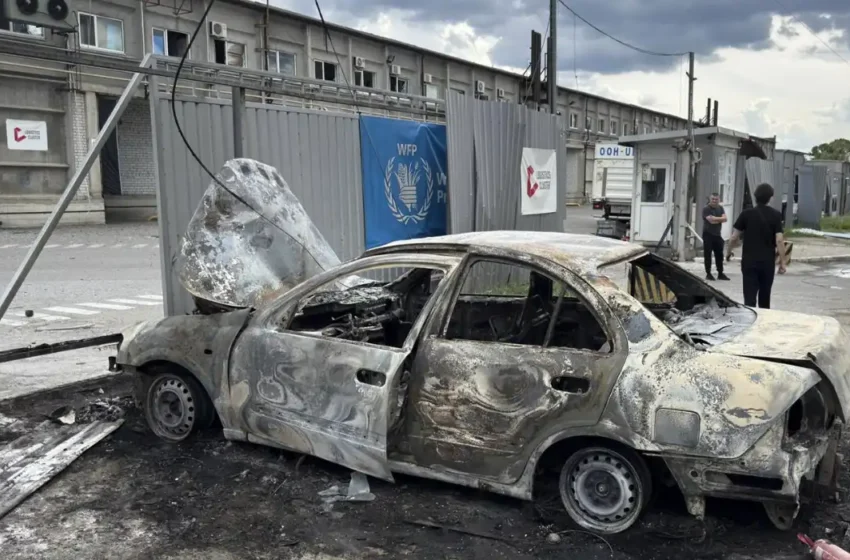
WFP Warehouse Strike in Dnipro Exposes Humanitarian Risks
The reported strike on a World Food Programme warehouse in Dnipro is more than another battlefield incident; it is a direct hit on a humanitarian supply chain that supports civilians living under constant pressure near the front line. If confirmed as described, the attack underscores how aid infrastructure itself has become vulnerable in the war, with consequences that extend far beyond the immediate blast zone.
Humanitarian target, broader message
A warehouse that operates as part of humanitarian efforts is much more than a storage area. The warehouse becomes an important component of the logistical infrastructure that ensures that the supply chain continues even in communities whose markets have collapsed and where transportation is hazardous and the demands of the citizens are increasing. If the warehouse is hit by an attack, there is destruction of property along with the disruption of logistics and deliveries.
If indeed the use of the Iskander ballistic missile was confirmed, this indicates the use of a precise-guided weapon, and not random shelling, which is different due to the fact that it makes one consider the motives behind it, the targets and whether humanitarian laws were ignored. Indeed, when describing conflicts, there is no difference whether the attack is random or precise, the latter just makes the matter even more complicated.
In this case, what is lost immediately includes food commodities, destined for consumption by people who live close to the frontline. This information is crucial due to the fact that people who live at the frontline can be affected by the disruption of supplies and other essential factors much easier than anyone else.
What the strike means
Attacking a WFP storage facility is more than just attacking a building; it represents an attack against the humanitarian process itself. There are usually several steps taken to ensure the proper delivery of food aid, namely, acquisition, transportation, storage, processing, and distribution. If any link in this chain suffers damage, it will affect all others, especially since this war involves many difficulties in movement, fuel, and security.
The result may be much worse than just the loss of a structure. Other routes will need to be taken to deliver food and other supplies, while some may need to be distributed from safer facilities that are less well-protected but operational. Practically speaking, this can lead to delays in distribution.
There is also a psychological dimension. Humanitarian workers rely on the expectation that marked aid facilities will be respected, at least to some degree, under the norms of war. When those facilities are hit, it sends a chilling signal to staff, partners, and local communities that even relief logistics are exposed.
Why Dnipro matters
It is important to mention that Dnipro has become one of the main rear cities in Ukraine’s humanitarian response system. This place is used for transportation and staging operations for aid delivery to other zones of eastern and southern areas of Ukraine. Therefore, this place is vital for humanitarian organizations working with people, who were displaced from these zones.
That is why one should say that a warehouse at Dnipro is not an isolated facility. In particular, it is connected to the transportation of food products, medical supplies, construction material and other emergency goods throughout a much wider area than Dnipro. This attack on the humanitarian logistics can impact many more people without knowing about the origin of their problem.
Politically speaking, this location is extremely important. There have been many stories about the problems of Dnipro because of its proximity to conflict. At the same time, the importance of this city remains unchanged. An attack on this place shows that there is no rear zone in Ukraine that can be secure enough.
Legal and moral stakes
With regard to the fact that the warehouse has been clearly employed for humanitarian purposes, the attack may prompt numerous concerns within the realm of international humanitarian law because facilities of such kind should be treated with particular caution. There are rules about the need to recognize military and civilian objects and protect the latter one from strikes. Consequently, in case with humanitarian warehouse, both damages suffered from it and decision itself should be analyzed thoroughly.
In terms of legal obligations in case with an attack on humanitarian warehouse, certain factors may play an important role, including whether there was clear identification of a warehouse, military employment, information about the object, and compliance with proportionality and precaution principles. However, as these matters have to be considered carefully, all preliminary statements tend to speak about verification and assessment.
From the ethical perspective, destruction of food supplies designed for civilians implies a situation where consequences have to be taken by those who suffer from scarcity. Besides, rebuilding of the warehouse does not mean restoration of aid because it is often hard to replace lost aid supplies, especially when it has been prepared for delivery.
The information gap
The problem with news reporting during war is the potential difference in the wording, the speed of delivering the news, and also how the information is confirmed by different sources. While one source reports a “strike” on a certain object, another talks about an “attack” on the same object. This is why a critical approach to news should be based on verified data, and not speculation or assumption.
In this case, the most powerful aspects of this news are related to the humanitarian aspect and geography. The other facts that are claimed to be true have to be proved and confirmed. This is because there will always be controversy about the weapon used in the early days of a war.
Nevertheless, even without verification, this piece of news shows the vulnerability of humanitarian efforts when they are done in a place where fighting occurs.
WFP’s operational challenge
This situation is not only an operational problem but also a reputational crisis for the World Food Programme. The ability to transport food products in bulk quantity effectively and in safety is crucial in its mission since it often happens in contexts where local markets are disrupted, and the populations become very vulnerable to any disruptions in the aid supply process.
On the one hand, WFP has to evaluate whether it is possible to rescue the stock, relocate it to other facilities, and replenish them quickly. On the other hand, it may take some time to modify risk management procedures and choose other locations for its warehouses. In addition, this takes time – which vulnerable communities cannot afford.
Reputation-wise, it is important because humanitarian missions operate in trust. Organizations like the WFP rely on the trust of their stakeholders including partners, beneficiaries, and the host nation, among others. This means that the damage inflicted on the aid facility becomes a threat to the very idea of safety of relief services in wartime.
What officials are likely to emphasize
In public statements, humanitarian agencies usually focus on three points: confirmation of the site, the scale of the damage, and the impact on civilian assistance. They may also highlight staff safety, evacuation if needed, and whether alternative supply routes remain open. This reporting pattern helps audiences understand what was lost and what can still be saved.
Government and military responses often follow a different pattern, emphasizing operational claims, battlefield context, or denials. That is why it is important to read all statements in context and note whether they are firsthand observations, official investigations, or early assessments based on fragmented evidence.
The most useful official language in a case like this is measured and specific. When agencies state that a warehouse was “used for humanitarian operations” and that food commodities were “destroyed,” those phrases indicate a direct impact on civilian relief. If they add details about frontline communities, the humanitarian significance becomes even clearer.
Impact on civilians
The biggest consequence of any strike on an aid warehouse is felt by civilians who were counting on those supplies. In areas near the front line, food insecurity is often cumulative: one delayed delivery may not seem catastrophic, but repeated disruptions quickly become dangerous. Families may be forced to reduce meals, rely on less nutritious alternatives, or travel farther for assistance.
This is why humanitarian stockpiles are so critical. They allow aid agencies to respond quickly to changing needs, sudden displacement, and access restrictions. When stock is destroyed, the loss is not merely financial; it creates a gap in the safety net that can widen over days or weeks.
For vulnerable groups such as children, older people, and displaced households, even temporary interruptions can have outsized effects. Aid systems in conflict zones are designed to prevent precisely this kind of collapse, which is why strikes on humanitarian facilities attract global concern.
The bigger war picture
The reported attack fits a broader pattern in which civilian infrastructure, logistics networks, and aid systems increasingly come under threat in wartime. As conflicts intensify, the line between military operations and civilian survival can become dangerously thin. Warehouses, depots, roads, and distribution centers become targets of opportunity or sites of collateral damage, with devastating humanitarian consequences.
In that environment, every confirmed strike on a relief asset becomes part of a larger debate about conduct in war. It raises questions about restraint, accountability, and the practical ability of international organizations to work safely in contested territory. It also tests the international community’s willingness to defend humanitarian principles beyond rhetoric.
If the reported facts are confirmed, the Dnipro strike will likely be cited in future discussions about the risks aid workers face in Ukraine and the need for stronger protection of humanitarian logistics. It may also prompt further scrutiny of how often civilian food systems are disrupted by high-precision weapons.

