

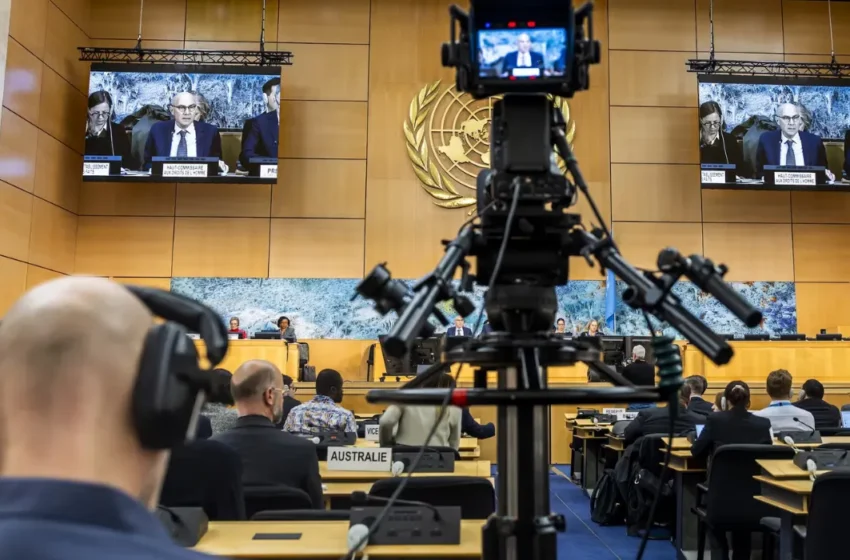
“We the Peoples” Under Siege: UN Council’s Tools Face Global Polarization
The institutional milestone was created by the twentieth anniversary of the United Nations Human Rights Council in February 2026, at a time of increased polarization of the world. The Council, established by the United Nations through the Resolution of the General Assembly 60/251 in 2006, was meant to respond to all the criticisms that were being leveled against its predecessor on the grounds of selectivity and politicization. It has over 50 regular sessions and made over 1500 resolutions over a period of more than 20 years, a demonstration of enduring operational performance in a highly geopolitical competitive environment.
During the anniversary session, Secretary-General Antonio Guterres issued a warning that human rights are under what he termed as a full scale attack globally. His statements put the work of the Council into a wider context of tension on multilateral norms and the underlying tenets that are contained in the preamble of the UN Charter, which reads We the Peoples. In the statement there has been a stress on the institutional working system within a climate of heightened bloc dynamics and a degrading cross-regional consensus.
Institutional Mandate and Structural Design
It was in 60/251 that the Council was set up as a subsidiary organ of the General Assembly specifically with the purpose of ensuring universal respect of human rights without discrimination. The formulation took the election criteria that aimed to give priority to the human rights of states and promote cooperative engagement. Regional group membership rotation was to provide balance in terms of representation and accountability.
The structure aimed at considering previous issues of credibility and at the same time remained inclusive. However, the geopolitical polarization of the Council has been preconditioned by its dependence on the state-oriented process of negotiation. Voting patterns are also becoming more regionalized instead of being issued based and thus making it difficult to achieve a wide-spread adoption of issue specific resolutions.
Democratic Backsliding and Global Context
The situation in the world recently has increased the demand to examine the ability of the Council to react efficiently. As the international democracy monitors assess in 2025, dozens of countries were under democratic backsliding, which led to an increased need to have it under multilateral control. The developments have increased anticipation that the mechanisms of the Council, especially the review processes and independent mandates serve as counter measures to the erosion of domestic governance.
Nonetheless, polarization between world powers has made it difficult to agree on the enforcement language. Bloc voting has sometimes placed the states beyond country-specific examination and strengthened the sense of unequal responsibility. It is the conflict between universal ideals and pragmatism on the diplomatic level that now defines much of the agenda of the Council.
Universal Periodic Review at an Implementation Crossroads
The Universal Periodic Review is considered to be one of the principal mechanisms of the Council. It has been evaluating all 193 UN member states on the various cycles since its inception in 2008 and has produced over 50,000 recommendations. The design focuses on peer dialogue and shared accountability, which are unique in structures of treaty-body enforcement.
However the rates of implementation are not evenly distributed, with most states not following up more than half of the recommendations they get in the latest cycles. Surveys of the key powers in 2025 found that there were significant differences regarding civic rights, the control of the internet, and media autonomy. These meetings brought out the structural conflict between cooperative interaction and substantive compliance.
Engagement Gaps and Compliance Challenges
Evidence in recent cycles suggests that there is a large number of nations who refuse to cooperate wholly with country visits or thematic enquiries. Although the level of participation is high, the level of follow-through on the recommendations is quite low. This is now a common characteristic of the mechanism between dialogue and implementation.
Officials of the council have termed the review process as crucial to progressive gains, which must be a pivotal strength, and that it is universal. The problem is however criticized to be deprived of greater domestic integration of recommendations as there is a risk of the process being procedurally comprehensive and politically limited.
Emerging Themes and Institutional Adaptation
After that, the Council increased its deliberation in 2025, which focused on new issues like artificial intelligence regulation and digital rights. These thematic solutions put across the ability of the body to change its agenda with regard to technological and economic changes. Through the adoption of contemporary policy areas into the conventional human rights paradigms, the Council also aims at being relevant in the face of rapid globalization.
However, the intergovernmental format of negotiations has the effect of polarizing thematic discussions in the same way that country-specific ones are polarized. Final language is frequently influenced by economic powers and regional blocs, which is an indication of larger geopolitical bargaining.
Special Procedures Under Operational and Political Pressure
Another pillar in the structure of the Council is its network of independent experts, usually referred to as Special Procedures. These specialists released over 1,000 messages in 2025 alone, dealing with crises in armed conflict to civic oppression with over 100 mandates having the theme and country specific issues. They are independent and thus have the powers to act promptly without needing the state authorization as such powers are based on independence and not treaty enforcement.
According to Secretary-General Guterres, human rights advocacy is not a spectator sport, as it requires an active engagement. Although this is the focus, restrictions on access and claims of retaliation against the holders of the mandate have made field investigations in some jurisdictions difficult.
Access Denials and Reprisals
In some cases, states have shown little co-operation with special rapporteurs due to the sovereignty issue or disagreements over the scope of the mandate. These limitations may hinder the missions of fact-finding and lower the amount of evidence in the recommendations. What the civil society organizations have recorded are incidences where the local activists are pressured after they contact the UN mechanisms.
These limitations paint a picture of what the political environment is like in which independent experts are working with. And even though mandates are quite strong, the state cooperation and transparency hold the key to the implementation.
Special Sessions and Crisis Response
The Council has held dozens of special sittings to solve emerging crises such as war in Myanmar, Gaza, and Ethiopia. These are sessions that allow fast investigative commissions and fact-finding mechanisms. Nonetheless, it is common that consensus-building in such conferences is a manifestation of regional differences especially in high-intensity geopolitical battles.
However, polarized, the system has proved to be resilient in developing investigative structures that maintain documentation and accountability channels. The so-called activation of crisis mechanisms can be considered one of the hallmarks of the institutional toolkit of the Council.
Membership Dynamics and Voting Patterns
The 47-member composition of the Council that is elected by the General Assembly does that to guarantee geographic representation. Civil society organizations often scrutinize election campaigns with an eye to assessing the human rights track record of candidate(s). This process is meant to strengthen the accountability during the selection level.
During the past few years, the voting patterns have indicated changing international orientations. Although the Council still adopts a large number of texts every year, resolutions targeting particular countries are likely to face regional objections. The country-specific mandates often get lower votes compared to the thematic initiatives, reflecting the political sensitivities.
Bloc Voting and Selective Enforcement
It is common to find regional and ideological blocs aligning their positions in negotiations. This alignment may be helpful in gaining consensus on thematic matters and difficult in the case of accountability measures against specific states. This is a dynamic which contributes to unequal enforcement perceptions.
Simultaneously, advocates believe that even during the contests, engagement keeps the lines of dialogue open, which otherwise would be shut. This balance between criticism and cooperation is manifested in the continuity of the operation of the Council.
Civil Society Participation
Non-governmental organizations accredited through the UN system contribute research, testimony, and advocacy. However, procedural constraints can limit speaking time and agenda influence. Despite these constraints, civil society engagement remains integral to the Council’s transparency and monitoring functions.
Observers often characterize the institution as a platform for victims’ voices in contexts where domestic remedies are limited. The presence of these actors reinforces the Council’s universal mandate, even amid political contention.
Thematic Innovation and Sustainability Challenges
The Council’s thematic agenda has broadened to include climate-related rights, gender equality, and digital governance. In 2025, several resolutions achieved rare cross-regional consensus, reflecting shared recognition of transnational challenges. These outcomes demonstrate the Council’s capacity to adapt to evolving policy domains.
However, financial sustainability and operational capacity remain ongoing concerns. Core funding relies on assessed contributions, while many mandates depend on voluntary support. Budgetary pressures can influence field missions and staffing resources, particularly in periods of global economic strain.
Financial Constraints and Operational Resilience
Audit reports have highlighted increasing costs associated with investigations and field-based monitoring. Maintaining independence while ensuring adequate funding requires careful coordination between member states and Secretariat structures. Resource allocation decisions may influence the scope of future mandates.
Despite these pressures, the Council continues to produce a substantial volume of outputs annually. Its sustained activity reflects institutional resilience even amid geopolitical fragmentation.
Navigating Polarization in the Coming Years
Two decades after its establishment, the Council operates within a more fragmented international landscape than that envisioned in 2006. The principle of universal accountability now intersects with intensified competition among major powers. This environment shapes negotiations, resolutions, and the implementation of recommendations.
The enduring question concerns whether mechanisms such as the Universal Periodic Review and Special Procedures can maintain effectiveness amid sustained polarization. Their future influence will depend on member-state cooperation, civil society engagement, and consistent financial support. As global tensions evolve, the capacity of these tools to uphold the principles embedded in “We the Peoples” will remain central to the credibility of multilateral human rights governance, inviting continued observation of how institutional design adapts to political reality.

