

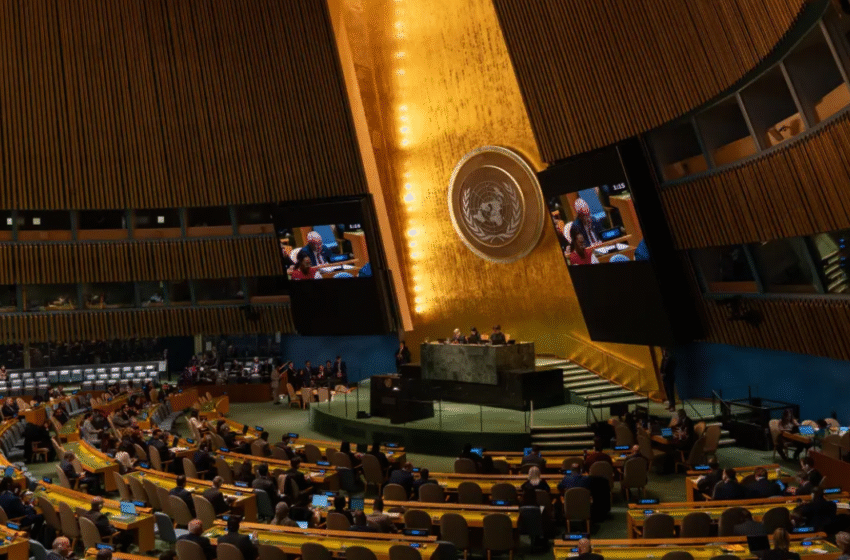
Next UN Secretary-General must be a defiant champion of human rights
The member states of the UN will elect a new secretary-general this year to succeed António Guterres as his term is set to lapse in January 2027. This leadership succession is set to take place in a critical moment for the human rights system globally, as democracy is in decline in many countries and multilateral systems suffer from political subversion and perennial financial crises.
According to global democracy indexes, more than two-thirds of the world’s population live in authoritarian or hybrid regimes, and civil liberties and media freedom are shrinking in various parts of the world. In such an environment, UN’s next leader will take charge of an organization that is having trouble defending what is considered to be at the very core of its mandate.
Early Candidates Reflect Regional Politics, Not Global Consensus
The only two formal candidates to have so far come forward are: Michelle Bachelet, the former President of Chile and ex-United Nations High Commissioner for Human Rights, and Rafael Grossi, director-general of the International Atomic Energy Agency, and a former Argentine diplomat.
Though Bachelet is the face of human rights advocacy, Grossi hails from a background in nuclear diplomacy and state security frameworks-a clear juxtaposition in technocratic diplomacy versus rights-centered leadership.
However, the process remains a deeply political one. The candidate has to pass the test of the five permanent members of the UN Security Council, also known as the P5, which comprises America, China, Russia, Britain, and France. The five permanent members hold significant geopolitical power on the world stage.
P5 Hypocrisy Undermines Human Rights Leadership
Human rights have become less central to the strategic calculations of major powers, be they the United States, China, or Russia.
China and Russia have always aimed at undermining the effectiveness of the UN Human Rights Council and reducing funding for human rights bodies and promoting sovereignty-first approaches designed to protect governments from international scrutiny. Furthermore, China has also been accused of practicing mass arbitrary detention and forced labor and cultural suppression in Xinjiang.
The United States has been a historic key architect of the UN system. However, in the last few years, it has pulled out of various international bodies, and cut humanitarian and rights-focused funding, also withholding billions in assessed UN dues-a major share in the blame for severe liquidity crises. As of early 2026, U.S. arrears exceeded $4 billion across the regular and peacekeeping budgets, a staggering share of the UN’s unpaid obligations.
These funding cuts have directly impacted UN agencies such as UNHCR, UNICEF, and the Office of the High Commissioner for Human Rights, resulting in hiring freezes, the suspension of programs, and emergency relocations..
Trump’s Parallel Power Structure and Authoritarian Alliances
Donald Trump, the current President of the USA, has also taken steps to reduce the relative importance of the UN by suggesting the idea of another kind of geopolitical system: a “Board of Peace” with himself at its helm for life, to which the reported invitees include leaders from China, Belarus, Hungary, Saudi Arabia, the Israeli Prime Minister Benjamin Netanyahu, and Russia’s President Vladimir Putin, both of whom currently have arrest warrants issued against them by the International Criminal Court.
This move marks a broader tendency in international relations towards personal diplomacy, authoritarian solidarity, and parallel institutions with questionable implications for multilateral oversight, as they concern international law specialists and civil society organizations.
UN’s Financial and Political Crisis Deepens
The UN has sunk into one of the worst financial crises it has faced in decades. Its regular budget of approximately $3.7 billion per biennium and peacekeeping budget of approximately $6.5 billion annually are increasingly strained by unpaid dues, rising operational costs, and political interference.
Human rights mechanisms account for less than 5 percent of the UN’s total budget and, consequently, are particularly vulnerable when the UN decides to cut costs. As critics note, this is a very political and highly unbalanced decision that reflects political priorities more than global needs: after all, conflict prevention and protection of rights are still severely underfinanced.
The Urgent Need for a Courageous, Rights-Centered Secretary-General
The next secretary-general must be prepared to take on the great powers and the offending governments, defend the marginalized, and strongly advocate and champion all forms of accountability measures, including international courts and independent investigations. Being a secretary-general is not just a job of consensus-building, and the secretary-general must be politically bold. History proved that those who avoid confrontation with great powers often do not help victims of mass atrocities, whether in Syria, Myanmar, Ethiopia, or Gaza.
A Call for Diversity, Transparency, and Merit-Based Selection
While many more candidates emerge, it is also important that member states ensure that they have a wide range of aspirants. There should be women, individuals from regions such as the Global South, as well as individuals with a strong record as human rights advocates. There has been a wide criticism from civil society organizations regarding how the UN picks its leadership, with many arguing that it is opaque as well as heavily influenced by great power bargains.
A Defining Moment for Multilateralism
The next secretary-general will shape whether the UN becomes a stronger defender of human dignity—or continues to be constrained by geopolitical paralysis.
At a time when authoritarian influence is rising and democratic institutions are weakening, the UN needs not a caretaker diplomat, but a principled global advocate willing to challenge power, defend victims, and rebuild faith in international law.

