

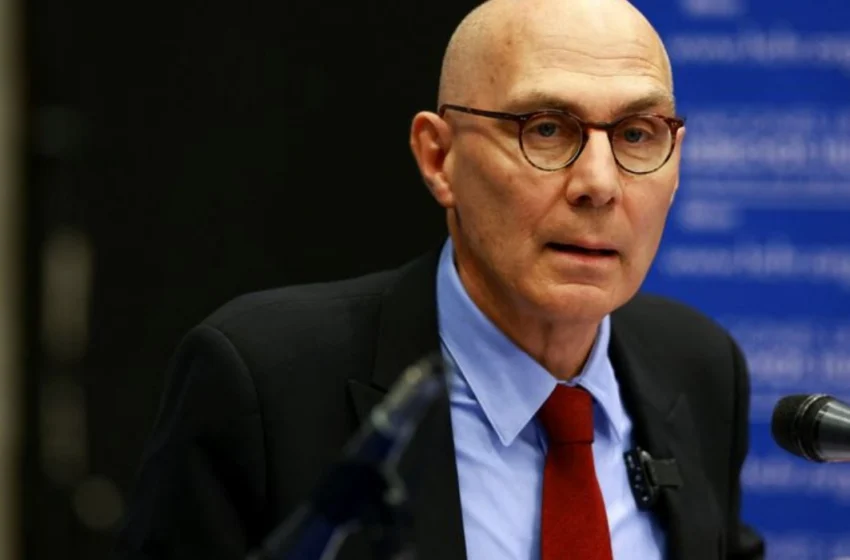
UN Rights Chief Volker Turk Faces Israel, Russia Opposition Over UN Reappointment
Volker Türk’s bid for a second four-year term as the United Nations High Commissioner for Human Rights has turned into an unusually political battle, with Israel and Russia both opposing the renewal ahead of a Friday vote. What had initially looked like a routine reappointment has instead become a test of the UN’s human rights architecture, the independence of the office, and the diplomatic pressure surrounding Gaza and Ukrain..[internazionale]
The controversy matters because Türk is not just another senior UN official. He has emerged as one of the UN system’s most visible critics of Russia’s war in Ukraine and Israel’s conduct in Gaza, and that posture has made him a target for governments facing intense scrutiny from his office.
Why the vote matters
The position of High Commissioner for Human Rights is one that holds international importance due to its being the highest-ranking position within the United Nations for human rights monitoring. It is required to be independent, outspoken, and capable of criticizing major nations in cases where civilian protection, detention, torture, or humanitarian law come into the picture.
The reappointment of Türk as the High Commissioner has thus turned into much more than a personnel matter, and it can be described as a vote as to whether the UN should continue to have such a confrontational human rights head at a time when there is international strife and diplomatic polarization. As reported by Reuters as mentioned in the above information, the UN Secretary-General, António Guterres, has put forward the reappointment of Türk until October 2030.
The core dispute
Not only the Turkish’s record, but also the question of the authority that will decide on the future course of action of the UN Human Rights Office comes into play. According to Reuters, Russia’s claim is procedural and political at the same time; in the case of Türk’s appointment for another four-year period, the future Secretary General will be deprived of the opportunity to appoint his/her own human rights officer. According to Reuters, Russia’s mission claimed that the extension would represent an “arbitrary decision” that would take away the freedom of choice from the future Secretary General, who must have the opportunity to appoint his/her own staff member to a position of such importance. This language implies that Moscow would like to put forward its claim not as a reprimand for the current office holder, but as a principle of institutional succession. However, Reuters also states that Russia rejected claims about “tunnel vision” of the mission, which considered the extension to be caused by Türk’s criticism of the Russian aggression in Ukraine.
Israel’s position is different in tone but similar in effect. Three diplomats told Reuters that Israel opposed a four-year extension, and the consequence was to make the vote contentious rather than consensual. The Israeli objection reflects the broader conflict between Türk’s human rights interventions and the government’s hostility to what it views as repeated UN criticism over Gaza.
Türk’s criticism of wars
Defenders of Türk note that his role involves the precise use of such tough language which has irritated states. Over the last few months and years, he has consistently pushed for accountability regarding abuses and highlighted the violation of international law in several conflicts. As Reuters notes, he has been an outspoken critic of Russia’s invasion of Ukraine and of Israel’s actions in Gaza, and this characterization highlights the key aspect of the diplomatic dispute surrounding his renewal.
According to UN statements made by Türk cited in the provided sources, he warned about the magnitude of the human suffering in Gaza and highlighted that the recovery has to involve accountability for violations and that a rights-based approach needs to be used for Ukraine.
Support and resistance
Despite the pushback, Türk is not isolated. Reuters reported that he enjoys strong backing from European states and many Latin American countries, while a diplomatic memo from the African Union showed “no objection” to the proposed four-year reappointment. That support matters because it suggests the opposition is serious but not necessarily broad enough to block him if the vote remains largely aligned with traditional UN human rights coalitions.
At the same time, Reuters said Washington had also raised doubts, which made the process more complicated than expected. That detail is important because it shows the issue is not simply a Russia-versus-West confrontation; rather, it reflects a wider discomfort in some capitals with how forcefully the UN human rights chief has taken positions on Gaza and Ukraine.
The vote, however, will take place at the UN General Assembly rather than the Security Council, where Russia and the rest of the permanent members could exercise their veto right. Such an approach decreases the weight of the great powers, but this fact does not mean the end of any political influence, since reputational consequences of such an opposition from powerful states will play a decisive role in the decision and the message delivered by the member states. This is what makes this vote so important and symbolic. A regular extension is supposed to demonstrate consistency, but the split vote will show that the post of the high commissioner became the stake in the wars of rhetoric and conflicts of interests of the international community. According to Reuters’ report, some of the states raised doubts concerning the renewal of the post before Guterres’ successor.
What this says about the UN
The dispute over Türk’s future also reflects a deeper crisis in how the UN handles accountability during active conflicts. Human rights chiefs are expected to challenge abuses without fear or favor, but the moment they become too vocal, powerful states often accuse them of bias. Türk’s case shows how difficult it has become for the UN to maintain an image of neutrality while still defending universal rights in wars that are politically explosive.
This is also an institutional issue involving whether the next Secretary-General should have the benefit of an incumbent human rights leader who cannot be changed in the long term. This is an argument Russia has put forward, and there might even be states that believe in human rights monitoring that think that leaving the issue to the next UN leader might suit their interests better. This clash between continuity and change is the crux of the matter right now.
Türk’s fight for his reappointment goes beyond just him personally – it also reflects how ready the UN is to continue with its vocal human rights advocate during this time when the world is preoccupied by Gaza and Ukraine. His victory in the process would imply that an alliance of states believes in having a strong human rights organization.

