

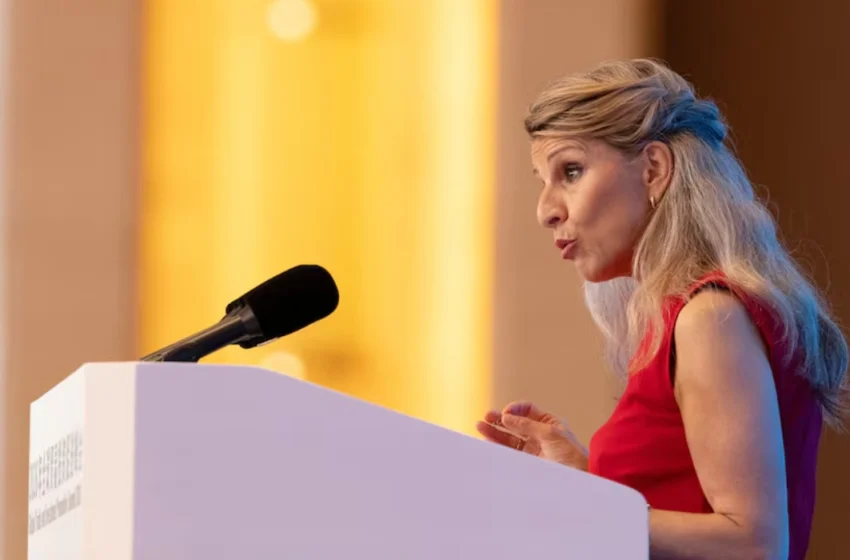
Spain backs labour minister for UN labour agency post, amid US funding concerns
Spain’s nomination of Labour Minister Yolanda Díaz to lead the International Labour Organization (ILO) is both a historic political move and a stress test for a UN body under severe financial strain. If elected, Díaz would become the first woman and the first Spaniard to head the century-old labour agency, while inheriting an institution grappling with unpaid dues, possible job cuts, and growing pressure from its biggest contributor, the United States.
Historic bid for the ILO
Spain officially nominated Díaz on Thursday, according to Reuters and the Spanish government itself, thereby putting her up as a nominee to become the director-general of the UN agency responsible for labour rights, decent work and social justice. The Spanish government stated that she was an
“excellent candidate for the direction of the ILO due to her experience, trajectory and consensus-building vocation.”
In case of success, she would become the first woman and the first Spanish person to occupy such a position.
The nomination instantly gives an additional political impetus to the race since it is not just another struggle for the next term. The position of director-general is crucial in defining the agenda of international labour regulations, acting as an intermediary between governments, employers and employees, and determining the policy of the organisation in the case of serious economical and social shocks.
Who Yolanda Díaz is
Díaz is Spain’s second deputy prime minister and labour and social economy minister, which gives her direct experience in labour policy, wage talks and employment disputes. That background is part of the political argument in her favour, because the ILO is designed around labour governance and tripartite negotiation rather than purely diplomatic management. Supporters say that profile could help her navigate a deeply polarized international environment.
Spanish Prime Minister Pedro Sánchez framed her candidacy as a symbolic step for women and for Spain. In a public statement carried by Spanish media, he said her designation would mean
“for the first time a woman and our country would be at the head of this fundamental institution for the defence of decent work and social justice”.
That statement captures the dual message behind the bid: historic representation and policy credibility.
Contest and timeline
Díaz is running against an incumbent in the form of the ILO chief, Gilbert Houngbo of Togo, who has been named by Reuters as her key rival in this race. This race is important because while the ILO is a technocratic organization, it is at the same time a political organization where regional politics, labor ideology and donors come together. It seems clear that this move on the part of Spain is meant to benefit from the larger discussion on the future of the organization when its weaknesses are evident. The timing is critical. According to Reuters, Spain nominated Díaz at a time when the organization was suffering from a financial crisis related to non-payment by the US.
Financial strain inside the ILO
The clearest backdrop to Díaz’s bid is the ILO’s worsening cash crunch. Reuters said the agency has warned that unpaid contributions from member states total more than 260 million Swiss francs, roughly one-third of its two-year core budget, making the cash-flow situation “critical”. That level of arrears is not a marginal administrative problem; it threatens the agency’s operating capacity and its ability to maintain staffing levels.
The United States is at the heart of this disagreement. According to a Reuters news piece, the United States, the biggest individual backer of the ILO, accounts for 22% of its regular funding budget and has defaulted on paying a sum of more than 173 million Swiss francs. The United States owes a total sum of 257 million Swiss francs, which includes contributions to 2026 and arrears from 2024 and 2025 according to another Reuters news story. It is these figures which make the funding issue part and parcel of the leadership conundrum.
The pressure is already being felt at the organizational level. As reported by Reuters, the ILO has withdrawn the nomination of a senior US official to the post of deputy head due to the arrears issue. The agency has even warned that arrears could cause an 27 million francs liquidity shortfall and could result in the activation of emergency measures, with as many as 120 jobs cut by January.
U.S. dispute and wider fallout
The U.S. arrears issue has become a broader governance problem for the ILO. Reuters noted that the agency usually reserves the deputy role for an American because of Washington’s size as a donor, but that convention has come under pressure as the payment dispute deepens. That change is significant because it reflects a breakdown in the informal bargains that often sustain multilateral institutions.
The issue is also politically loaded because the cash squeeze is not only about one country. Reuters and other reports cited arrears from several member states, not just the United States, with the total unpaid amount reaching roughly 250 million to 260 million Swiss francs depending on the reporting date. Still, the U.S. remains the single most important actor in the crisis because of its scale and influence.
There is also a staffing dimension. Reuters reported that 225 roles were eliminated earlier this year across Geneva and field offices after reduced U.S. funding under former President Donald Trump. That history matters because it shows the agency has already been forced into austerity once, and the current crisis could deepen those cuts rather than reverse them.
Why the race matters
The battle for leading the ILO is not merely an issue of occupying a Geneva-based position. The next leader of this organization should work on restoring the confidence in the agency amongst the member states, on appeasing the staff, and dealing with a constantly squeezed budget. In this sense, the candidature of Díaz represents the fusion of symbolism and crisis management. Indeed, her profile could be appealing for governments in search of a more socially-oriented and politically-experienced leader.
The Spanish government referred to Díaz as a candidate with “experience” and “consensus”, which implies that they try to present her as a person both ready to implement reforms and capable of compromise. At the same time, no matter how reformative is the agenda of a chosen leader, the issue of arrears will always be a burning one. One could also talk about the question of further development of global labour governance. ILO was designed to protect labour rights and promote social justice; however, it could do it properly only if its members were providing it with stable funding.

