

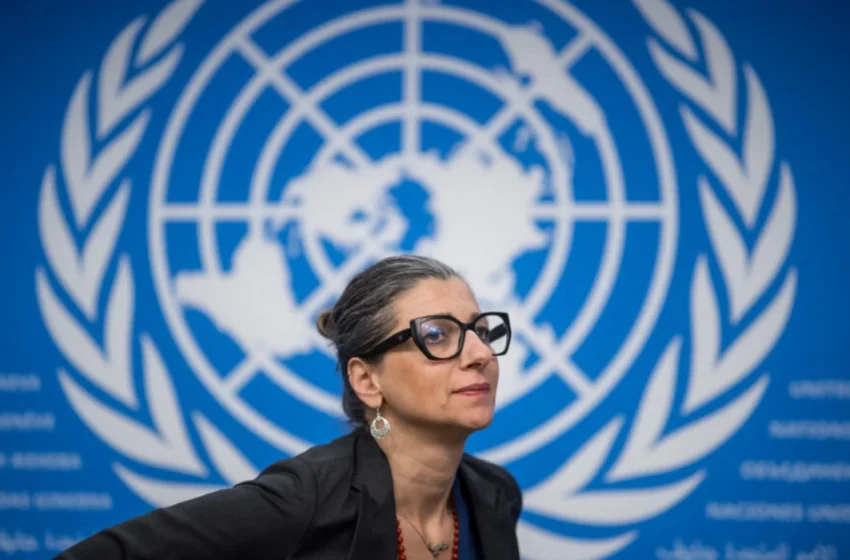
UN pushes back against European attacks on Palestine Rapporteur
The UN has come to the defense of its Special Rapporteur on the occupied Palestinian territories, Francesca Albanese, as some European countries criticized and called for her resignation.
A spokesperson for the U.N. Office of the High Commissioner for Human Rights said, personal attacks on independent investigators undermine the integrity of international accountability efforts, and detract from the gravity of alleged serious human rights violations in Gaza and occupied West Bank.
“We are very worried,”
said spokesperson Marta Hurtado, stressing that U.N. officials and judicial actors are increasingly targeted with misinformation and political pressure that undermines their work documenting abuses.
European Governments Escalate Political Pressure
The row began when Germany, France, Italy, and the Czech Republic criticized Albanese for making comments about Israel’s actions in the Gaza conflict. The Czech Republic’s Foreign Minister, Petr Macinka, demanded that she be removed after she referred to Israel as a “common enemy of humanity,” although a transcript of her speech in Doha on February 7 did not contain these words.
German Foreign Minister Johann Wadephul described Albanese’s position as “untenable,” while French Foreign Minister Jean-Noël Barrot described Albanese’s statements as “outrageous and reprehensible.” Albanese, an international law expert and academic, has always been vocal about her criticism of Israeli policies, especially regarding Israeli settlements, collective punishments, and war crimes.
UN Experts and Their Mandate
Special rapporteurs are appointed by the U.N. Human Rights Council to investigate and report on a particular human rights situation, but they do so independently and do not represent the U.N. Secretariat or its member states. Their independence is intended to protect them from political influences, although they are often subjected to heavy lobbying by powerful states.
There is no precedent for a special rapporteur’s term to be terminated in the middle, and diplomats say that, while a resolution can be proposed in the 47-member council, there is little chance of it passing given the support for Palestinian rights across many of its member states. Albanese’s current term runs until 2028, and she is due to brief the council next month.
Albanese’s Response and Gaza’s Human Toll
Albanese quickly shot back with strong tweets, charging the governments of European countries with excessive outrage over her alleged statement, yet not showing the same degree of urgency over the civilian casualties in Gaza. She cited the figures of the Palestinian health authorities, who reported over 72,000 casualties since October 7, 2023, with tens of thousands of women and children among them.
The independent bodies, including the United Nations, humanitarian bodies, and various academic-based conflict monitoring groups, have all identified Gaza as being in one of the worst humanitarian situations of the 21st century. The widespread destruction of residential areas, hospitals, schools, water, and electricity infrastructure has forced 90 percent of the population, or 1.9 million people, to be displaced, with famine and diseases being repeatedly identified as potential threats by U.N. bodies.
U.S. Sanctions and Corporate Accountability Letters
The controversy surrounding Albanese was further fueled by the Trump administration’s move to impose sanctions on the woman for letters she wrote to US companies, accusing them of participating in the violation of human rights in Gaza and the West Bank. The letters claimed the companies’ potential complicity in settlement building, military supply chains, and surveillance, all of which are now being closely examined in the context of international humanitarian law.
Her actions align with a growing push by human rights bodies to hold private actors accountable for complicity in alleged war crimes, a trend that has alarmed Western governments and multinational corporations alike.
Europe’s Political Double Standard Debate
This is in line with the claims of critics who assert that the European governments’ criticisms of Albanese are part of a larger attempt to exonerate Israel from responsibility while silencing critics who expose the alleged crimes. The European Union institutions have been clear in asserting Israel’s right to self-defense, but they have also been criticized for not imposing appropriate sanctions in the face of increasing claims of war crimes and possible Genocide Convention violations.
Human rights advocates note that European states have sanctioned officials and institutions in countries such as Russia, Syria, and Myanmar for far fewer documented civilian casualties, raising questions about consistency and credibility in international human rights policy.
The Growing Assault on Human Rights Mechanisms
The U.N. has increasingly alerted about the political campaigns against independent experts, judges, and investigators. In recent times, rapporteurs on Myanmar, China, Russia, and Saudi Arabia have been subject to similar attacks, travel bans, and sanctions. Analysts are cautioning that this is undermining global efforts to hold leaders accountable at a time when conflicts and autocratic behaviors are on the rise.

