

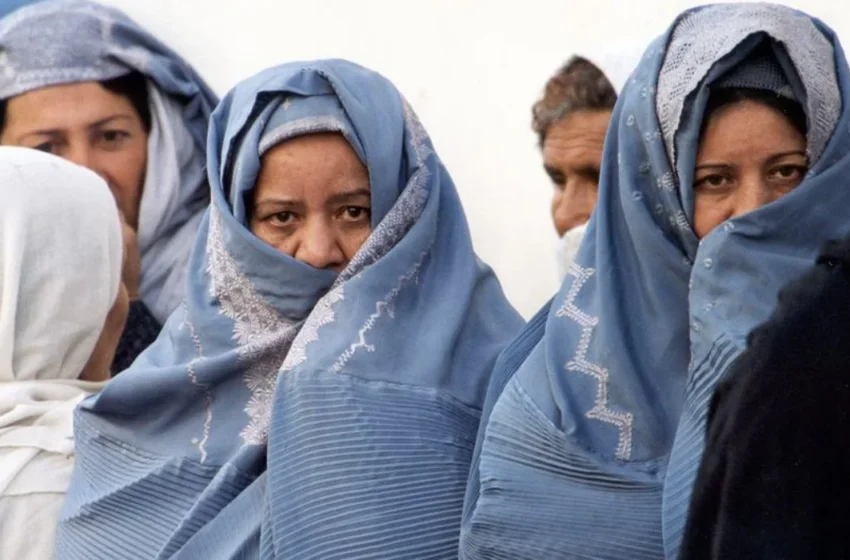
Taliban Policies: Engineering a 25,000-Woman Workforce Crisis by 2030
The Taliban Policies 25,000 Women Crisis is rooted in a sequence of decrees that have redefined women’s participation in Afghanistan’s public life since 2021. These measures, sustained through 2025 and into 2026, have systematically restricted access to education and employment, creating structural conditions for a long-term workforce deficit. The ban on girls’ secondary education remains central, effectively cutting off the pipeline for future teachers, nurses, and skilled professionals.
At the same time, employment restrictions expanded in 2025 to include prohibitions on women working with international organizations, including UN-affiliated roles and many NGOs. These policies were framed by authorities as measures aligned with moral and cultural protection, yet their economic and institutional impact is measurable. Female workforce participation, once near 19% before 2021, has dropped to approximately 5% by 2025, reflecting a contraction that extends beyond immediate labor markets into future human capital formation.
Education bans and structural exclusion
The continued closure of secondary schools for girls has created a generational break in skills development. Without access to education beyond primary levels, the capacity to produce qualified female professionals has effectively stalled. This is not a temporary disruption but a structural exclusion that compounds annually as cohorts of girls are denied progression.
Employment restrictions and institutional withdrawal
The 2025 expansion of employment bans deepened the crisis by removing women from existing professional roles. International organizations, which had previously provided employment pathways, scaled back or adapted operations, further reducing formal opportunities for women. This institutional withdrawal has reinforced a cycle where exclusion from education feeds directly into exclusion from employment.
Education Sector Under Sustained Pressure
The education system sits at the center of the Taliban Policies 25,000 Women Crisis, both as a source of immediate disruption and as a predictor of long-term workforce shortages. Female teachers have historically been essential in Afghanistan, particularly in primary education where cultural norms often require gender-segregated instruction.
Teacher attrition trends
Data from 2022 to 2024 shows a decline in female teachers from approximately 73,000 to 66,000, a reduction of around 9%. Projections suggest that by 2030, the system could lose up to 20,000 female educators. This decline is not solely due to policy enforcement but also reflects the broader environment of uncertainty, reduced incentives, and limited career pathways.
As attrition accelerates, the education system faces a dual challenge: maintaining current capacity while anticipating future shortages. The absence of new entrants exacerbates the problem, creating a shrinking workforce with no replenishment mechanism.
Pipeline breakdown and future scarcity
The absence of girls in secondary education since 2021 has halted the training pipeline entirely. Teacher training institutions depend on secondary school graduates, and without that input, the system cannot produce replacements. This breakdown is particularly significant in a country where female literacy rates were already low before the policy shift.
The cumulative effect is a projected shortage that aligns closely with the broader estimate of a 25,000-woman workforce gap by 2030. This figure captures not just teachers but also the interconnected roles that depend on educational attainment.
Health Sector Facing Parallel Strain
The healthcare system mirrors the education sector in its dependence on female professionals, particularly in maternal and child health services. The Taliban Policies 25,000 Women Crisis extends directly into this domain, where cultural norms often require female patients to be treated by female providers.
Workforce projections and service gaps
Estimates suggest that up to 5,400 female health workers could leave the system by 2030, with the number potentially rising to 9,600 by 2035 if current trends continue. These projections highlight a gradual erosion rather than a sudden collapse, making the crisis less visible but more difficult to reverse.
The loss of female healthcare workers has immediate implications for service delivery. Clinics, especially in rural areas, face staffing shortages that limit their ability to provide essential care. This is particularly critical for maternal health, where the absence of trained female staff can directly affect outcomes.
Rural impact and access limitations
Rural communities are disproportionately affected due to mobility restrictions and limited infrastructure. Women in these areas already face barriers to accessing healthcare, and the reduction in female staff compounds those challenges. The result is a widening gap between urban and rural service provision, with long-term consequences for public health indicators.
Economic Ramifications and Productivity Loss
The Taliban Policies 25,000 Women Crisis is not confined to social sectors; it has measurable economic consequences that extend into national productivity and household stability. The exclusion of women from formal employment reduces the available labor force and limits economic diversification.
The projected annual GDP loss of approximately $84 million, linked to a 0.5% productivity decline, reflects the cumulative effect of workforce shortages in education and healthcare. These sectors are foundational to broader economic activity, and their weakening has ripple effects across the economy.
Workforce contraction and informalization
As formal opportunities disappear, women are increasingly pushed into informal, low-paying roles. This shift reduces income stability and limits contributions to tax revenues and economic growth. The decline in female participation in the civil service, from 21% in 2023 to 17.7% by 2025, illustrates this trend within government structures.
Youth unemployment and skills deficit
The absence of educational pathways also affects younger generations, contributing to rising youth unemployment. Without access to secondary education and vocational training, young women are excluded from emerging sectors, including digital and service-based industries. The long-term impact is a skills deficit that constrains economic recovery and innovation.
Societal Costs and Demographic Shifts
Beyond economics, the Taliban Policies 25,000 Women Crisis carries broader societal implications that reshape demographic patterns and social structures. The exclusion of women from education and employment influences family dynamics, health outcomes, and social mobility.
Early marriage and social pressure
Restrictions on education have been linked to increased rates of early marriage, as families adapt to limited opportunities for girls. This shift has implications for population growth, health, and long-term economic participation. It also reinforces cycles of dependency and reduced autonomy for women.
Psychological and generational impact
The prolonged exclusion from public life contributes to psychological stress and a sense of lost opportunity among young women. International appeals in early 2026 highlighted that over 2.2 million girls are affected by education bans, underscoring the scale of the issue. This generational impact extends beyond immediate policy effects, shaping attitudes toward education and participation for years to come.
International Responses and Limited Leverage
International organizations have responded with a mix of advocacy, adaptation, and constrained engagement. The Taliban Policies 25,000 Women Crisis has become a focal point for global discussions on human capital and development in Afghanistan.
UN and donor perspectives
UNICEF leadership warned in 2026 that Afghanistan
“cannot afford to lose future teachers, nurses, doctors, midwives and social workers,”
emphasizing the essential role of women in sustaining basic services. Donor programs have attempted to adapt through remote education and digital platforms, but these solutions face limitations under existing restrictions.
Constraints on intervention
Efforts to maintain engagement are complicated by policies that restrict mixed-gender work environments and limit access for international staff. By mid-2025, reports indicated that operational access for NGOs had become increasingly constrained, reducing the effectiveness of external support.
The interplay between domestic policy and international response creates a situation where external actors can mitigate but not reverse the underlying trends. This dynamic reinforces the structural nature of the crisis.
The Long-Term Strategic Implications
The Taliban Policies 25,000 Women Crisis represents more than a sectoral challenge; it is a test of how policy choices shape national capacity over time. The convergence of education bans, employment restrictions, and demographic pressures creates a trajectory that is difficult to alter without significant policy adjustments.
If current trends continue, Afghanistan faces a future where essential services operate below capacity, economic growth remains constrained, and social inequalities deepen. The question is not only how the crisis unfolds but whether incremental changes could alter its direction.
The possibility of selective policy reversals introduces a degree of uncertainty into this trajectory. Even limited reopening of education or employment pathways could begin to rebuild the workforce pipeline, though the lag between policy change and measurable impact would remain significant.
What remains uncertain is whether internal pressures, economic necessity, or international engagement will create space for such adjustments, or whether the current path will continue to define Afghanistan’s human capital landscape for the next decade.

