

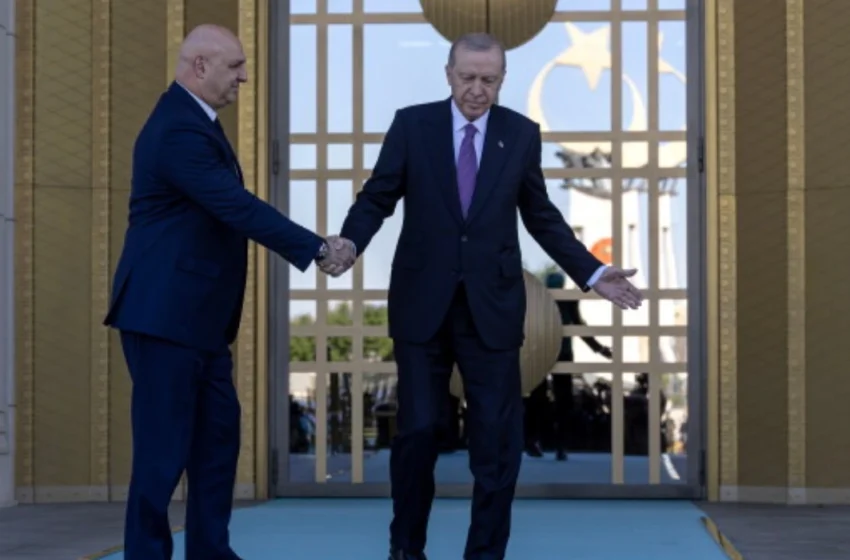
Turkey Eyes Post-UNIFIL Role in Lebanon
Turkey’s expressed interest in joining a new security initiative for Lebanon marks more than a routine diplomatic gesture. It reflects Ankara’s intent to shape the post-UNIFIL landscape in southern Lebanon at a moment when the UN peacekeeping mission is approaching the end of its mandate, regional alignments are shifting, and Lebanon is searching for a replacement framework that can prevent a security vacuum.
A transition with high stakes
An immediate context is the impending end of the UN Interim Force in Lebanon (UNIFIL). As per AP, there are about 7,500 troops deployed under the mission in the south of the country. This illustrates the nature of the security arrangement that will be needed to replace or modify in case UNIFIL is not renewed as expected. UNIFIL is not a new player in Lebanon. It has been deployed since 1978 and its mandate was extended again in 2006 following the conflict in the south.
In August 2025, the Security Council approved the extension of its mandate until December 31, 2026, with the subsequent withdrawal taking place in 2027. This provides an explanation for the intensification of the discussion regarding the potential successor. President Joseph Aoun already stated that it might be necessary and even suggested the creation of a European-led mission in case of the inability of UNIFIL to stay in Lebanon. Among other options mentioned in recent reports are Turkish, NATO-led, Arab and Islamic participation.
Turkey’s stated position
President Recep Tayyip Erdoğan has made Turkey’s position unmistakably clear. After talks with Aoun in Ankara, he said Turkey wants to take part in initiatives that support Lebanon’s sovereignty and regional security once the current international force withdraws. In one widely quoted formulation, he said Turkey wants to be involved in “all initiatives” aimed at safeguarding Lebanon’s sovereignty.
Erdoğan also said,
“We will continue our support for strengthening Lebanon’s institutional capacity and also maintain our humanitarian and technical assistance,”
according to TRT World’s reporting of the Ankara meeting. He added that Turkey stands ready to provide “all possible support” for the reconstruction of southern Lebanon after Israeli attacks end.
These remarks matter because they suggest Turkey is not merely offering symbolic backing. Ankara is signaling readiness to combine security assistance, humanitarian support, technical cooperation and possible participation in a future international arrangement. That is a broader posture than a simple troop offer, and it fits Turkey’s recent tendency to blend diplomacy, military cooperation and reconstruction diplomacy in regional crises.
Why Ankara is moving
Turkey’s interest in Lebanon should be viewed within the framework of broader regional rivalry. According to The National, Ankara is increasing its diplomatic activity amid the shifting balance of power in Lebanon, where Turkey seeks to offset both the dominance of Israel and Iran. As political analyst Karim Bitar put it to the newspaper, it was “definitely clear” that
“Turkey was not in favor of Lebanon switching from Iranian sphere of influence to the Israeli one.”
Such assessment explains why Turkey perceives Lebanon not as a problem for bilateral relations but as a component of broader rivalry for regional order. It is the leadership of the country that has been repeatedly emphasizing the restoration of sovereignty in face of ongoing activities of Israel and war environment in general. In such a way, Turkey has an opportunity to position itself as a stabilizing factor in the region not associated with neither Tehran nor Tel Aviv.
Turkey is also already connected to UNIFIL’s architecture. TRT World reported that Ankara had previously contributed to the naval wing of UNIFIL, and other reporting notes that Turkey has maintained military and security cooperation with the Lebanese state. That gives Turkey a practical foundation for arguing it has experience, not just ambition.
Lebanon’s balancing act
For Beirut, the search for a future security arrangement is as much about politics as it is about peacekeeping. Aoun has said Lebanon welcomes a possible Turkish role in any future international arrangement in southern Lebanon, particularly as discussions continue on UNIFIL’s future. He has also stressed that any new force must support the Lebanese army, preserve stability and respect sovereignty.
That is a careful formulation. Lebanon wants help, but it does not want replacement arrangements that could look like foreign tutelage or an imposed security model. Aoun’s message is essentially that any successor framework must reinforce the Lebanese state rather than weaken it. The fact that he is talking about multiple possible contributors — European, Turkish, Arab, NATO-backed and Islamic — shows Beirut is trying to widen its diplomatic options and avoid being trapped by any one external sponsor.
This balancing act is especially important because Lebanon’s regional environment remains crowded. The country is navigating ties with Turkey, France, the Gulf states, the United States, Cyprus and others, while also trying to contain the fallout of conflict with Israel and the continuing influence of Hezbollah. In that environment, a security transition in the south is never just a military matter; it is a diplomatic test of whether Lebanon can manage rival external interests without becoming hostage to them.
Security, sovereignty and reconstruction
Turkey’s offer transcends the battlegrounds. President Erdoğan noted that Turkey will continue assisting the Lebanese Armed Forces and be willing to assist in Lebanon’s institutional capacity building. According to Middle East Monitor, he will be willing to help in rebuilding southern Lebanon and to continue assisting the Lebanese army while being involved in future international or alternative security arrangements.
This is strategically important. Future arrangements in the south will definitely need not only manpower but also logistics, intelligence coordination, border stabilization, reconstruction and training support. By positioning itself in these roles, Turkey attempts to build up its image as an active player in these aspects. It is also important to note that the previous military deployment extension in Lebanon also adds importance to these remarks. In October 2025, the Turkish parliamentarians approved an extension of Turkish military deployment in UNIFIL for two years. This means that Ankara was already preparing for maintaining a formal presence in Lebanon prior to the current transition discussion intensification.
Regional implications
The broader regional significance is hard to miss. If UNIFIL ends and a new mechanism is created, the composition of that force will reveal how the balance of power is being rewritten in the eastern Mediterranean and the Levant. Lebanon’s alignment choices will matter not just for security along the Israeli border, but also for Turkey’s wider effort to expand its influence through diplomacy, military assistance and reconstruction.
There is also an Israeli dimension. The Times of Israel reported that Israel would likely oppose Turkish participation, given Ankara’s strong criticism of Israeli operations in Gaza and Lebanon. That opposition would complicate any Turkish role in a future mission, especially if the arrangement requires some form of regional or international consensus.
At the same time, Turkey’s willingness to engage could give Lebanon additional leverage. When Beirut has more than one potential patron or guarantor, it can resist pressure to accept an overly narrow security model. That is why Aoun’s visit to Ankara was not merely ceremonial; it was part of a broader effort to ensure Lebanon is not left alone with a security problem when UNIFIL exits.
What comes next
The central issue yet to be determined is whether the post-UNIFIL mission would be a UN-sponsored operation, a multinational stabilization force or simply a loose coalition of nations operating with the Lebanese military forces. At the moment, the options include everything from the involvement of European troops to Turkey or NATO involvement or even participation by Arab and Islamic nations. But as yet, there is no definitive structure decided upon, which means the coming months would see important diplomatic maneuvering.
The position of Turkey seems to be one of exerting influence without becoming overextended. As one analysis quoted in The National put it, what Turkey seeks is not to supplant Iran but to become one of the major architects of a new Middle Eastern order. This is a very ambitious policy, but it also reflects Turkish calculation – Turkey wants to have a say in Lebanon’s future security, but knows it has to accommodate other players.
For Lebanon, the challenge is the reverse. It needs a force or framework that can prevent a vacuum in the south, support the army, reassure external partners and preserve sovereignty. Turkey’s interest gives Beirut one more option, but it also adds another layer to an already crowded geopolitical equation. In that sense, the story is not just about whether Turkey joins a new security initiative; it is about who gets to shape the next chapter of Lebanon’s security order.

