

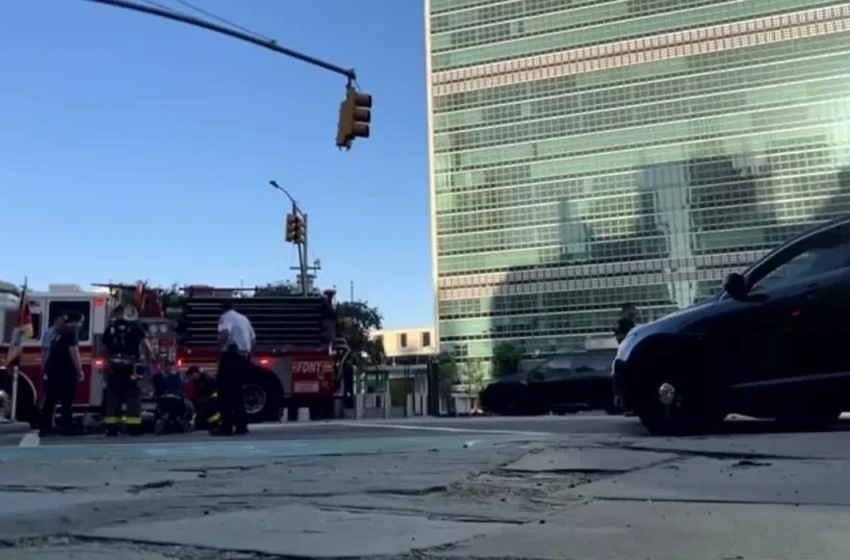
Tibetan Activist Dies After Self-Immolation Near UN Headquarters in New York
The death of a 52‑year‑old Tibetan activist who set himself on fire outside the United Nations headquarters in New York has sent a jolt through human‑rights circles and the global Tibetan diaspora, transforming a single, harrowing act into a stark symbol of mounting frustration with China’s policies in Tibet.
The man, identified by the Tibetan exile community as Lobga (alternatively known as Logba), who had been carrying a Tibetan flag while walking around near the United Nations complex on Manhattan’s East Side prior to setting himself ablaze, is said to have committed the act in a politically motivated protest, and not a spontaneous act of suicide. It is said that New York City police got a call in an emergency at 6:30 p.m. local time, after which they discovered that he had extensive burn wounds over his body. The man was rushed to Bellevue Hospital, where he was declared dead.
The Man Behind the Protest
Identity and life in New York
Exile groups of Tibetans and Tibetan media sources identified the victim as Lobga (Logba) Rangzen, an experienced activist who lived in New York and worked as a taxi driver in addition to being deeply involved in the Tibetan movement. He was described by friends and associates as a man who never gave up on his political beliefs despite the pressures of immigration to the USA.
According to them, he saw driving as both his means of earning a living and a chance to engage in conversation with his passengers on issues such as Tibet, human rights and problems faced by his community. This is how the International Campaign for Tibet, one of the most vocal advocacy groups working for Tibet, describes him – as “a tireless advocate for Tibet,” who was devoted to non-violent activism.
Anger over China’s policies
Based on sources such as Voice of Tibet and other Tibetan exile press, it appears that Rangzen had been becoming more and more worried about what was happening in Tibet, especially regarding the new “ethnic unity” laws that were being passed in Beijing, which many people believe speed up the process of assimilation and dilute minority identity. Those who knew him personally stated that he felt that previous ways of demonstrating against injustice—such as petitioning, rallies, and even social media campaigns—had not succeeded in overcoming indifference of the international community.
What Happened Outside the UN
The sequence of events
The eyewitnesses’ testimony and press coverage paint a disturbing picture: Rangzen approached the United Nations compound holding a Tibetan flag, which is a significant image in itself, considering the position held by Beijing regarding Tibetan nationalism. According to exiled media sources, Rangzen had earlier either filmed or transmitted an audio message, making a call for Tibetan independence and solidarity. Under such circumstances, Rangzen’s choice of setting himself on fire in front of such a place of global diplomatic significance was well thought out.
Police say they responded to calls at around 6:30 p.m., finding him critically injured and immediately arranging transport to Bellevue Hospital. Despite medical intervention, his burns were too extensive, and he was pronounced dead soon afterwards. A UN spokesperson indicated that the incident occurred after all scheduled meetings had finished for the day and stressed that UN business was not disrupted. The statement, while factual, also reflects a cautious institutional approach: acknowledging the event, but avoiding political comment at an early stage.
Police response and ongoing investigation
While it has been confirmed that he was in his early fifties, close to the United Nations headquarters in New York, and died due to third degree burns, the police has refrained from identifying him because of the need for notifying the next of kin properly. An investigation is currently underway to look into the cause and motive behind the action, but no formal declaration has been made regarding it being a politically motivated act or any associated criminal charges. It is obvious that in reality there is no doubt about it being a politically motivated act since the presence of the Tibetan flag and the comments made by the exiles clearly indicate this.
A Long, Painful Tradition of Self‑Immolation
Historical pattern among Tibetans
This is definitely not a singular case in its historical background. According to Tibetans fighting for their rights, over 150 Tibetans have committed suicide by burning themselves alive as a form of protest against the government of China since roughly 2009. Most of these cases of self-immolation happen within Tibet or in the regions populated by Tibetans and under the administration of China. Some of these self-immolations carry messages calling for freedom, the return of Dalai Lama, or for the end of the religious and cultural persecution of the protesters.
Self-immolation, for many Tibetans, is viewed as a very extreme but deeply meaningful form of protest, combining elements of Buddhist sacrifice and political strategy – the hope that such shocking acts would pierce the censorship and international weariness. Critics, including some human rights advocates, argue that it normalizes a form of suicidal protest that inflicts great pain on families and communities while giving nothing in return.
The Ethnic Unity Law: Immediate Trigger, Deeper Fear
Beijing’s law and its justification
One key piece of legislation around which many of the exiles’ interpretations revolve is the Ethnic Unity Law of China, passed just prior to the self-immolation. The Chinese government claims that this new legislation represents a step toward fostering “national unity” among all its diverse ethnic groups. Chinese policy makers claim that highlighting national unity and discouraging “separatism” is essential to ensure development and prevent unrest among the diverse ethnic populations. This kind of policy is described as integration rather than assimilation by Chinese authorities.
Official and institutional responses
New York authorities, bound by legal and professional constraints, have responded in more neutral language. Police statements focus on the facts: a man, approximately 52, found with severe burns near the UN, transported to hospital and later pronounced dead, with an investigation now underway.
The UN’s early comments similarly avoid political interpretation, noting that the incident occurred after meetings had ended and that operations were not disrupted. This caution reflects the institution’s need to balance human‑rights advocacy with its role as a forum for member states, including China, which is highly sensitive to criticism over Tibet.
The gap between activist rhetoric and institutional language is striking. While Tibetan groups speak of sacrifice, oppression and cultural survival, official bodies speak of “incident,” “investigation” and “operations,” illustrating how raw protest is often processed through bureaucratic filters before it reaches the level of diplomatic debate.
What This Death Says About Tibet Today
The act of self-immolation by Rangzen near the UN offices is a powerful testament to the fact that the problem of the Tibetans continues despite being overshadowed in the media as compared to the previous decades. This action connects various issues, including the issue of resentment against the Chinese government, the new law concerning unity among the different ethnic groups, lack of international response to their problems, and a cultural practice of self-sacrifice as the only means of communication.
For the international community, however, the act poses difficult questions. How does the international community react when people decide to burn themselves as a means of protesting against policies of the government? Is it possible for international organizations, such as the UN, to adequately tackle these issues without offending the interests of their influential member countries? And how much of an obligation do the media, diplomats, and human rights activists have to make sure that the message is heard before the fire burns out? What is evident is that the act of burning oneself by a Tibetan man near the UN Headquarters in New York City has turned an ordinary night into an issue of global concern for Tibetans everywhere.

