

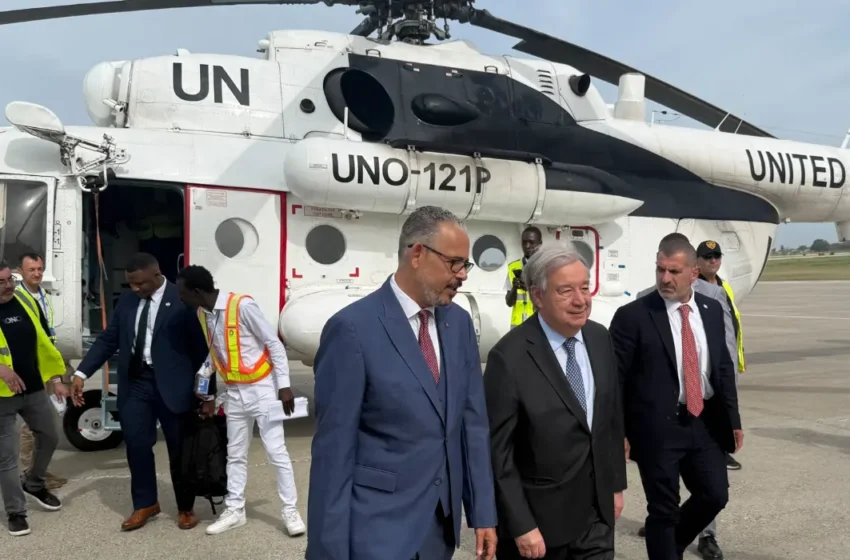
UN Chief Visits Haiti: Global Gang Suppression Force Deployed Amid Unprecedented Violence Crisis
Antonio Guterres, the UN Secretary-General, flew into the capital city of Port-au-Prince on June 16, 2026. It is worth noting that Guterres’ visit to the impoverished country marks the beginning of his first tour of Haiti after two years. His arrival in the country happens amidst the ongoing chaos and turmoil as the Carribean country grapples with one of the most complicated situations ever witnessed, given the escalating gang violence which has forced over 10% of the population in the country out of their homes with internal displacements crossing the milestone of 1.45 million internally displaced persons.
While on the ground, Guterres visited the Gang Suppression Force headquarters for the first time, an international military force set up by the UN to help curb the menace that is threatening the economic and educational systems of the country.
This particular visit is rife with significant symbolism as Guterres will be addressing directly displaced men, women, and children who have been forced out of their homes due to the rising level of violence, while also discussing matters related to the prime minister of the country, Alix Didier Fils-Aimé, who came into power in February 2026 when the mandate of the interim president expired.
This particular visit from the UN’s secretary general will mark the first time in more than two years that he personally witnessed the situation in a country that still finds itself at the bottom of the heap when it comes to poverty in the Americas with an estimated population of 11 million people caught up in an all-round crisis of politics, economics, and security.
The Gang Suppression Force: Structure, Mandate, and Deployment Challenges
The Gang Suppression Force is an unprecedented expansion of security assistance to Haiti through the UN Security Council, with an authorization of up to 5,550 personnel, including 5,500 uniformed personnel consisting of soldiers and police officers as well as 50 civilians. This is in comparison to the former mission that consisted of the Kenyan-led multinational force to assist the Haitian police forces, a mission that was criticized extensively due to its inability to adequately handle the extent of violence due to lack of adequate equipment and funding.
However, despite this grand plan, deployment efforts have been plagued by logistical and operational hurdles, with only less than 1,000 troops having been deployed to Haiti up to Guterres’s inspection on June 16. Some of the countries contributing to the deployment of the force include Jamaica, Chad, El Salvador, Guatemala, and Kenya, with around 750-800 Chadian police officers and gendarmerie making up the core of the force.
Troops comprising the UN-sponsored Gang Suppression Force began deploying to Haiti on April 1, 2026, under the mandate of one year of operations, including a required evaluation process after a period of nine months of operations in Haiti. Financially, pledges for funding the Gang Suppression Force have surpassed expectations, totaling more than $200 million pledged by 13 members of the UN Security Council, including $59 million for operations.
The Standing Group of Partners, headed by the United States and consisting of Bahamas, Canada, El Salvador, Guatemala, Jamaica, and Kenya, manages international assistance to the mission as it carries out operations through a model set to counteract the proliferation of gang violence prior to the postponed elections of Haiti, where no elections have been held since 2016 amid worsening security concerns. According to UN Human Rights Chief Volker Türk, there was a need to urgently send the force because the authorities in Haiti had to act fast on setting up judicial units to combat the prevailing culture of impunity fueling gang violence for years now.
Unprecedented Violence: Death Toll, Displacement, and Humanitarian Catastrophe
The extent of violence that is being witnessed in Haiti has reached an unparalleled degree with statistics from the United Nations Human Rights Office showing that there have been at least 2,300 fatalities and 1,100 injured due to gang violence, with 99 kidnappings reported since the beginning of 2026. A statistical assessment conducted over a ten-month period from March 2025 up to mid-January 2026 indicates a total number of 5,519 fatalities and 2,608 injuries where 1,424 fatalities and 790 injured were due to gang-related violence, with 3,497 fatalities and 1,742 injuries resulting from security forces’ actions against armed gangs.
The first quarter of 2026 alone witnessed 1,642 people killed and 745 injured, representing a continuation of the accelerating violence trajectory that has transformed Haiti into one of the world’s most dangerous urban environments. The humanitarian consequences extend far beyond immediate casualties, with the UN migration agency IOM reporting that escalating gang violence has pushed displacement to record levels, leaving nearly 1.5 million people without a stable place to live and representing approximately 13 percent of Haiti’s total population. More than 1 in 10 Haitians are now homeless, forced into overcrowded and unhygienic temporary shelters, with approximately 300,000 people concentrated in makeshift encampments throughout Port-au-Prince that lack basic sanitation, water, and medical services.
Food insecurity has escalated to a critical point all around the country, whereby a total of 5.7 million to 5.8 million Haitians, representing 52 percent of the population, are experiencing critical levels of food insecurity or even more severe conditions. Out of this shocking figure, almost 1.8 million individuals experience emergency food insecurity, which implies that their survival options have dwindled to the point that they are not able to meet their most basic nutritional requirements. The current situation has resulted in a humanitarian crisis wherein gangs deliberately deprive civilians of basic necessities by restricting access to food, water, and health-care services within and outside the capital.
Guterres’s Stern Warnings: Gangs Terrorize, Institutions Weaken
During a press conference held in Port-au-Prince on June 16, Guterres delivered some of his most forceful statements ever regarding Haiti’s crisis, making clear that the situation demands immediate and sustained international attention.
“Let’s be clear: gangs have been terrorizing Haiti. Institutions have been weakened,”
Guterres stated, emphasizing that armed groups have systematically undermined state authority while paralyzing the country’s economic and social infrastructure. His remarks came after visiting areas surrounded by armed gangs that block main roads connecting Port-au-Prince to Haiti’s northern and southern departments, effectively isolating the capital and preventing humanitarian aid from reaching rural populations.
The UN Secretary-General detailed how the gang had been using sexual violence as a means to instill terror, noting that the gang had employed extensive use of sexual violence as a way of inflicting fear on civilian populations, especially women and children in displacement camps and poor communities. Gang violence has paralyzed Haiti along with its economy, educational institutions, and humanitarian assistance efforts.
However, the situation is not beyond saving, Guterres added, as he juxtaposed his grim description of the state of affairs with an element of hope that international intervention would help turn things around. The UN Secretary-General’s mission involved an evaluation of the UN’s response mechanisms regarding Haiti’s complex humanitarian challenges, which includes logistical and operational support to the Gang Suppression Force.
Volker Türk, the UN Human Rights Chief, provided additional context on the violence’s human rights dimension, stating that in Haiti, gang violence has resulted in at least 2,300 deaths, 1,100 injuries and 99 kidnappings since the start of the year. I urge the authorities to move quickly on the judicial units to tackle impunity. Türk’s comments underscore the connection between the Gang Suppression Force’s security operations and the need for judicial mechanisms to hold perpetrators accountable, addressing the cycle of violence that has persisted due to systemic impunity. Farhan Haq, Guterres’s spokesman, confirmed that the Secretary-General will see firsthand the humanitarian and security challenges facing the country, as well as efforts by national authorities and the international community to restore stability and support the Haitian people.
Political Vacuum and Electoral Deadlock: A Nation Without Democratic Governance
The political crisis further exacerbates the security crisis and humanitarian crisis in Haiti, which has failed to conduct elections since 2016, given the worsened security situation in the country, preventing elections from taking place. Haiti’s current Prime Minister, Alix Didier Fils-Aimé, has assumed the role of exercising executive powers since February 2026 following the lapse of the interim presidential council’s mandate. The last unelected prime minister stepped down in early 2024 amid increased gang violence and the evacuation of key areas by the government due to their inability to control such territories.
The lack of election processes has led to a situation whereby Haiti lacks a head of state or any legislative institutions that can serve the purpose of governing the nation democratically, and there is a situation whereby the gang leaders do what they please without any form of checks and balances. Political vacuum has made it difficult for any kind of coordination from international partners because the security force has to collaborate with individuals who have no mandate whatsoever, and their capabilities are limited owing to the violence that has continued in the region for a number of years.
The combination of political unrest, economic breakdown, and insecurity has led to a situation that UN officials refer to as a multifaceted crisis, one that requires continuous efforts by the international community in several areas, including security operations, humanitarian aid provision, and rebuilding the country’s institutions. Guterres’s mission has shown that temporary measures will not solve the underlying problems of Haiti, which should be dealt with through prolonged engagement and the facilitation of elections, rebuilding of the judiciary, and improving economic conditions.

