

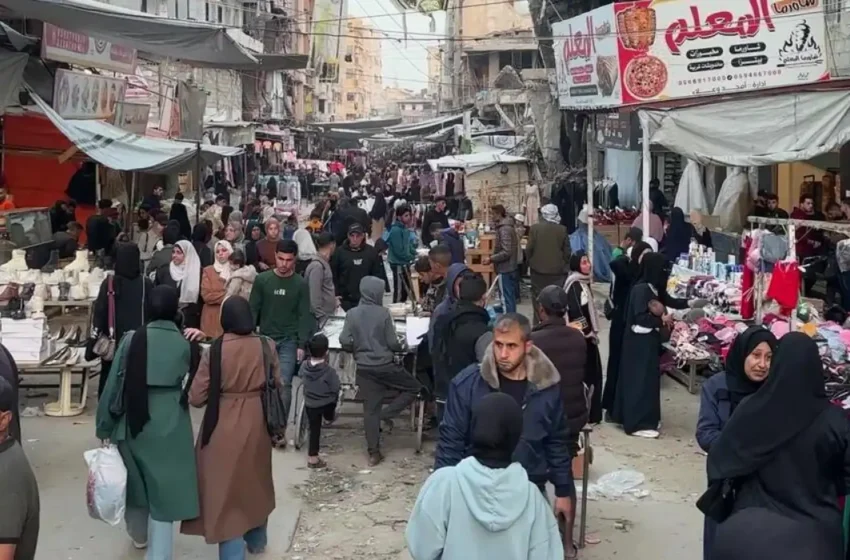
Gaza’s highly educated are surviving in the informal economy
Gaza’s highly educated informal economy reflects a deep structural imbalance between human capital and available work. Years of investment in higher education produced a generation of graduates in medicine, engineering, education, and technical fields. However, the economic collapse since late 2023 has removed the institutional framework that once absorbed these skills.
By 2025, unemployment had surged to extreme levels across Gaza, with a large proportion of jobless individuals holding university degrees or professional training. This shift transformed unemployment from a cyclical challenge into a systemic crisis. Graduates who once expected entry into structured careers now face a labor market where formal employment opportunities have largely disappeared.
The result is not a shortage of talent but a shortage of functioning institutions. Clinics, schools, private firms, and administrative offices that previously offered stable employment have either been destroyed, downsized, or rendered inactive. This disconnect has pushed highly educated individuals into alternative survival strategies.
Informal Economy As The Primary Survival Mechanism
The informal sector has emerged as the dominant source of income for Gaza’s population, including its most educated segment. What was once a supplementary part of the economy has become its central operating system.
Expansion Of Informal Work Since 2025
Before the current crisis, informal employment already accounted for a significant share of economic activity. Developments in 2025 accelerated this trend, as widespread destruction of businesses and restrictions on movement disrupted formal supply chains. The closure of factories, retail outlets, and service providers removed the structural base required for regulated employment.
As a result, a majority of income-generating activities now occur outside formal systems. Workers operate without contracts, social protection, or predictable wages. For educated individuals, the informal sector offers immediate access to income, even if it does not match their qualifications.
Survival Over Professional Alignment
Highly educated workers are not choosing informality as a career path but as a necessity. Doctors, teachers, and engineers increasingly engage in small-scale trade, delivery services, or home-based enterprises. These activities provide minimal but essential income to sustain households in a context of widespread poverty.
This shift represents a form of economic adaptation rather than opportunity. The informal economy absorbs labor quickly, but it does not utilize specialized skills effectively. As a result, professional training becomes disconnected from actual economic output.
Structural Drivers Behind The Downward Shift
The movement of educated workers into informal roles is driven by systemic disruptions rather than individual decisions. The collapse of enabling conditions has fundamentally altered the relationship between education and employment.
Breakdown Of External Labor Channels
Prior to 2023, Gaza’s economy relied partly on external labor markets and cross-border economic linkages. Access to employment opportunities outside the territory provided income streams that supported households and stimulated local demand. Restrictions imposed during and after the conflict severed these connections, eliminating a key source of formal employment.
The loss of these channels had a cascading effect. Without external income, domestic demand weakened, further reducing the viability of local businesses. This cycle reinforced the contraction of the formal sector.
Collapse Of Domestic Economic Output
Economic indicators from 2025 show a severe contraction in output, with overall production declining sharply. This decline reduced both public and private sector hiring capacity. Government institutions faced budget constraints, while private enterprises struggled to operate under disrupted conditions.
In this environment, even highly qualified individuals cannot secure stable employment. Informality becomes the only accessible option, not because it is efficient, but because it is available.
Sector-Specific Erosion Of Skilled Employment
The impact of economic collapse is particularly visible in sectors that traditionally require advanced education. These sectors illustrate how professional roles have been fragmented and redefined under crisis conditions.
Healthcare And Education Under Strain
Healthcare systems have experienced both physical damage and operational limitations. Medical professionals often divide their time between overstretched facilities and informal income activities. This dual role reflects the inability of formal institutions to provide adequate compensation or consistent employment.
Education faces similar challenges. Teachers and academic staff have seen reduced working hours, delayed salaries, or complete job loss. Many now operate informal tutoring networks or engage in small-scale trade to supplement income.
Engineering And Technical Professions
Engineers and technical graduates have also been affected by the decline in infrastructure projects and private sector activity. Without large-scale construction or industrial operations, their expertise has limited application in the formal economy.
Many have shifted to small repair services, material trading, or short-term reconstruction tasks. These activities provide income but do not fully utilize their technical capabilities. Over time, this underutilization risks eroding professional skills.
Gender And Generational Pressures
The shift toward informality has distinct effects across different demographic groups, particularly women and younger graduates. These dynamics reveal deeper inequalities within the labor market.
Women In Informal Workspaces
Women face additional barriers to formal employment, and the crisis has intensified these constraints. Many highly educated women have transitioned to home-based economic activities, such as food production, tailoring, or small retail operations.
While these activities contribute to household income, they often lack visibility and protection. The absence of formal recognition limits access to financial support and growth opportunities, reinforcing economic vulnerability.
Youth Facing Limited Prospects
Young graduates entering the labor market during the crisis encounter a fundamentally altered landscape. Expectations of professional careers have been replaced by short-term, low-income activities. This shift affects not only current earnings but also long-term career development.
The lack of entry-level opportunities in formal sectors reduces the ability of young professionals to gain experience. Over time, this gap may weaken the overall skill base of the workforce.
Long-Term Risks To Human Capital
The persistence of Gaza’s highly educated informal economy raises concerns about the sustainability of human capital. Skills that are not actively used or developed may deteriorate, affecting future recovery prospects.
Brain Waste And Productivity Loss
The current situation represents a form of “brain waste,” where educated individuals are unable to apply their knowledge effectively. This mismatch reduces overall productivity and limits the potential for economic growth.
The longer this condition persists, the more difficult it becomes to reintegrate skilled workers into formal roles. Rebuilding institutions alone may not be sufficient if the workforce has experienced prolonged skill erosion.
Institutional Capacity Challenges
The loss of skilled labor from formal sectors also affects institutional capacity. Healthcare systems, educational institutions, and administrative bodies depend on trained professionals to function effectively. When these professionals shift to informal work, institutional performance declines.
Reconstruction efforts will require not only physical rebuilding but also the restoration of professional networks and expertise. This process is complex and time-intensive.
Policy Considerations And Recovery Pathways
Addressing the challenges of Gaza’s highly educated informal economy requires targeted policy interventions that go beyond immediate relief. Recovery strategies must focus on reconnecting education with employment.
Reintegration Into Formal Employment
Policies aimed at creating formal job opportunities are essential for long-term stability. Public works programs, reconstruction projects, and targeted hiring initiatives can provide pathways for skilled workers to return to professional roles.
These efforts must be aligned with broader economic planning to ensure sustainability. Short-term employment programs should be designed to build lasting institutional capacity.
Supporting Transitional Economic Models
At the same time, the informal sector cannot be ignored. Transitional policies that support informal workers while encouraging gradual formalization may offer a practical approach. Access to microfinance, training, and legal recognition can help improve productivity and income stability.
Balancing regulation with flexibility is critical. Overregulation may discourage participation, while underregulation can perpetuate vulnerability.
Between Survival And Structural Recovery
Gaza’s highly educated informal economy captures a moment where survival has overtaken professional identity. The shift of skilled workers into informal roles reflects not only economic collapse but also the fragility of systems that once connected education to opportunity.
As reconstruction plans evolve and international support frameworks take shape, the central challenge remains whether these educated individuals can transition back into roles that match their skills. The answer will influence not only economic recovery but also the broader question of whether Gaza’s future labor market can rebuild on its existing human capital or continue to operate in a state where education and employment remain fundamentally disconnected.

