

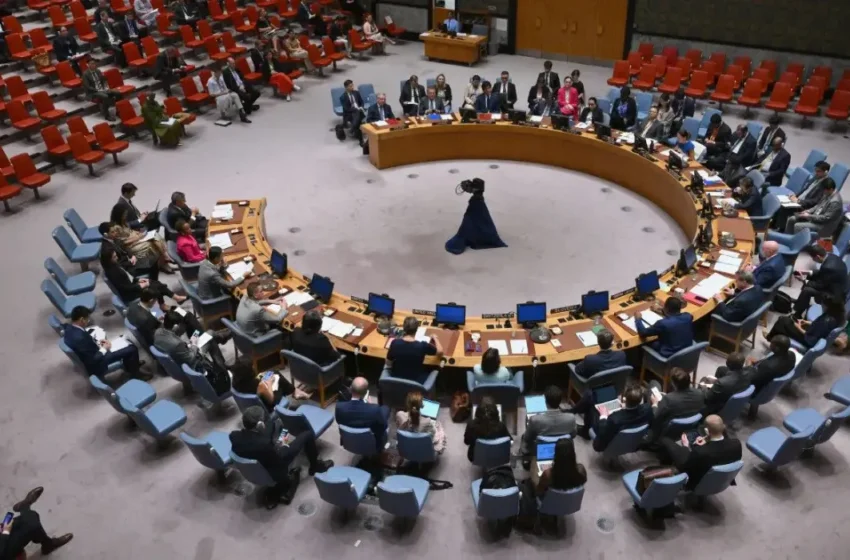
The Security Council and the World Without Rules: A Call for UN Reform
The UN Security Council occupies a central position in the global system, wielding unparalleled authority over peace and security. Under Chapter VII of the UN Charter, the Council can authorize sanctions, military interventions, and peacekeeping missions binding all 193 member states. Yet, paradoxically, its credibility as a rules-based arbiter is eroding. Critics contend that the Council often functions as a venue where the unchecked power of its permanent members, and their allies, goes unaddressed. The notion of a “world without rules,” noted in commentary by The Guardian, captures the perception that the Security Council mirrors the very power politics it was meant to constrain.
This legitimacy gap has been particularly visible in recent crises. During 2025 and early 2026, the Council struggled to act decisively on Gaza, Ukraine, and Myanmar, with vetoes or watered-down resolutions preventing meaningful outcomes. The concentration of veto power in the five permanent members: China, France, Russia, the UK, and the US allows a single state to block action even when the majority supports intervention. Many governments, especially in the Global South, perceive the Security Council less as a guardian of international law than as a vehicle for great-power interests. This perception undermines the normative authority of the UN Charter and contributes to the sense that the world risks slipping toward a purely power-driven international order.
How Veto Power Fuels Impunity and Paralysis?
The veto system lies at the heart of critiques about the Security Council. It enables any permanent member to block binding measures targeting its own actions or those of its allies, including sanctions, arms embargoes, or accountability mechanisms for mass atrocities. In practice, this produces a pattern where the Council is proactive only when aligned with major-power interests, but indecisive when confronting them.
Operational Consequences
The consequences of veto-induced paralysis extend beyond legality and morality to operational effectiveness. UN peacekeeping missions and humanitarian interventions rely on robust mandates, yet the threat of a veto often produces weak, incremental resolutions. These measures may avoid naming perpetrators, authorizing forceful interventions, or imposing enforceable timelines. Civilians in conflict zones consequently face prolonged violence while the Council negotiates procedural language unlikely to alter realities on the ground. As The Guardian notes, the Council has increasingly become a venue for ritual diplomacy rather than effective crisis management, allowing abusive actors to exploit the system to delay accountability.
Mass Atrocities and the Shield of Power
The commentary raises a fundamental question: has the veto, originally designed to prevent great-power war, become the principal obstacle to preventing mass atrocities? Evidence from 2025 suggests that countries engaged in aggressive or repressive actions are emboldened when they anticipate a permanent member will shield them from Council scrutiny. This dynamic undermines both civilian protection and the credibility of the UN’s rule-based framework.
Reform Debates and the 2024–2025 Momentum
Calls for Security Council reform have long been part of UN discourse, but recent references to a “world without rules” have intensified political urgency. Reform proposals focus on three interlinked issues: representation, decision-making, and the veto.
Expanding Membership and Representation
The General Assembly’s intergovernmental negotiations have emphasized expanding Council membership to include more states from Africa, Asia, Latin America, and the Arab world. Advocates frame this as a move toward a more representative, democratic body. The 2024 Summit of the Future and the Pact for the Future reaffirmed member states’ commitment to a Council that is “more representative, inclusive, transparent, efficient, effective, democratic and accountable,” urging progress in reform without delay.
Rethinking the Veto
Debates increasingly focus on the veto’s role. Proposals include limiting its use in cases of genocide, crimes against humanity, war crimes, and ethnic cleansing; requiring multilateral approval for veto exercise; or removing veto rights for certain categories of resolutions entirely. The Guardian commentary highlights that the veto’s absoluteness is incompatible with a global order based on shared norms rather than the preferences of five states. The 2025 UN discussions also explored enhancing the General Assembly’s role in shaping the Council’s agenda and evaluating performance, potentially introducing a counterbalance to permanent-member dominance. Yet all proposals face the same hurdle: amending the UN Charter requires permanent-member consent, effectively asking the Council to vote away its own privileges.
A Test of Whether the UN Can Still Govern Peace
The Security Council’s current trajectory raises broader questions about multilateral governance in an era of intensifying great-power competition. Commentary framing the Council as driving a “world without rules” underscores the risk that its paralysis encourages states to pursue unilateral measures, ad hoc alliances, or extra-Charter arrangements. Reform is therefore not just procedural but symbolic, signaling that the international community remains committed to a collective framework for peace even under stress.
Balancing Power and Protection
Designing a Council capable of enforcing rules without being captured by dominant powers requires a recalibration of priorities. Protection of civilians must remain central, rather than an optional by-product of negotiations among the five permanent members. Without reform, the UN risks being perceived not as a guarantor of global order but as a bystander to great-power-driven conflict, weakening both its authority and its relevance.
The Challenge of Willingness
Even if reform is technically possible, the political question remains: will the permanent members permit the Council to evolve into the institution that global circumstances now demand? The commentary suggests that the stakes are high, as the Security Council embodies both the promise and limitations of multilateral governance. Its capacity to adapt may determine whether the international system can manage conflict collectively or whether states will increasingly rely on self-help strategies that fragment the global order.
The discourse surrounding Security Council reform illustrates a tension between institutional inertia and global necessity. The Council’s configuration, particularly the veto mechanism, has allowed unchecked power to persist while undermining the international system’s moral and operational authority. The debates of 2024–2025 indicate recognition of this challenge, yet political obstacles remain formidable. Observers and member states alike now watch whether the Council can reconcile entrenched privilege with the requirements of contemporary global governance. How the Security Council navigates these pressures will shape not only the management of crises in Ukraine, Gaza, and elsewhere but also the broader trajectory of multilateralism in an era increasingly defined by contested norms and rising power competition.

