

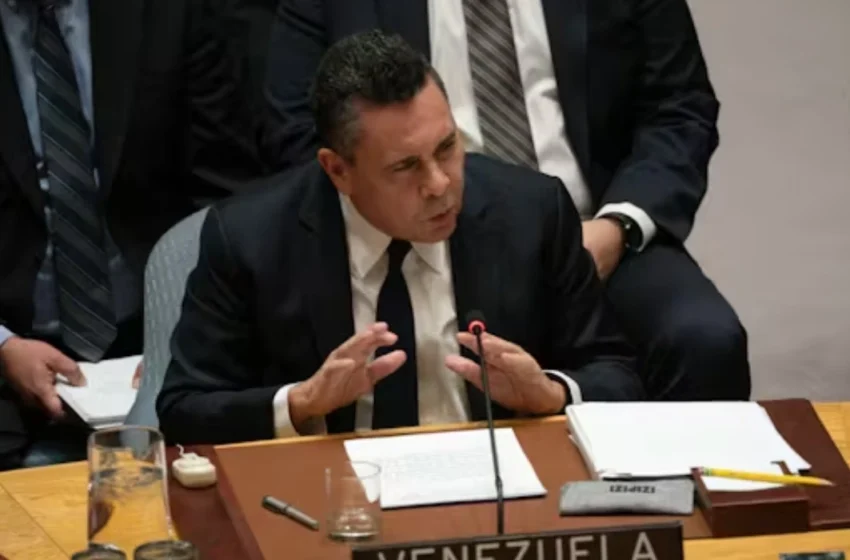
Has UN failed its mandate amid crises in Venezuela, Gaza and Ukraine?
In October last year, the United Nations marked its 80th year of age – a ripe one for what is globally recognised as the most important international body ever built. It was born in the wake of World War II with one very important objective in mind: to avert conflicts and crises like the ones engulfing the world today.
Current developments such as the military intervention in Venezuela under President Donald Trump in relation to Venezuelan President Nicolás Maduro, Ukraine’s violation of international law by Russia in 2022, and the humanitarian crisis in Gaza, among others, fundamentally undermine this entire system of the United Nations. Together, they raise an increasingly unavoidable question: Is the UN still capable of maintaining international peace and security?
Has selective outrage exposed Europe’s double standards?
The US use of force in Venezuela has laid bare Europe’s deep contradictions. After months of near-silence on Israel’s alleged war crimes in Gaza and tacit acceptance of the US-Israel strike on Iran, European governments have largely hesitated to condemn Washington’s audacious military operation aimed at regime change in Caracas.
With only a few notable exceptions — including Spain, the Netherlands and Norway — most European leaders have offered vague or evasive responses. Spain took it even further, reacting independently within the EU to criticize the US decision together with some Latin American countries.
It seems that the governments in Europe lack the willingness to state a truth that may be uncomfortable but is nonetheless a must, namely, that Nicolás Maduro is perhaps an illegitimate authoritarian leader, but forcibly toppling him via military interference is, in any case, a clear contravention of international law.
Is the UN losing its relevance in an age of power politics?
The more unilateral military actions there are, the more accountability seems to wear off. Many observers have come to a point where they’re wondering whether the United Nations has any future at all-particularly if it cannot fulfill its core mandate to prevent war and protect civilians. If the UN cannot even restrain major powers or consistently condemn their actions, has it reached the end of its effective lifespan?
How is the UN Security Council supposed to prevent war?
It is the responsibility of the UN Security Council to ensure international peace and security. The use of force is legal in two situations only, as enunciated by the UN Charter: (a) authorisation by the Security Council in accordance with Article 42, or (b) in the exercise of the right of self-defence enunciated in Article 51.
Even self-defense is strictly governed. It has to be in response to an attack by force and is legal until the Security Council makes an appearance as a means to restore peace. This system theoretically combines collective security with unilateral action.
The Security Council has 15 members: Five permanent members: China, France, Russia, United Kingdom, and the United States. The other ten: Non-permanent members, voted for two-year terms. A resolution needs at least nine votes and does not require the approval of any of the permanent members.
Has the veto turned the Security Council into a deadlock machine?
The veto system has been created in a manner that ensures the UN cannot act against the great powers that won the war in the Second World War. This should ensure that the great powers do not gain a majority at the expense of the smaller powers.
Nonetheless, this is only possible if a consensus is reached by the permanent five or, at least, if they do not veto a measure. If the five are actually the aggressor nations, then the Security Council is deliberately crippled. The veto power has been proven on several occasions, most notably by Russia and America, to be able to make the United Nations’ security body completely irrelevant, no matter how apparent the violation of international law.
Can the veto power ever be reformed?
The veto is frequently criticised as unjust and outdated. Yet legally speaking, there are no enforceable limits on its use. The UN Charter does not prohibit self-serving vetoes, nor does it allow judicial review of Security Council decisions.
This is one of the UN system’s most deliberate design flaws. The Charter places the permanent five above the law — granting them not only the power to block action, but also the power to block any attempt at reform.
While Articles 108 and 109 technically allow for amendments to the Charter, any meaningful reform would require the consent of the very states whose privileges would be reduced. In practical terms, veto reform is functionally impossible.
The only true structural alternative would be dissolving and reconstituting the UN under a new charter — an outcome requiring a level of global political unity that simply does not exist today.
Are we witnessing the collapse of the UN security system?
There is a painful truth that underlies this current situation, namely that it seems that the UN-centered international system for peace and security is effectively disintegrating before our very eyes.
It cannot effectively take action when the greatest powers within the Security Council are responsible for the aggression. This is not an implementation failure; this is institutional design.
Nonetheless, a preponderant attention on the Security Council might entail the overlooking of the majority of what the UN maintains daily, mostly out of public observation.
Is the UN more than just a paralysed Security Council?
Despite its impotence in great-power conflicts, the UN is far from an empty shell. Its Secretariat supports peacekeeping missions, mediates political processes and facilitates global diplomacy. The Human Rights Council documents violations and keeps international scrutiny alive. UN agencies deliver humanitarian aid, coordinate disaster response, and support health, education, climate action and development worldwide.
These functions do not require Security Council authorisation, but they do depend on the UN’s institutional framework — of which the Council remains a central pillar.
Is a flawed UN better than no UN at all?
The stark reality is that the world currently faces a binary choice: a deeply flawed global institution, or none at all. The UN’s future may lie less in reform than in endurance — preserving what still works while waiting for political conditions to shift. It survives not because it is perfect, or even consistently effective, but because its absence would leave a dangerous vacuum.
Should the world aspire to a better system — one that does not reward power with impunity? Absolutely. But abandoning the UN altogether because of the hypocrisy and misconduct of the permanent five would mean discarding the quiet, life-saving work the organisation continues to perform beyond the Security Council’s chambers. For now, the UN remains indispensable — not because it succeeds, but because the alternative is far worse.

