

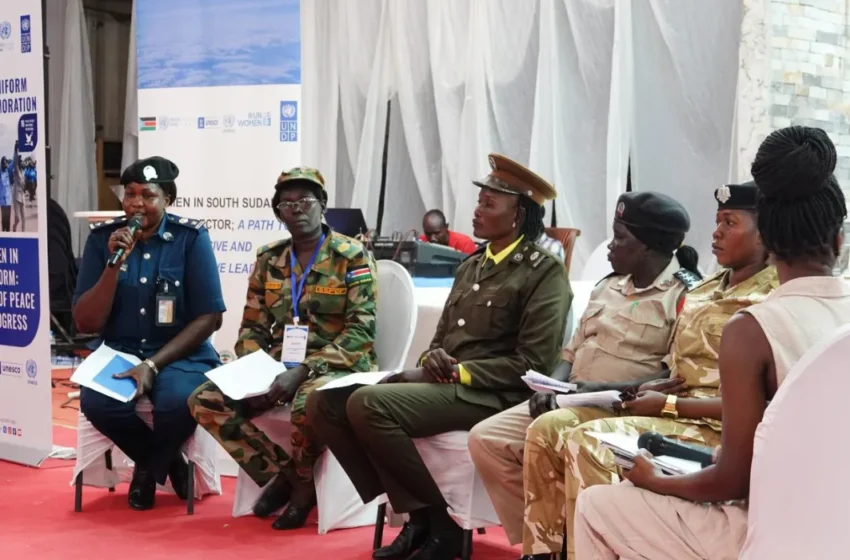
UN Mentorship Unites Fractured Politics: Women’s Rise in South Sudan Security
United Nations agencies expanded security sector reform efforts across South Sudan throughout 2025, centering on large-scale mentorship pipelines designed to prepare women for leadership positions ahead of the country’s 2026 elections. The programs were built around both technical and political training, anchoring support within police units, the military, prison services, wildlife authorities, and civil defense institutions. According to UN program data, nearly 1,400 women had received structured training by the end of the year.
The South Sudan Security Sector Women’s Network, established in 2022 with Peacebuilding Fund backing, remained at the center of these developments. More than 500 women participated in its activities in 2025, with a major expansion into trauma healing, field-leadership preparation, and rights-based protection practices. UNESCO supported parallel literacy and ICT programs, reaching over 800 women whose education had been disrupted by conflict. UNDP Resident Representative Dr. Mohamed Abchir described the initiatives as “a practical pathway to achieving SDG 5 in spaces historically closed to women.”
Women in Uniform Day Gains National Visibility
Women in Uniform Day on July 28, 2025, marked a pivotal moment in public recognition of the programs. Thousands marched in Juba, carrying banners spotlighting inclusion across all security branches. Panels at Freedom Hall brought together UN Women, UNDP, UNESCO, and UNMISS, with discussions emphasizing the shift from symbolic involvement to operational decision-making. Officials noted that the rapid growth of SSSWN had given the country its first cross-service women’s coordination body.
Expanding Access Across Urban and Rural Sites
Training hubs in Juba, Aweil, and Malakal enabled broader access for women from ten states, including those without previous formal education. UN facilitators reported strong turnout from lower-rank security personnel seeking leadership preparation. These programs also supported implementation of the Revitalized Agreement provisions requiring gender inclusion within national defense and internal security structures.
Mentorship Bridging Political Divides
A defining outcome of the 2025 UN mentorship work was the growing cooperation among women political actors from competing factions. The National Transformational Leadership Institute, supported by UN Women, trained more than 400 women since late 2023 and became an important forum for cross-party dialogue. Sessions emphasized conflict-resolution tools, public-sector ethics, and methods for building nonpartisan coalitions.
Hon. Mary Ayom Deng, one of the program beneficiaries, described the mentorship as “opening political spaces that were previously inaccessible,” adding that the training helped women collaborate without regard to factional rivalry. Her remarks echoed broader comments by participants who said that mentorship techniques were gradually reshaping approaches to parliamentary negotiation.
Security Officers Advocating Cross-Generational Inclusion
Lt. Col. Harriette Fouzia warned that without structured pathways for younger women, “the security sector will remain incomplete,” underscoring the need for sustainability beyond the election cycle. Her perspective reflected a wider concern within UNMISS and civil society groups that institutional gains could stall without long-term investment.
Conflict Resolution Skills Supporting Local Governance
Women enrolled in literacy and leadership classes reported using new skills to manage community disputes, particularly in regions affected by localized clashes. UNDP field officers observed strengthened coordination between women peace actors and local administrators, integrating security sector insights into provincial decision-making. The trend aligned with UN Security Council Resolution 1325 commitments, which stress women’s responsibility in preventing and resolving conflict.
Representation Gains Across Security and Governance Structures
The program expansion in 2025 generated tangible increases in women’s visibility across the country’s major security structures. SSSWN facilitated leadership workshops that included scenario-based training, psychological support sessions, and guidance on responding to gender-based violence risks affecting more than 2.7 million women and girls nationwide. Participants shared stories at Freedom Hall on how trauma-healing modules helped them continue field duties during periods of instability.
Senior leaders in the Women Parliamentary Caucus emphasized the need to translate these gains into electoral influence. Hon. Yar Telar, the caucus deputy chair, argued that “representation in command positions is not symbolic; it is foundational for the new security architecture.” Her comments followed a 2025 African Union solidarity mission that reaffirmed women’s centrality in conflict prevention.
Integrating Multiple Security Branches
Expanded activities linked personnel from wildlife services, police divisions, customs units, prison authorities, and civil defense agencies. Organizers said the cross-branch approach improved compliance with the UN Human Rights Due Diligence Policy and strengthened operational communication between agencies that had historically functioned with limited coordination.
Building Confidence for Leadership Entry
UNESCO’s literacy modules proved particularly transformative for women applying for promotions or preparing for new administrative responsibilities. Trainers noted that many participants had never previously used digital tools, which limited their access to reporting systems. The programs improved both confidence and technical capacity, contributing to visible improvements in institutional effectiveness.
Electoral Momentum and Legislative Advocacy
The timing of these mentorship programs is closely tied to the political calendar. With South Sudan preparing for its long-delayed 2026 national elections, women’s representation remains far below the quotas outlined in the Revitalized Agreement. Youth groups and civil society organizations in December 2025 renewed calls for comprehensive legislation against gender-based violence and accelerated implementation of the National Action Plan on Women, Peace, and Security.
UN Women Executive Director Sima Bahous reiterated that “women’s leadership is consistently proven to advance sustainable peace.” Her remarks followed a series of provincial consultations where women leaders exchanged strategies for campaign participation and community mobilization.
Building a “Women’s Tribe” in Political and Security Spaces
NTLI senior facilitator Richard Mursoke described the emergence of what he called a “woman’s tribe,” a network of leaders whose collaboration transcends party labels. The concept resonated among participants who stated that shared security training made collective advocacy easier, even when legislative or factional disagreements persisted.
Strengthening Cohesion within Major Parties
Mentorships were also used to mend fences between Sudan People Liberation Movement and its offshoots. According to organizers, female participants in rival political wings started working together over institutional reform, specifically in the areas of community safety, local peace committees, and justice sector controls.
Challenges That Persist Amid Progress
The mentorship programs are still battling the cultural resistance that is deeply rooted, low levels of literacy and institutional instability in post-conflict regions despite the large growth. According to the trainers, women with security aspirations were likely to meet with family/community hard push, particularly in the rural counties where uniformed service is still predominantly male. However, according to the numerous respondents, advocacy campaigns among the population in 2025 such as Rights for Peace workshops made the participation of women more acceptable locally.
Since 2011, UN partners have financed gender-equality programs in South Sudan, which have cumulative knowledge that underpins the present program. The test that eventually should be made, though, is whether institutional structures will be able to withstand funding variations as well as electoral uncertainty.
The UN mentorship brings the divided politics together by establishing women as leaders of their own security at a pivotal point in the political transition of South Sudan. With the build-up to 2026 elections, the overlap of literacy benefits, inter-party dialogue, and training on operations, the power of the women in the governance, as well as the security arena, continues to increase. The question now emerges, will these developing networks continue to exist beyond the fluctuations of the election cycle or become a stable pillar of an even more stable national structure?

