

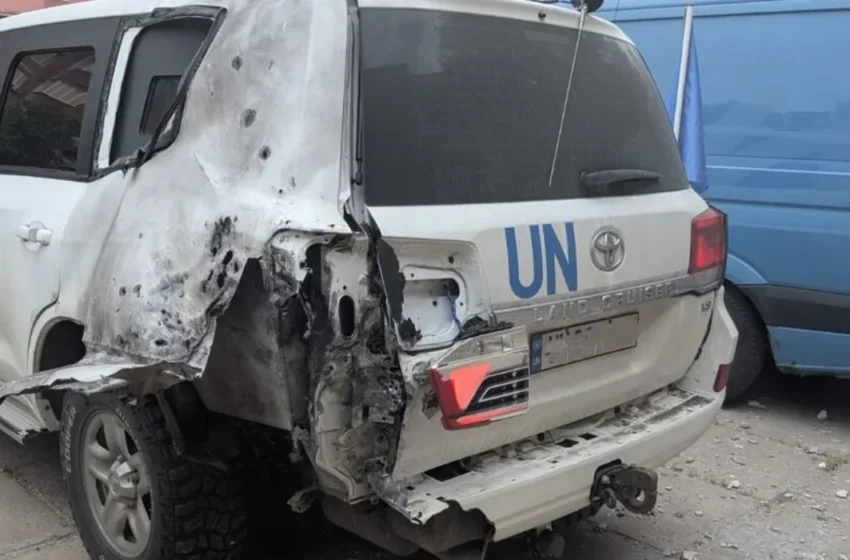
Russia accused of targeted drone attack on UN humanitarian convoy
There have been allegations against Russia that it launched a drone strike on an obvious humanitarian convoy belonging to the UN, which has led to concerns regarding the safety of humanitarian workers working in active zones. It is believed that the UN convoy carrying food supplies to civilians in the Kherson area had been targeted despite clear indications of the presence of the UN logo and that of the World Food Programme.
The essential importance of this situation does not just lie in the material destruction of the aid vehicles; rather, it lies in the wider implications that the attack has for humanitarian organizations attempting to deliver aid to people impacted by the conflict. When an aid convoy is attacked, it instantly throws into question the motives behind the attack, as well as the legality of the act itself.
In a post on X, Shaun Pinner former British soldier, Ukrainian Marine, defender of Mariupol, independent journalist & author, said:
“Despite the UN warning both Ukraine and Russia in advance, Russia still openly bombed a UN convoy, then proudly released the footage through channels linked to Russian drone groups.
This is exactly why so many now view Russia’s so-called “humanitarian concerns” as utterly hollow.”
What happened in Kherson
The incident occurred on October 14, 2025, in the Kherson region around Bilozerka. It was stated that UN inter-agency lorries were delivering humanitarian aid to the local civilians. There were reports suggesting that the convoy was attacked using drones, while some sources also claimed that further attacks on the convoy had taken place through artillery fire. The vehicles were clearly identified as bearing UN/WFP logos on them.
While the magnitude of material damage seemed limited to several vehicles, the implications were much more profound politically and from a humanitarian standpoint. As war reporting is concerned, an attack on the aid convoy takes on great significance precisely because it entails both danger and humanitarian immunity – and therefore poses a challenge to this aspect of the international humanitarian law. The symbolic blow may be great even where few causalities occur.
UN response and language
Indeed, the UN reaction came as expected, with strong criticism that described the situation as “utterly unacceptable,” noting at the same time that humanitarian personnel and humanitarian assets fall within the scope of protection under international humanitarian law. This context is significant since in such a way, the UN positions the case not just as a military event but as an act which could qualify as a war crime if proved that humanitarian assets were deliberately targeted.
Also, it is necessary to emphasize that the UN attempted to explain that the humanitarian convoy in question was a non-military operation. In addition, according to the available reports, none of the UN employees suffered any damage, although, based on the information provided by the media, two civilians located near the strike area were injured.
Legal and humanitarian stakes
This case comes at the crossroads of conduct in battlefields and laws of international humanitarianism. Usually, aid convoys, more so if they carry signs indicating the affiliation with the UN, are considered off-limits unless there are grounds suggesting they are being used for military operations. Based on current data, this suspicion has not been verified in any manner; therefore, this attack can be considered an act of intentional destruction of a protected humanitarian effort.
In case if this is proven, the legal implications will be very serious. Intentional attacks against humanitarian workers and/or clearly marked relief vehicles are classified as war crimes and, hence, the use of such strong terminology by the UN and human rights groups. Moreover, before a proper legal inquiry takes place, such cases are harmful to the principles that allow for feeding, helping, and supporting civilians amidst war conditions.
Competing narratives and information war
In line with other events in the Russia-Ukraine conflict, this battle ground event rapidly evolved into an information battle. Various media sources linked to Russia or supporting Putin’s regime posted videos supposedly depicting the drone attack and the destruction caused to the convoy, while some viewed it as a rightful act within the context of war. Such information battle is critical as it demonstrates how the attack on aid convoys could be used for propagandistic purposes very quickly.
On the other hand, footage from open sources should be analyzed with utmost caution. Videos could confirm one side of the story, or they could be manipulated to confirm a different version of events. From the available information, the most trustworthy sources regarding this incident are the United Nations’ official statement, eyewitness accounts, and coverage by multiple media outlets. Thus, the most accurate interpretation of the event could be that the convoy was attacked and that the allegations of deliberate attack remain the main issue.
Human rights and accountability
Human Rights Watch, along with similar organizations focusing on human rights violations, considered the event as one more in a series of threats that affect humanitarian convoys operating in Ukraine. Not only were they concerned about the fact that one convoy got attacked, but also they feared that attacks or threats to convoys could develop a deterrent effect, meaning agencies involved would be less motivated to send humanitarian goods through dangerous areas. This would mean civilians away from the frontlines will also be affected negatively.
In order for the attack to become an event that requires prosecution, several factors have to be taken into account: first, there should be solid evidence showing that the convoy was targeted intentionally rather than accidentally. The proof would consist of the use of forensic information, the exact route of the convoy, analysis done by drones, videos proving the identity of vehicles, and eyewitness accounts from convoy members.
Why this matters now
The timing and the place of this attack make it particularly important. Kherson is known to be a highly volatile area where humanitarian convoys travel amid artillery shells, drones, and fluctuating front lines. It is in such circumstances that the UN markings should work as a protective barrier to convey neutrality and purely humanitarian objectives. Such an incident implies that this protection is no longer sufficient to ensure safety.
Furthermore, there is a humanitarian implication here. Humanitarian organizations rely on predictability when planning their operations. The fact that a convoy can come under fire even with proper markings implies that future operations will become more costly, more hazardous, and more limited. This may affect food, medical supplies, construction materials, and other forms of humanitarian aid for people who live under threat of bombardment.
Reported statements in context
The key statements surrounding this incident should be understood as part of the same unfolding story, not as isolated quotes. The UN’s condemnation reflected both outrage and a legal warning. “Utterly unacceptable”, as the UN reportedly described the attack, was not just a moral reaction but an assertion that humanitarian norms were violated. That wording also signaled that the organization wanted the event treated as a serious breach rather than an unfortunate but routine war hazard.
Similarly, the human-rights framing that deliberate targeting of aid convoys may amount to a war crime is crucial because it shifts the discussion from damage assessment to accountability. It implies that the central question is not whether the convoy was hit, but whether it was intentionally singled out because it was humanitarian. That distinction is what separates battlefield collateral damage from potentially prosecutable conduct.
Russian-aligned accounts, by contrast, sought to normalize or justify the strike by presenting it as legitimate war activity. That stance is significant because it shows how one side’s narrative attempts to reduce the moral and legal force of the incident. However, absent credible evidence that the convoy was being used for military purposes, such justifications remain highly contested and are not aligned with the mainstream humanitarian position reported by the UN and rights groups.
Wider pattern in the war
This attack is part of the broader trend in the Russia-Ukraine conflict, where aid corridors, evacuation routes, and other infrastructure have been threatened multiple times. Aid agencies working in wartime situations have noted that the battlefield has become more technologically precise, but perhaps less humane. In this case, drone technology has made it possible to attack vehicles on the move, some of which might have been considered off-limits according to the laws of war.
The significance of this fact is that humanitarian law relies on overt restraint. By painting their trucks, notifying their destinations, and coordinating their movements, these groups are trying to ensure they will not become targets. However, if these precautions do not work, it is not only the effectiveness of this operation that has been undermined; it raises questions about all future operations.
What investigators may examine
Future assessments will likely focus on several core questions. Was the convoy clearly identifiable from the air? Was the drone strike deliberate or misdirected? Were the vehicles traveling on a notified humanitarian route? Was there any evidence that the convoy had been compromised for military use? These questions are essential because they determine whether the event is a tragic wartime strike or a potentially unlawful attack on protected aid workers.
Investigators may also review the sequence of events surrounding the reported drone strike and any artillery fire that followed. If the attack pattern shows repeated targeting after identification was possible, that would strengthen claims of intent. On the other hand, if evidence suggests confusion or misidentification, the legal interpretation could differ. At present, the reported facts place the burden on those defending the attack to demonstrate why a marked convoy should have been targeted at all.

