

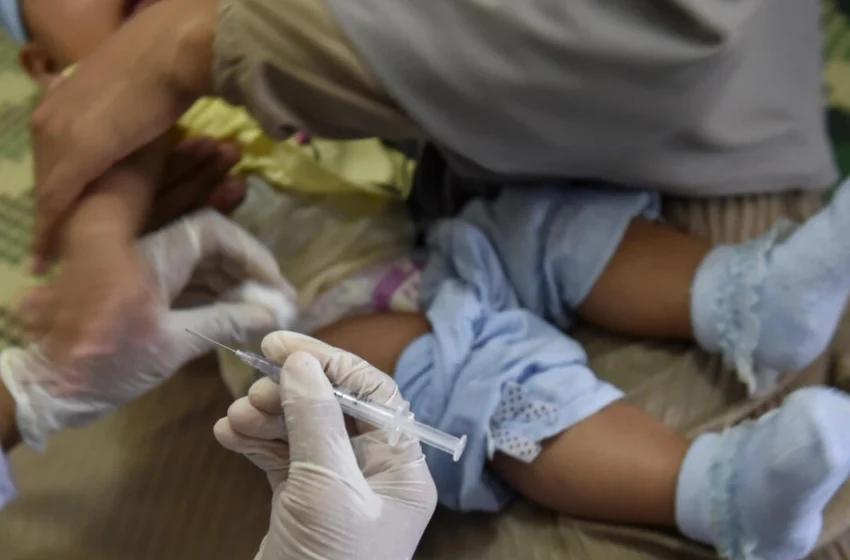
Cracks deepen in global immunisation system, UN warns
The United Nations has issued a sobering warning that the world’s immunisation system is showing visible cracks, even as childhood vaccination coverage recorded a modest improvement in 2025. The latest data from the World Health Organization and UNICEF show progress on paper, but the agencies say the gains are fragile, uneven and overshadowed by funding cuts, conflict, displacement, misinformation and a rising number of vaccine-preventable disease outbreaks.
At the center of the warning is a troubling contradiction: global coverage is inching forward, yet the system designed to protect children is becoming harder to sustain. For public health experts, that means the world is not dealing with a simple coverage problem anymore. It is facing a structural challenge in which weak surveillance, interrupted services and declining trust are combining to leave millions of children vulnerable.
Slight improvement, major concern
As per WHO and UNICEF, more than 90% of babies worldwide — which comes down to almost 116 million babies — got at least one dosage of the DPT vaccine in 2025. 85% of the infants were also vaccinated in their entirety in 3 doses. This indicates an increase by 1% for both cases as compared to 2024 and 4% from 2021. However, these organizations also pointed out that the world has not returned to its former position. Coverage is still 1% behind 2019 – that year just before the outbreak of the coronavirus around the world.
The concern is not just the numbers themselves. It is the growing gap between countries and communities that have managed to rebuild immunisation access and those still struggling with conflict, instability and basic health service delivery. In many places, the report suggests, vaccination is no longer failing because the science is weak. It is failing because systems, financing and trust are under pressure.
Zero-dose children remain exposed
One of the most alarming figures in the report is the number of “zero-dose” children, a term used for children who receive no vaccine shots in their first year of life. In 2025, that figure stood at 13.5 million globally. While that was 750,000 fewer than in 2024 and about 1 million fewer than in 2023, the scale remains enormous.
These children are the most obvious evidence of the gaps in the system. They do not lack just one vaccine; they lack the whole entry point for routine vaccination. Many of these children come from remote locations, conflict-ridden areas, and poverty and displacement-afflicted communities. As soon as a child becomes a zero-doser, the chances of recovery become significantly reduced. UN organizations found out that there were 7.3 million babies who were vaccinated with DTP and missed the measles vaccination after that. This drop-out rate is particularly alarming since it reveals the inability of the system to retain contact with families until the completion of the immunization process.
Measles exposes the weak spots
The continued existence of the disease is still a clear sign of weak immunization coverage, and the latest report indicates that the disease is back, taking advantage of the vulnerabilities. First-dose measles coverage stagnated at 84%, while second-dose coverage was stagnant at 77%. These percentages are much lower than 95% required to prevent community transmission of the disease. This has led to an increased number of outbreaks. UN reported that 57 countries have experienced large or disruptive outbreaks of measles in 2025. This is not a minor issue, but a sign that the world leaves many children vulnerable to a highly contagious disease.
The danger of measles is not only that it spreads fast. It is that it is a proxy for broader weakness in immunisation systems. When measles rises, it often signals missed routine vaccinations, delays in campaign delivery, poor surveillance or declining public confidence. In that sense, the outbreak map is also a map of system stress.
Funding cuts and surveillance gaps
The message of the UN does not solely lie within the realm of the vaccination figures but rather extends into its mechanisms as well. The UNICEF’s Immunisation Chief Ephrem Lemango has raised the issue of the reduction of funding for the collection of the figures that measure the state of the system and the level of the damages done by such reductions. The issue of data quality is vital since poor data can cover up the actual problem until the epidemics emerge. Underfunded systems of data surveillance make it impossible for the health agencies to find out which regions lack vaccinations or have new outbreaks.
This is why the agencies are describing the problem as a crack in the system rather than simply a dip in performance. A system can absorb a short-term shock if its monitoring, financing and outreach structures remain strong. But when those supports weaken at the same time, even modest declines in coverage can become far more dangerous.
Conflict and mistrust deepen the divide
There still is no denying the fact that conflict continues to pose major challenges for immunisation campaigns. According to WHO and UNICEF, children from regions where wars and displacements are rampant are the most difficult to reach through vaccination programs. Reuters notes that over fifty percent of the world’s unimmunised children come from countries embroiled in conflicts like Syria, Yemen, Sudan and Palestine despite the fact that these countries make up just a third of total global births. Such a disparity clearly indicates how unevenly the burden has been shared. Children in regions with strife face higher risks of lacking basic immunizations, being off the radar of the health system and falling victims to the outbreaks when diseases break out.
Misinformation is making the problem worse. WHO said false information and growing hesitancy are contributing to the gap between the start of vaccination schedules and completion of later doses, including measles vaccination. In a world where digital rumors can travel faster than public health messaging, mistrust can turn a local coverage issue into a wider outbreak risk.
What the officials said
The strongest statements in the report underline the urgency of the moment. WHO vaccine director Kate O’Brien said the outbreaks are already revealing
“real cracks in the system now for immunisation,”
highlighting that the issue is no longer theoretical but visible in disease patterns.
UNICEF executive director Catherine Russell delivered a human-centered warning, saying
“No child should suffer from a disease that a simple vaccine can prevent,”
and stressing that vulnerable children are still being left behind by conflict, displacement and poverty.
Gavi, the global vaccine alliance, offered a more measured note of progress while still sounding the alarm. It said coverage in the 57 low-income countries it supports reached record highs, but warned that declining funding could erase those gains and cost lives later. That statement matters because it reflects the broader tension in the report: success in some places does not cancel fragility in the system overall.
Why the warning matters now
The timing of the warning cannot be understated. According to WHO, there could potentially be more impact of the budget cuts not captured by the figures for 2025, which means that the second phase could be even worse if the problem persists. To put it simply, the world may only be observing the beginning of the problem with immunization. The matter is alarming since immunization is one of the most cost-efficient ways of preventing diseases in public health ever created. If everything works as expected, then there will be no epidemics, there will be savings in health budget and children will be protected from illnesses in advance. Otherwise, the results will come into effect fast in the form of outbreaks of diseases such as measles, increased vulnerability of newborns and increasing strain on health care system. The other point made in the report is that only 18 surveys of national immunization have been conducted in 2025, which was 50 in the previous year.
The broader public health signal
This report should not be read as a simple annual update. It is better understood as a warning about resilience. Global coverage is improving slightly, but the protection system is becoming less dependable in the places that need it most.
The most worrying element is the combination of three trends moving together: stagnant or weak measles coverage, rising outbreaks and weaker surveillance. That combination suggests that gains in routine immunisation are not yet stable enough to withstand external shocks such as conflict, misinformation or budget cuts.
What should governments and public health organizations take away from the UN report? Clearly, it is one thing to reach out to a child once; the bigger question is about maintaining a service and keeping faith in the system, while paying for it. The point being raised here by the UN report is not about a future problem at all. It is about the current state of affairs and the fact that it is unbalanced. The world has achieved some results in the field of vaccination in childhood but there has been an insufficient speed and a lack of uniformity in the process to narrow the gap. With 13.5 million zero dose children, 57 countries suffering from measles outbreak and weakened surveillance due to lack of funding, it is quite obvious that the immunization system is facing tough times.

