

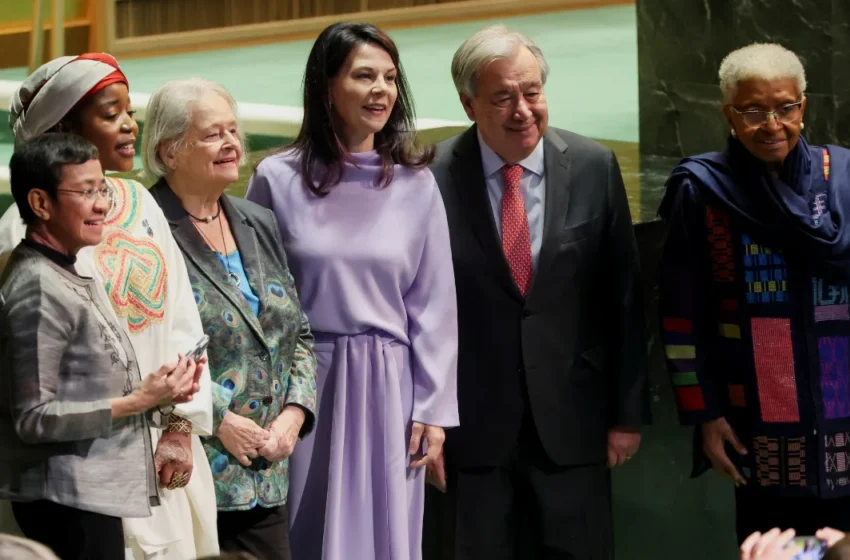
Assessing Beijing’s Enduring Impact on Global Women’s Rights After 30 Years
The Beijing Declaration and Platform for Action is one of the most effective international regulations on the promotion of women rights that have been made 30 years since its adoption. It was adopted by 189 governments at the Fourth World Conference on Women in 1995 and set out a bold agenda of gender equality in twelve areas that are vital such as education, health, employment and political participation.
UN Deputy Secretary-General Amina Mohamed called the Declaration a living blueprint, still informing the work of the world and shaping the way of life of significant frameworks, including the 2030 Sustainable Development Goals and the future Pact of the Future. It was a historical moment in global policy by affirming the position that the rights of women are the rights of humans, which struck a chord in the world when it was ambassadored by the then-US First Lady Hillary Clinton at the Beijing conference.
Within the last thirty years, the Declaration has led to the legal changes, establishment of new gender equality institutions, and the building of civil societies networks across the world. Nevertheless, its standardizing effect has been very powerful but implementation has not been even across territories and this has shown persistence of gender inequality.
Persistent Challenges Despite Progress
Although significant improvements in literacy rates, participation in labor, and political representation have been made, the 2025 UN gender equal measure testifies that little progress of the global gender goals is projected to have been met by 2030. The UN Department of Economic and Social Affairs reported that some 708 million women continue to be out of the workforce, largely because of the domestic labour that is not paid. Moreover, some 351 million women and girls remain in unimaginable poverty with conflict zones or low income nations having the highest risks.
This information highlights a growing disjuncture between policy promises and practice. Legislations that tackle gender-based violence or discrimination are usually present in paper but are weakly implemented. Besides, the burden of women is experienced in socio-economic inequality, climate crisis, and migration demands, which negate the gains made since Beijing.
Backlash and Emerging Threats
The recent years have witnessed the growing opposition to gender equality. In 2025, UN Secretary-General Antonio Guterres said that the world is experiencing a wave of misogyny, citing the increasing numbers of political groups trying to reverse reproductive rights, halting feminist groups, and limiting funding sources related to gender.
Though digital technologies provide new sources of empowerment, they have also increased online harassment and marginalisation in the new economic directions. Those overlapping dangers are evidence of the frailty of progress and of the necessity of protecting the gains which have been made since the Beijing conference.
China’s Role in Shaping Women’s Rights Discourse
The fact that China has chosen to host the 2025 Global Leaders Meeting on Women, emphasizes its quest to redefine the symbolic status of the 1995 meeting and establish itself as a global champion of the cause of women. The Chinese authorities emphasize the improvement in education, health, and labor involvement as the factors of national success in the development of women.
Chinese feminists and outside observers however, observe that there are still contradictions. Although the government tries to encourage women in economic modernization, the limitation of civil society and prison of women activists in the fight for women rights indicates that there are boundaries to independent mobilization. The state focus on family harmony and demographic stability does not always sit well with the general human rights principles of the Beijing Declaration.
Policy Priorities in 2025
The policy pillars in the address of President Xi Jinping at the occasion of the anniversary event were as follows: the development of enabling environments to support the growth of women, high-quality development of the causes of women, strengthening governance in order to defend the rights of women, and the inclusive world cooperation. These goals are a combination of internal agendas, and foreign signaling, which makes China an advocate of the principle of equality based on development.
Although the emphasis on the capacity-building and innovations can be discussed as consistent with the international priorities, the lack of promises of civil liberties and independent activism point to the selective vision of empowerment, a vision that places more emphasis on state-driven progress than on the mobilization of grassroots movements.
Advancing Practical Equality and Economic Empowerment
The UN and other international financial institutions have continued to associate gender equality with economic performance. UN Women estimates in studies in 2025 that by bridging the gender digital divide and increasing access to education and technology by women the global economy could see 30 million people lifted out of poverty and ultimately add 1.5 trillion to the global economy in five years.
This economic framing has been popular in politics, particularly in the context of the post-pandemic recovery in which inclusive growth and going digital are the top-priority policies. However, unless childcare, healthcare, and workplace equality are specifically targeted, several women will be left out of the modernization benefits of the economy.
Representation and Decision-Making
The number of women in leadership has grown but quite unequal. In 2025, the Inter-Parliamentary Union said that the world had over 27 percent of women in parliamentary seats, an all-time high but still not equal to the 50-percent mark. Women hold less than 20 percent of executive positions in corporate and financial domains, even though the gender balanced leadership has proven to be innovative and resilient to an organization.
This gap can be bridged by ensuring that there is a long-term policy implementation and leadership development and that informal barriers like prejudice in hiring and promotions are broken down. The final standard of equality is structural transformation rather than symbolic inclusion.
The Ongoing Struggle for Rights and Representation
The coming 69 th session of the UN commission on the status of women and the 2030 SDG deadline have revived world focus on the outstanding work of the Beijing declaration. People and specialists are demanding that governments should shift rhetorical commitment to concrete responsibility. Among the priorities are reforms of discriminatory laws, securing of reproductive and digital rights, and institutions to ensure women are not exposed to violence.
Civil society organizations also point out that change should not be achieved solely by the state but also by ensuring that there are spaces of advocacy and dissent. The application of the Beijing Platform is not fully achieved in those nations where the activists are censored or persecuted. The nexus between gender equality and democracy, human rights, and environmental justice is becoming prominent as of what sustainable development entails.
Concurrently, the younger generations are redefining the vision of the Declaration via digital activism, climate movement, and intersectional movements that consider race, classes and identity. Their interaction is a development of the global women’s movement that adopted the policy-based advocacy to an inclusive call of a general change in the system.
The Beijing Declaration is a living agenda and legacy to the world thirty years after it was adopted historically. It still influences international norms and inspires activism, despite the fact that the world is still struggling with the ongoing inequality and backlash. The equality between movement and backwardness shows a timeless fact that women rights are a constant battle, but not a project.
The question for 2025 and beyond is not whether the principles of the Beijing Declaration remain relevant, they clearly do but how governments, institutions, and societies can translate them into tangible equality amid shifting political and technological landscapes. The durability of the Beijing vision will ultimately depend on whether the world can sustain collective will and moral clarity in an era of renewed polarization and change.]

