

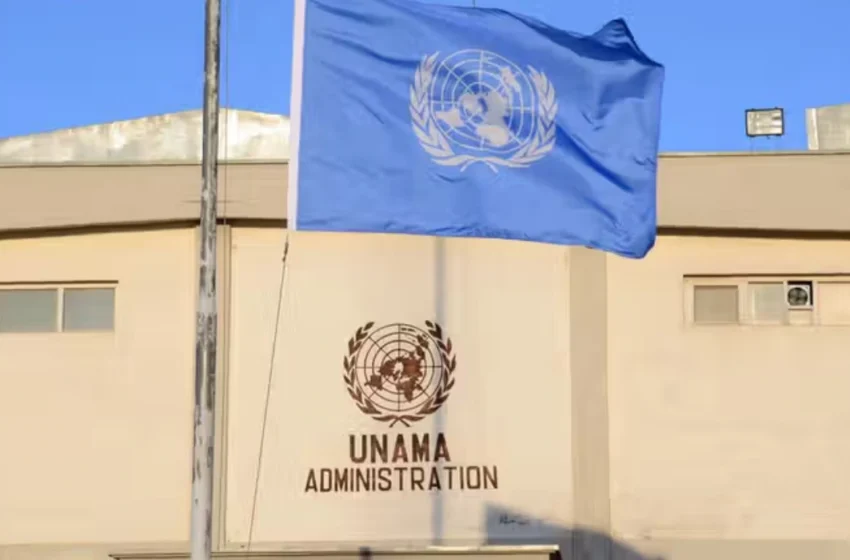
Taliban Detain UNAMA Staff: UN Immunity and Rights Work at Risk
The detention of two Afghan staff members of the United Nations Assistance Mission in Afghanistan (UNAMA) in Herat is not just another headline in a long list of arrests under Taliban rule. It is a stress test of the legal and operational framework that allows the UN to function in a country where the de facto authorities have repeatedly narrowed the space for independent reporting, rights documentation, and humanitarian work. On Sunday, 9 August 2026, officials from the Taliban’s General Directorate of Intelligence (GDI) took two male UNAMA employees from the mission’s human rights section as they were leaving their office in Herat, according to UN statements and reporting by multiple outlets.
The mission has said it has
“not been informed of the charges against them or permitted to see them,”
UN Deputy Spokesperson Farhan Haq told reporters in a briefing. In the same breath, he added,
“We call on the de facto authorities to ensure compliance with the privileges and immunities of the UN and its officials.”
Those lines, delivered in the measured tone typical of UN briefings, carry a sharp edge: they signal that the organization views the arrests not merely as a personnel issue but as a challenge to the legal protections that underpin its presence in Afghanistan.
What is known: who, where, and how
The two men who have been detained are Afghans who work for the UNAMA human rights section in Herat, a province that has had multiple disputes between the Taliban authorities and the groups recording their crimes, particularly those against women. The United Nations Assistance Mission in Afghanistan has revealed that the two individuals were detained by officers of the de facto General Directorate of Intelligence on 9 August in the western province.
The mission has not made known their identity because that is the common approach in sensitive detention cases where risk may increase and back-channel negotiations can be jeopardized. Importantly, UNAMA reports that no formal accusations have been presented to it and the agency has not been permitted to meet the two men since their detention. It should be noted that the failure of UNAMA to have access to these two men is quite telling. In accordance with UN practices, the “privileges and immunities” are designed to protect UN staff members from arbitrary detention and guarantee access to them during their duties.
Why Herat, and why human rights staff
The city of Herat has become a focal point of controversy related to documentation of abuse cases. As stated by Afghanistan International, the two UNAMA employees had recently collected data about the detention of women in the province and had conducted interviews with several girls detained in the province. This report states that the intelligence officers arrested the employees when they left their office.
Though the Taliban did not provide any explanation concerning the arrest, the time and the profile of the victims clearly indicate that there is a tendency: people gathering and publishing data about abuses, especially abuses related to women are under threat. This is not a unique phenomenon in the region. In June 2026, around 20 aid workers were arrested by the Taliban’s Ministry for the Propagation of Virtue and Prevention of Vice because of beard-length regulations; some of them worked for the organizations cooperating with the UN.
In July, Human Rights Watch reported that six male staff of the Women and Children Legal Research Foundation (WCLRF) were “forcibly disappeared” from the NGO’s Kabul office, compounding fears about the safety of rights defenders. And in May, the UN and rights groups said the Taliban had detained at least three journalists on undisclosed charges, alongside reports of assaults and property confiscation during searches.
The UN’s legal line: privileges, immunities, and access
This reaction on the part of the United Nations has been meticulously considered. Through the use of the phrase “privileges and immunities,” what the mission is demanding is more than just consular access; it is making known to the de facto government certain legal obligations arising out of its status as an organization within the purview of international law and from agreements made by the UN when operating in other countries. The privileges mentioned are designed specifically to ensure that such a situation as the one at hand does not occur: namely, the detention of UN personnel without being notified, without charge, and without access by the mission itself.
Farhan Haq framed it succinctly when he said,
“We have not been informed of the charges against them or permitted to see them,”
before calling for compliance with UN immunities. That sequence—facts first, legal principle second—is a deliberate strategy: establish the breach, then anchor the demand in law.
Taliban silence and the cost of ambiguity
As of the latest reporting, the Taliban administration has not issued a public statement specifically addressing these two UNAMA detentions. The silence is itself a signal. In previous cases, the Taliban have sometimes offered administrative justifications—violations of dress codes, travel rules, or “propaganda” charges—to legitimize arrests. Here, the absence of an official narrative leaves room for speculation and heightens anxiety among aid and rights organizations.
That ambiguity has a cost. When the rules are unclear and enforcement is unpredictable, organizations restrict movement, limit interviews, and reduce public reporting to manage risk. The result is less information about abuses, fewer services for vulnerable populations, and a shrinking evidence base for any future accountability. Fereshta Abbasi, Afghanistan Researcher at Human Rights Watch, warned that the detentions of UNAMA staff threatened the UN’s “ability to deliver lifesaving aid,” a reminder that rights work and humanitarian access are intertwined.
A broader pattern: impunity, intimidation, and the shrinking space
The incident occurs amid reports of arbitrary arrests and intimidation. According to reports provided by UNAMA itself early in 2026, there have been several dozen cases of arbitrary arrests and detentions of former government officials and former members of the Afghan National Defence and Security Forces as well as torture and ill-treatment. UNAMA has reported extrajudicial killings and impunity for violations committed by the de facto authorities as well as unknown perpetrators. In light of this, the detention of two human rights officers in Herat seems to be a tactic to dissuade from documenting the situation.
It is a clear message to civil society that one would get arrested working on sensitive issues, particularly women’s rights and detention practices. Such a chilling effect is already taking place. As of April 2023, except for some rare cases, all Afghan UNAMA staff, both men and women, have been working remotely to prevent discrimination in the workplace, according to UN reports. Remote work protects the staff from risks but limits the mission’s ability to verify the information, interview victims, and build cases.
What this means for UN operations and aid delivery
For UNAMA, the stakes are operational as well as legal. The mission’s mandate includes monitoring human rights, supporting political processes, and coordinating closely with humanitarian actors. If its staff cannot travel safely, interview witnesses, or publish findings without fear of arrest, the mandate becomes harder to fulfill. The risk is not only to UNAMA but to the broader aid ecosystem. Many NGOs rely on UN coordination and protection frameworks; when those frameworks appear weak, donors and implementers grow cautious, and programs slow down.
Human Rights Watch’s call for the release of both the two UNAMA staff and the six WCLRF workers underscores this interdependence. As Abbasi put it, the detentions threaten the UN’s “ability to deliver lifesaving aid,” linking the fate of rights monitors to the flow of assistance. In a country where millions depend on humanitarian support, any constraint on the UN’s operational freedom has immediate human consequences.
Possible scenarios and what to watch next
Three scenarios now dominate internal planning within UN agencies and partner organizations. In the first, the Taliban quietly release the two staff after behind-the-scenes negotiations, perhaps with a vague administrative justification. That would ease immediate pressure but leave the underlying deterrent intact. In the second, formal charges are brought—possibly related to “propaganda” or unauthorized reporting—leading to a protracted legal process that keeps the case in the news and keeps other staff cautious. In the third, the detainees remain in limbo, with no charges and no access, becoming another entry in a growing list of unresolved cases that erode trust between the UN and the de facto authorities.
What to watch next includes whether the Taliban’s chief spokesman, Zabihullah Mujahid, offers a public explanation. He told Reuters he was “trying to gather details” about recent detentions but had “not received final clarity,” a formulation that leaves room for either resolution or delay. Also critical is whether UNAMA gains access to the detainees and whether the mission feels able to resume more visible fieldwork in Herat without escalating risk.
The larger question: can rights work survive under these conditions?
The crux of this story lies in whether independent rights reporting can endure in a system that treats the gathering of information as an attack on the status quo. While immunities invoked by the UN may be essential, they alone are insufficient. If the facts on the ground are willing to violate these rights, and there is nothing for the international community to do about it, then the effects will be slow erosion: less interviews, less in-depth reporting, and less truth in the public record. For now, the UN’s position is strong but limited to three principles: access, dissemination, and reminder of protocol. Farhan Haq summarized this view perfectly when he stated that, “We call on the de facto authorities to ensure compliance with the privileges and immunities of the UN and its officials.” What will happen going forward will depend on the next few days and whether the Taliban determine that the price of holding UNAMA employees does not justify the effort to silence the reporters of abuse.

