

UN Slams Israel’s West Bank Expansion
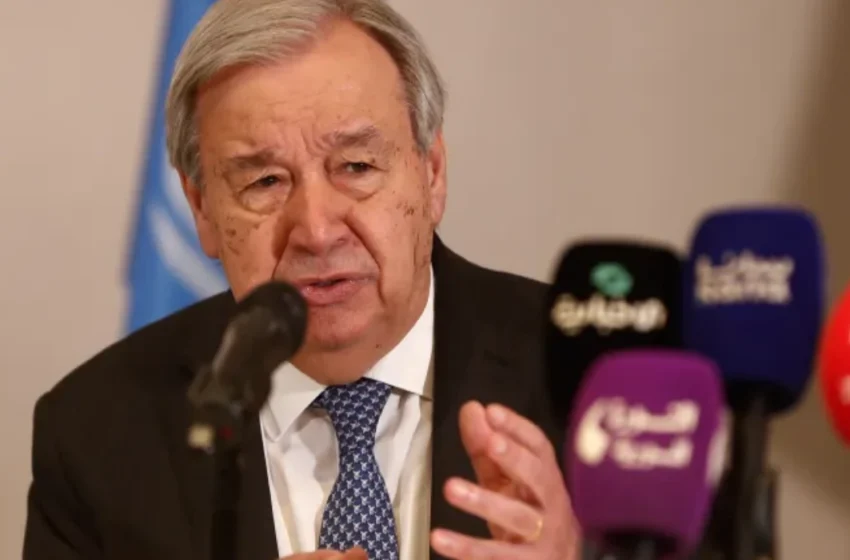
The United Nations has renewed its sharp condemnation of Israel’s settlement drive in the occupied West Bank, with Secretary-General António Guterres calling the expansion a “flagrant violation” of international law and warning that it is worsening an already volatile situation on the ground.
The most recent reaction of the UN is in the wake of plans by the Israeli government to advance the development of settlements and legitimize the outposts, thus increasing the fear regarding the fate of the territory and its chances of reaching a two-state solution. This is not a new problem, but it is particularly relevant due to the situation that exists. There have been increasing violence, attacks on the part of the settlers, increased military presence, and humanitarian pressures on the Palestinian population.
UN’s strongest warning in recent months
Guterres did not merely express concern. He used language that places the settlement issue at the center of international legal and diplomatic criticism. According to the reported statement, the UN chief said the settlement activity has “no legal validity” and amounts to a “flagrant violation” of international law.
This is significant because it shows the United Nation’s consistent stance on Israeli settlement activities within the occupied Palestinian territory being illegal under international law. Also, the warning from the Secretary-General came in light of reports of Israel planning to expand its settlement building and efforts towards legalizing farms in the occupied West Bank. This translates to further encroachment by more buildings and institutional support to the Israeli population in occupied territories, which UN believes complicates the situation even further. For Guterres, this is not just an issue of disagreement on the policy. From his perspective, the expansion of the settlements is seen as an impediment to the achievement of peace.
Why the timing matters
This latest dispute comes amid escalating violence in the West Bank, which has become one of the most dangerous and politically sensitive arenas in the Israeli-Palestinian conflict. Settler violence, Palestinian attacks, raids by Israeli forces, arrests, and retaliatory incidents have created a cycle of confrontation that keeps tensions high and leaves civilian communities exposed.
It is based on the fact that growth of settlements and violence are reinforcing each other in a vicious circle. With the growth of settlements, there is a limitation of land, roads, water, and agricultural resources for Palestinians. Whenever conflicts erupt due to such limitation, there is more violence and when the violence increases, the scope of compromise becomes further limited. This vicious circle is precisely what the UN is saying is happening in the West Bank right now. The way in which the UN has reported on the issue and briefed it has called the increasing settlement activities as a major cause of the worst displacement situation in the area since 1967. This is a highly important historical point.
Legal dispute and UN position
The discussion about the settlements in the legal domain has been ongoing for many years already, yet the position of the UN stays unchanged. The UN has always been stating that the Israeli settlements in the West Bank, including East Jerusalem, are illegal. This statement is supported by international humanitarian law, the Geneva Convention, and UN resolutions. The most recent statement of the UN on this matter is based not only on the international humanitarian law and the previous statements but also on the 2024 advisory opinion of the International Court of Justice, in which it was noted that the presence of Israel in the occupied Palestinian territory is unlawful and the construction activity must stop.
The UN Human Rights Office has also said that Israel’s recent and ongoing settlement expansion and related legal changes in the West Bank
“fly in the face of international law.”
That phrasing reflects the wider UN view that the issue is not limited to housing construction alone. It includes land designation, outpost legalization, infrastructure planning, and administrative measures that gradually entrench the settlement system.
For the UN, all of this has a cumulative effect. Even small decisions can become strategically significant when they are part of a broader process of territorial consolidation.
Settlement growth and political messaging
While the allies of Israel tend to regard the issue of settlements as being either an issue of historical links or a question of security or administration, the United Nations and the international community in general consider this differently. According to them, conducting settlement construction when there are no progress in peace negotiations influences the situation on the ground in such a way that it pre-judges the results of these negotiations. For this reason, it is the message that Guterres and other representatives of the UN keep conveying: settlements are not a local issue of planning but rather a political and legal tool of changing borders ahead of diplomacy. Especially it is a critical issue in relation to the West Bank as the current situation of fragmentation of the territory makes it almost impossible to imagine a contiguous Palestinian state.
The head of the UN has already raised alarm regarding the threat that settlement expansion poses to the “viability of a contiguous and sovereign Palestinian state” and “undermines the Palestinians’ right to self-determination.” These issues raise not only the issue of rhetoric; rather they concern the very geography of the conflict.
Violence on the ground
The settlement debate is inseparable from the violence now spreading across the West Bank. Reports cited in coverage of the issue describe settler attacks on Palestinian homes and property, including incidents linked to illegal outposts and communities such as Havat Gilad. These attacks are part of a broader pattern that has alarmed the UN, human rights organizations, and some Israeli voices as well.
The UN has constantly emphasized that violence from settlers is compounding the humanitarian crisis and exacerbating the danger of confrontation. Civilians living in the impacted area commonly experience attacks on their crops, destruction of their property, intimidation, harassment and coercion, including coercion to abandon their property. Sometimes, this results not only in fear but also displacement of people. This is the reason why the UN considers the settlements as a cause of humanitarian deterioration. This is not simply a legal point, but the very experience of living that people have to go through.
What the figures show
The reported numbers help explain the scale of the problem. In 2023, the UN said Israel advanced plans for more than 5,500 housing units in settlements in the occupied West Bank. That figure illustrates how settlement growth is not a marginal process. It is a sustained and organized expansion.
Another UN Human Rights Office statement said Israeli Finance Minister Bezalel Smotrich announced a military order to allocate 148 acres for the new settlement of Nahal Heletz. Even without entering the full political debate over the minister’s role, that specific land allocation shows how settlement expansion can be tied to state action, military orders, and legal-administrative steps, not just private construction.
A later UN report described 2025 as the year in which settlement advancement reached its highest level since UN tracking began in 2017. That is a striking signal because it suggests the trend has accelerated rather than stabilized. In other words, the controversy is not fading. It is becoming more institutionalized.
Israeli and Palestinian stakes
For Israel, settlement policy is highly domestic politics related. Settlement construction is backed by tough political groups that view West Bank, or at least its significant part, as crucial for Israeli security and historical rights. For the government, giving away something in exchange for concessions regarding the settlements would be political trouble. On the other hand, for the Palestinians, the matter touches their fundamental state interests, sense of dignity and territorial integrity. Every additional settlement makes statehood dreams appear as less likely. That is why the Palestinian side and its allies regard the settlement growth problem not technically but existentially.
As for the United Nations, its task is to preserve this legal and political dilemma on the international stage. With the term of violation and description of the settlements as “flagrant violation,” the UN shows that this situation is not supposed to become normal simply due to its long-term nature.
Broader diplomatic implications
In terms of the bigger picture, the implication of the above-mentioned conflict is that it brings the already difficult two-state solution even closer to collapse. This is what the diplomats continue calling it, but in reality, this implies that the diplomatic situation is becoming more narrow. With the growth of settlements and the rise of violence, the chances of conducting some useful negotiations grow slimmer. Moreover, the UN itself tries to ensure that the problem stays high-profile and does not get pushed away to become an insignificant side note to world events. The importance of the strong rhetoric of Guterres is that it serves to remind the world that the settlements problem is an important part of the peace process in the international relations sphere even if it is not always in the headlines every day.

