

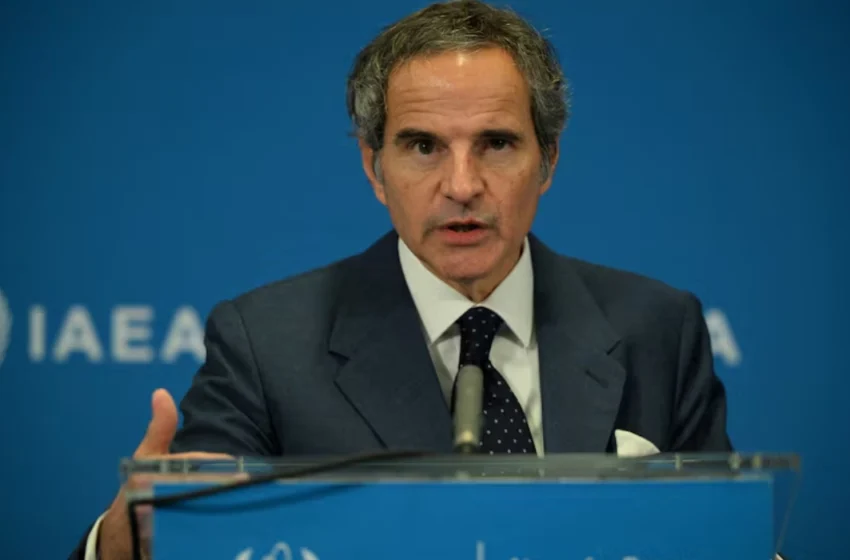
Iran-US Peace Deal: IAEA Chief Welcomes Deal, Technical Work Starts
Rafael Mariano Grossi, who serves as the Director General of the International Atomic Energy Agency (IAEA) at the UN, has welcomed a proposed peace agreement between the Islamic Republic of Iran and the USA and said that work is starting on the technical aspect of nuclear safeguards. It is important to note that this move is indicative of a fundamental shift from high politics to a more practical approach that involves inspections, verifications, and other aspects of safeguards. According to the IAEA, this marks the point of rebuilding trust through actions rather than just talk.
Grossi’s message carried a calm but decisive tone:
“The technical work starts now.”
Another key line from his remarks underscored the agency’s role in anchoring political progress:
“The IAEA welcomes the Iran–US peace deal and stands ready to support implementation through rigorous technical work.”
These statements are not endorsements of political terms but affirmations that the IAEA will execute its statutory mandate—verifying that nuclear materials and activities remain under peaceful uses—once parties commit to a framework that enables verification.
The timing is essential. Following years of uneasy collaboration, restricted access to inspections, and growing questions regarding Iran’s nuclear program, any realistic chance for restoring confidence would hinge on the IAEA having the opportunity to reinstate full-spectrum monitoring. It is important to bear in mind that the IAEA does not participate in treaty-making; rather, it monitors compliance. This is the reason why the attention shifts from negotiation tables to control centers, sampling facilities, and plant floors where inspectors place cameras and collect data.
What the IAEA Chief’s Statement Actually Means
What Grossi said should be seen as giving a procedural thumbs-up. It is important to understand that the role of the IAEA has been decided by a political agreement first and foremost, and not the other way around. “The IAEA welcomes” is meant to acknowledge that the political situation has improved such that the conditions for verification have been created. The next step will be for the agency to undertake or resume its safeguarding measures in accordance with the terms of the verification regime.
The statement “technical work will start now” refers to such practical tasks as restoring continuity of presence procedures, establishing data connections from containment and surveillance systems, resuming environmental monitoring, and liaising with the national authorities to gain access to sites. At the same time, “technical work will begin now” is also about recreating the process by which inspectors are able to freely travel from site to site while at the same time ensuring that the documentation remains tamper-proof.
Grossi also emphasized the agency’s commitment to impartiality and evidence.
“The IAEA’s role is to verify, not to judge politics; our reports will reflect what we see and measure on the ground.”
This distinction is crucial. The agency’s reports are technical assessments grounded in measurements and observations. They do not resolve political disputes but provide the factual basis that diplomats, policymakers, and sanctioning bodies rely on when deciding next steps.
The Road From Diplomacy to Verification: Next Steps and Timelines
The move from political understanding to technical action consists of various steps. First, there is a need to establish an architectural framework for the verification process, which includes specifying which locations will be inspected, how monitoring equipment is to be employed, and data-sharing responsibilities. Second, the IAEA devises an operational plan for its staff and equipment deployment and access. Third, the verification process begins on site, resuming continuity of inspection and monitoring efforts. Finally, first reports are issued by the agency to determine the consistency of peaceful use and sufficient cooperation.
In practical terms, the “technical work” includes several key tasks:
- Reinstalling and calibrating containment and surveillance equipment at declared nuclear facilities
- Restoring data links and ensuring continuity-of-presurance measures for real-time monitoring
- Conducting environmental sampling and worker interviews to cross-check declarations
- Verifying that nuclear material inventories match reported figures and that no unauthorized activities are underway
- Coordinating access agreements that allow inspectors to move between sites without delaying critical operations
Every task produces quantifiable results. If there is an online camera that is timestamped, then that provides consistency. Similarly, if a sample shows no isotopic anomalies, then that will support peaceful use. In addition, a ledger that corresponds with material accounting would be considered evidence of integrity.
Grossi outlined the agency’s readiness with a measured expectation:
“We are prepared to deploy teams and equipment as soon as access is confirmed, and we will report findings transparently.”
Transparency here is not just about publishing results; it is about making the methodology and evidence chain visible to stakeholders so that the verification process can be trusted even by parties that previously doubted the agency.
Stakes for Global Security and Regional Stability
The Iran-US peace deal, when implemented through verified means, will have consequences beyond the technical jurisdiction of the IAEA. In terms of global security, there will be reduced fears of escalation in nuclear arms and the re-establishment of a regime in which nuclear materials are used for peaceful purposes. In terms of regional stability, there will be cooling down of the environment in the region due to nuclear ambitions. For the IAEA, its task is to cement the political successes in verifiable facts.
The watchdog’s endorsement is carefully framed. The agency does not celebrate the deal as a political victory; it treats it as a necessary precondition for verification. Grossi’s statement makes that distinction clear:
“The IAEA welcomes the deal because it enables verification, not because it resolves politics.”
This is the agency’s standard posture: it supports agreements that allow it to fulfill its mandate, and it reports on what it observes, regardless of political narratives.
There is much at stake here, including the effectiveness of the international inspection process itself. The more effective the monitoring process becomes again, as managed by the IAEA, the stronger the international understanding that any nuclear program should be transparent and open to verification will become. Failure to make further progress would lead to erosion of confidence, which could increase the likelihood of miscalculation. This explains why technical efforts are not secondary but essential to a long-term peaceful solution.
How the IAEA’s Verification Work operates in Practice
The verification concept used by IAEA has three pillars, namely containment, surveillance, and corroboration. Containment entails security measures used to deny any movements of nuclear materials. Surveillance involves use of camera, seals, and sensors to watch what is happening in a facility. Corroboration entails collection of independent information like environmental sampling, worker declarations, and logbooks to verify the statements made.
As soon as the inspection agency starts up its operation again, inspectors start with continuity. This involves making sure that seals are still there, cameras are filming, and data streams are continuous. Next comes the verification process, in which the inspectors compare the bookkeeping accounts with actual inventories, review operational logs for accuracy, and sample the environment in order to identify any traces of concealed activities.
Grossi highlighted the evidence-based nature of the work:
“Our conclusions will rest on measurements and observations, not assumptions.”
This is the IAEA’s core principle. The agency’s reports are technical assessments that reflect what is measured and observed. They do not adjudicate intent; they assess whether the program is consistent with peaceful use and whether cooperation is sufficient to support confidence.
Challenges That Remain Even After a Deal
The signing of an agreement does not mean that its verification process will go smoothly. Various obstacles might prevent success: late or incomplete access, damaged equipment, lack of information, or problems with administration. As seen from experience, while political deals may be signed, they can be hindered technically by various past activities, for example, disconnection of monitoring devices and modification of sites without proper documentation.
There are also political sensitivities. The agency must maintain neutrality while navigating working relationships with national authorities, facility operators, and international stakeholders. Grossi addressed this directly:
“The IAEA will remain impartial and base its reports strictly on technical evidence.”
Impartiality is essential to credibility; it ensures that the agency’s findings are trusted even by parties that disagree on political terms.
Another challenge is the pace of implementation. “Technical work starts now” does not mean instant results. Resuming monitoring, calibrating instruments, and validating data chains take time. Initial reports may be partial, focusing on what can be verified quickly while flagging areas that need further investigation. That is the nature of safeguards work: confidence accumulates through repeated, consistent evidence.

