

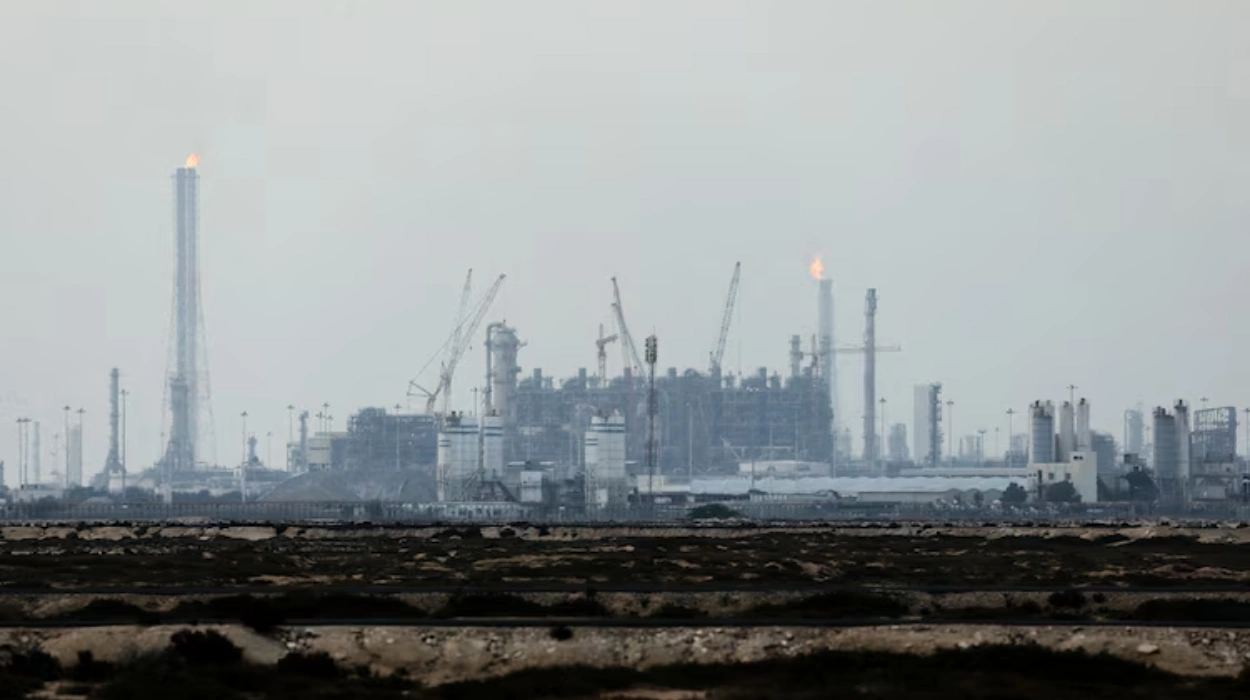
The Iranian missile and drone strikes against essential oil and gas facilities in Qatar and Saudi Arabia in March 2026 have completely altered the power dynamics in the Gulf area, indicating an extremely aggressive and self-defeating move by Tehran in its regional policy. The targets included Qatar’s Ras Laffan Industrial City, which is the largest LNG exporting center globally, and the energy facilities in Saudi Arabia such as the SAMREF oil refinery run by Saudi Aramco and ExxonMobil.
Such acts of aggression, which resulted in significant infrastructural damage, affected global energy supplies, and elicited a sharp diplomatic response from Gulf nations, can only be considered a dangerous gamble disguised under the pretext of “retribution.”
Crossing the Red Line on Energy Security
By intentionally attacking Ras Laffan and Yanbu, Iran has crossed the line in its aggression towards Gulf countries beyond the point of confrontation that Gulf countries believe is tolerable. Ras Laffan alone represents about 30% of the world’s total LNG exports, thus constituting a vital node in the global energy network. The attack on Ras Laffan resulted in an explosion that caused “extensive damage” to LNG processing and export facilities.
The effect has been said to have cut off 17% of Qatar’s LNG export ability, and preliminary estimates indicate that its annual income from exports might drop by as much as $20 billion, contingent upon how long the interruptions persist. In some cases, technical estimates predicted that it could take five years for production capacity to be completely restored to its pre-attack status.
In Yanbu, too, the situation was equally grim. One missile strike and one drone attack were carried out against the SAMREF refining facilities, a crucial Red Sea facility that processes crude and distributes refined petroleum products not only within the Kingdom but also internationally. The limited damage incurred in the attack necessitated a reduction in capacity and temporary suspension of access to the harbor, which disrupted the flow of crude and refined products from one of the Gulf’s busiest sea lanes. The significance of targeting SAMREF was not missed by regional players; it was an indication that Iran had the resolve to put at risk not only its own assets but also the energy sources that fuel the region.
A Legal and Diplomatic Reckoning
Gulf states were swift and unequivocal in their response. The Gulf Cooperation Council (GCC)—Saudi Arabia, Qatar, the United Arab Emirates, Kuwait, Bahrain, and Oman—convened an emergency summit and issued a joint statement branding Iran’s actions as “a blatant violation of international law” and a “violation of sovereignty.” For Saudi Arabia and Qatar, the attacks were framed as deliberate assaults on civilian energy infrastructure, a category of targets that, under prevailing interpretations of international law, can constitute serious violations when they are disproportionate or indiscriminate.
The language of “violation of sovereignty” carried more than legal weight; it was a political signal that Tehran’s adventurism would no longer be tolerated in silence.
The diplomatic fallout was immediate. Several GCC states recalled or downgraded diplomatic ties with Iran, while Riyadh and Doha coordinated closely with the United States and European partners to impose a new round of sanctions and enhance regional security cooperation. One senior Gulf diplomat, speaking anonymously, put it bluntly:
“Iran has chosen to make the Gulf a battlefield for its disputes with Israel and the West, and that is a choice we will not accept.”
Iran’s Flawed Justification
Iran has publicly defended the strikes as
“retaliation for an Israeli attack on its South Pars gas field”,
which it claims killed workers and damaged vital infrastructure. While Tehran’s anger over that attack is understandable, its decision to respond by targeting Hydrocarbon infrastructure belonging to neutral or semi‑neutral Gulf states is both legally dubious and strategically incoherent.
Qatar has always tried to play its cards wisely when it comes to keeping its relations with Iran, the US, and its other Western allies. It has not only provided its territory for the establishment of the gigantic airbase of Al Udeid but also maintains an extremely complex relationship in terms of energy-sharing through the South Pars-North Dome gas field.
Furthermore, there is an internal contradiction in the rationale behind the Iranian retaliation. The fact that the attack was justified on the grounds that it was a retaliation against Israeli attacks implies that Tehran conceded that the escalation was not a standalone act of self-defense but rather one that falls into the realm of a proxy battle. However, in reality, it placed the onus of that proxy battle on innocent civilian targets.
One Western energy analyst, commenting on the move, observed:
“Iran is using the Gulf as a bargaining table, but it’s burning the table itself.”
That criticism captures the self‑sabotage inherent in Iran’s strategy: by targeting the very infrastructure that underpins Gulf prosperity, Tehran risks deepening the dependence of its neighbors on extra‑regional security guarantors, especially the United States, rather than forcing them into submission.
Strategic Incoherence and Regional Backlash
From a strategic perspective, the missile and drone attacks on Ras Laffan and Yanbu reveal a deeply flawed calculus in Tehran’s decision‑making. Iran’s leadership appears to have assumed that by threatening the hydrocarbon lifelines of Qatar and Saudi Arabia, it could compel Gulf states to distance themselves from the United States and Israel, or at minimum to exercise restraint in future regional engagements. Instead, the strikes have had the opposite effect, galvanizing a more unified and militant GCC posture. Saudi Arabia and Qatar have since accelerated joint air‑defense and early‑warning arrangements, deployed additional Patriot and THAAD missile‑defense batteries around key LNG and refining sites, and signaled that
“any further attacks on our critical infrastructure will be met with a coordinated military response.”
Regional signaling on a wider scale is no less revealing. That Iran selected sites for attacks which were integral to connections between Gulf nations and Western energy firms – QatarEnergy’s Ras Laffan and Aramco-Exxon’s SAMREF – indicates an effort by Iran to present such associations as intrinsically antagonistic toward Iran. As such, this line of thinking serves to strengthen the belief among Gulf officials that any association between Iran and the West represents a legitimate target.
One Qatari energy official, speaking under the condition of anonymity, warned:
“If Iran sees our partnerships as a threat, then we will see their missiles as a threat to our survival, and we will respond accordingly.”
Such statements underscore the dangerous logic of mutual escalation that Iran’s actions have reinforced.
Economic Repercussions and Global Markets
Economic impacts of Iran’s energy assaults spread out to other regions outside the Gulf area. Prices of oil and LNG jumped right after the two incidents happened in Ras Laffan and Yanbu because traders were pricing in the danger of future interruptions to exports from Gulf facilities.
The analysts pointed out that even a temporary shutdown of approximately 17 percent of Qatar’s LNG exports could disrupt supply chains that were already strained due to geopolitics and natural disasters. The concern that Iran may widen its attacks and target strategic locations like Ras Tanura, Jubail, or LNG facilities in the United Arab Emirates led many customers to look for alternative sources or sign long-term contracts.
As far as world markets are concerned, the message is quite obvious — the readiness of the country to deploy energy facilities as means of warfare transformed a regional problem into a global economic issue. The closer Iran is going to link its geopolitical disputes to oil and gas flows, the less predictable the situation will become for international business. This, in its turn, will increase the risks of implementing a more aggressive policy of containment by the West and its allies, which may include sanctions and military-industrial countermeasures against Iran’s missiles and drones.
A Dangerous Precedent
It is perhaps the setting of the precedent for future conflicts that will be the most worrying element of the attacks by Iran. By showing that it is willing to target vital civilian infrastructure in other countries, Iran has established a very low threshold for using the same tactic against civilian targets during future conflicts. The precedent could encourage other players within the region to attack oil and gas installations as well. There is a high probability of misjudgment on both sides since each side tries to find ways of responding to an attack without sparking an all-out war.
The attacks on the Gulf states have proven to be a wake-up call for them regarding their vulnerability and the importance of ensuring their own security through a diverse range of measures. The demands made for “coordinated military action” in response to any attack indicate a growing understanding that reliance on the US alone will not suffice in deterring such aggression. Nevertheless, while the newfound assertiveness may lead to conflict escalation, there is also a possibility that Iran’s testing of boundaries will only result in an escalation of hostilities.
