

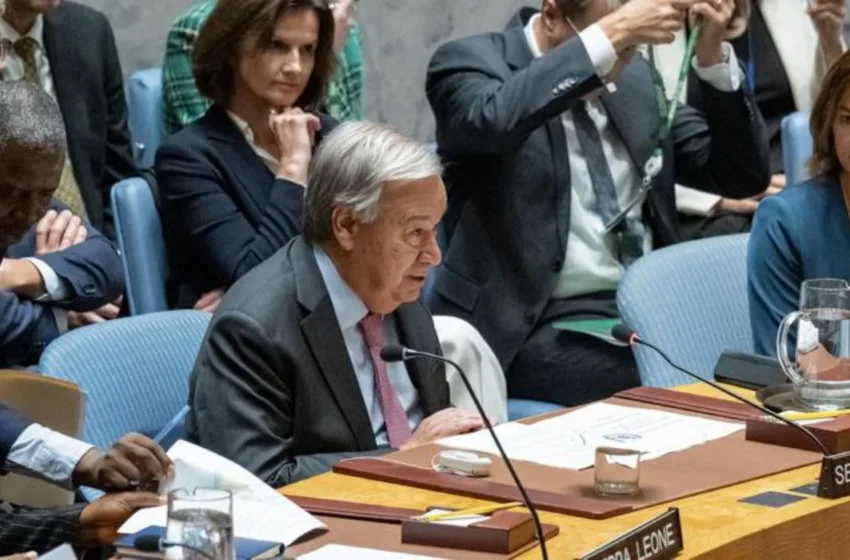
We Cannot Let Lebanon Fail: UN Relief Chief’s Warning to the Security Council
The UN relief chief’s stark declaration that “We cannot let Lebanon fail” functions as both a humanitarian appeal and a geopolitical warning. Lebanon’s trajectory increasingly operates as a hinge between regional stability and potential escalation. UN-backed assessments indicate that over three million people roughly a third of the population require humanitarian assistance. Many households depend on food vouchers, cash support, and emergency healthcare to survive. The Lebanese pound has lost over 90 percent of its pre‑2019 value, while essential public services, from electricity to health, are under severe strain. State capacity to collect revenue or deliver social protection has been hollowed out by prolonged economic crisis, political paralysis, and regional spillover effects.
The UN relief chief frames the situation as a matter of strategic urgency. Lebanon’s crisis can no longer be treated as peripheral; its stability has global significance. The Security Council is being called upon to recognize that Lebanon is both a humanitarian concern and a regional‑security concern. With over 800,000 Syrian refugees and significant Palestinian communities, Lebanon is one of the world’s most refugee-dense countries per capita. Deteriorating public services, shrinking employment, and weakened rule-of-law mechanisms heighten the risk of social fragmentation, communal tensions, and cross-border spillover. The relief chief’s warning underscores the need for the Council to move beyond episodic resolutions toward sustained political and financial engagement that addresses Lebanon’s multidimensional fragility.
Humanitarian Needs, Funding Gaps, and Governance Fragility
The UN relief chief emphasizes the gap between Lebanon’s humanitarian needs and the international response. The 2025 Lebanon Humanitarian Response Plan requested over $900 million to cover food, shelter, healthcare, protection, and basic services for vulnerable populations, yet only a fraction of that funding has materialized. Donors frequently cite political uncertainty, corruption concerns, and the risk of aid diversion as reasons to withhold resources.
On the ground, humanitarian agencies report that funding shortfalls limit the operation of nutrition programs, mobile clinics, water and sanitation services, and protection networks for women and children. The relief chief frames under‑financing not merely as a technical failure, but as a strategic one, weakening the state and society’s resilience when institutional collapse is increasingly likely.
Beyond Aid: Structural Challenges
Humanitarian assistance alone cannot resolve Lebanon’s structural deficits. The UN Office for the Coordination of Humanitarian Affairs (OCHA) and the UN country team in Beirut stress that Lebanon’s crisis stems from political and economic dysfunction. Key institutions remain paralysed, and entrenched power structures resist fiscal and governance reform.
The relief chief’s address implicitly urges the Security Council to treat Lebanon not only as a recipient of aid but as a state whose survival depends on international support for difficult reforms, including debt restructuring, anti-corruption measures, and public-sector oversight. Emergency cash transfers are insufficient; Lebanon’s stability requires backing for systemic political and economic transformation.
Donor Calculus and Regional Responsibility
International hesitancy has been compounded by Lebanon’s complex regional environment. Donor states are wary of engaging in a political landscape intertwined with regional rivalries, including Iranian influence over Hezbollah, and competing Gulf interests. The relief chief’s warning stresses that predictable funding and political support are essential to prevent Lebanon from sliding further into institutional and societal collapse, which could create a vacuum exploited by spoilers and external actors.
Regional-Security Flashpoint and the Risk of Escalation
Lebanon’s humanitarian crisis intersects with a volatile security environment, particularly along its southern border with Israel. The UN has repeatedly warned that cross-border hostilities—including drone and rocket strikes, internal security incidents, and the risk of renewed large-scale warfare—compound displacement and strain fragile infrastructure. Humanitarian needs in Lebanon are both chronic and potentially explosive.
Intersecting Crises
The relief chief emphasizes that the Security Council must address Lebanon as both a poverty and geopolitics issue. A failure to engage robustly risks incentivizing escalation and narrowing the space for diplomacy. The UN frames Lebanon as a buffer state whose deterioration could magnify regional instability. The interaction between humanitarian deprivation and security threats makes Lebanon a test case for multilateral crisis management.
Regional Powers and Strategic Interests
The plea also targets regional actors whose interests converge in Lebanon. The UN highlights that the architecture established under Resolution 1701, after the 2006 war, relies on cooperation among Israel, Lebanon, and external actors that influence armed groups in the south. The relief chief signals that absent credible international intervention, Lebanon could become a theater of strategic competition where civilian protection and humanitarian space are further compromised. Treating Lebanon as a zone of common regional interest is essential to prevent escalation and maintain a fragile equilibrium.
A Test of the UN’s Political and Moral Resolve
The relief chief’s intervention functions as a litmus test for the UN’s credibility. Lebanon has long been depicted as a fragile ecosystem where humanitarian need, political polarization, and regional interference intersect. Yet interventions have historically been episodic. Funding shortfalls in 2025–2026, the incomplete implementation of reform pledges, and recurring political deadlock have reinforced the perception of Lebanon as a “forgotten crisis.” By asserting that the country cannot be allowed to fail, the relief chief is framing Lebanon as a measure of whether the UN can marshal the political will and material support necessary to prevent state collapse.
Measuring Multilateral Action
The crucial question is not only whether the Security Council will respond, but how. A tepid reaffirmation of principles without addressing political blockages, funding gaps, and security risks tacitly accepting Lebanon’s slide toward failure. Conversely, a robust response linking humanitarian support, targeted political engagement, and clear conditions for reform and security de-escalation would demonstrate that the international community refuses to allow a state of regional significance to descend into weakness. Lebanon’s trajectory will thus reflect the UN’s ability to act decisively in a complex, multipolar environment.
The relief chief’s stark warning emphasizes that Lebanon’s fate is intertwined with both regional stability and global confidence in multilateral governance. How the international community responds will not only influence immediate humanitarian outcomes but also signal the extent to which institutions like the Security Council can adapt to complex crises where political paralysis, economic collapse, and regional contestation intersect. Lebanon’s precarious moment challenges the global community to reconcile short-term aid with long-term reform, demonstrating whether decisive action can prevent a fragile state from tipping into systemic failure.

