

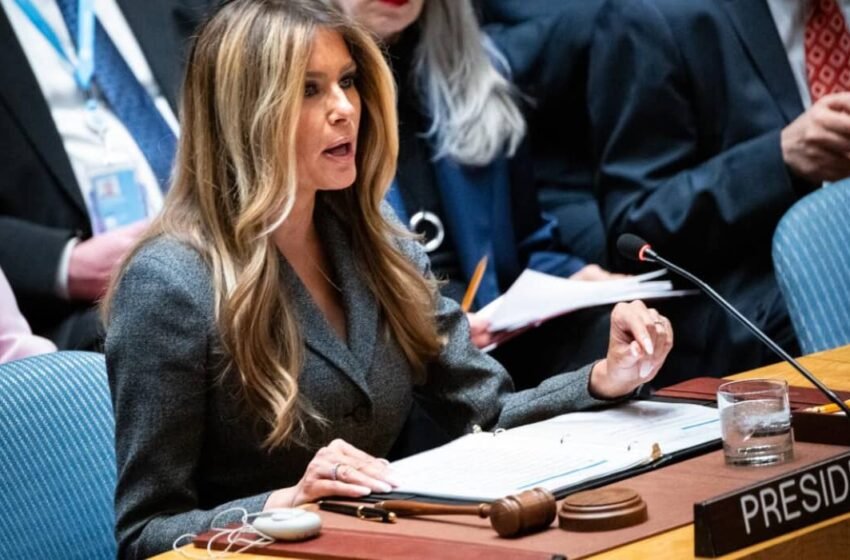
Guterres Condemnations Frame Melania Trump’s UNSC Presidency Debut on Children in Conflict
This was a procedural milestone in the history of the United Nations Security Council when Melania Trump was serving as United States rotating president. The event, which focused on Children, Technology, and Education in Conflict, was meant to highlight how digital tools and schooling can be used to avoid instability in the long run. However the mood of the session was informed by the recent geopolitical agitations most especially those that were going on with Iran.
The debate took place just after heightened tension in the region such as military attacks and emergency meetings at the Council. To that extent, expressions of Antonio Guterres on the infringement of international law served as a critical interpretive frame to the session. The focus of de-escalation and compliance with the UN Charter affected the reception of the child-centered agenda of the presidency by the member states.
Escalation and Humanitarian Concerns
The recent strikes caused the immediate Council deliberations. There were reports of casualties in Iran and it is claimed that there were child deaths due to an alleged school strike. Although numbers were not completely confirmed and checked by all, the humanitarian aspect prevailed in the comments of the international community.
Such incidents strengthened the criticism on how international forces balance military interventions with the promises of child protection. The contrast between the development of the conflict escalation and the session devoted to education helped to realize the difficulty of recognition of the security policy in accordance with the humanitarian norms.
Guterres’s Framing of International Responsibility
Guterres restated the issues of sovereignty, restraint, and international law in earlier statements around the emergency meeting. His condemnations did not only focus on a single actor but emphasized that the various actors should not engage in activities that can worsen the suffering of civilians. This was a compromise that strengthened the institutional role of the Secretariat in protecting neutrality.
This intervention of the Secretary-General established the atmosphere of caution that was brought into the March meeting. Although this was not specifically targeted to the presidency, the overall message was that there is tension between the operational military action and the multilateral action on behalf of children rights.
Melania Trump’s Debut and Child Protection Emphasis
The position of Melania Trump as the presiding officer was a historic event since she was the first sitting First Lady to preside over the Council in the presidency of the United States. Her comments focused on universal child welfare, continuity in education and the significance of technology in opening up access to education. The agenda she presented was a chance to show how innovation can counter the effects of conflict among the youth.
Her advocacy is based on earlier campaigns regarding child welfare, such as in 2025, she encouraged children to reunite with their families following conflicts such as those between Ukraine. Those interactions became very popular as an example of humanitarian diplomacy in the context of a high-level political discourse.
Technology as a Conflict Mitigation Tool
The theme of the session specifically focused on the digital infrastructure in the war-affected areas. Briefings highlighted the importance of connectivity, remote learning environments, and learning technologies in mitigating the potential long-term damage caused by disruption of schools. Nevertheless, interviewees also mentioned the dangers of misinformation, surveillance, and cyber vulnerability in conflict situations.
These two facets of protection and risk depict why technology governance is the focus of security conversations more and more. The framing of the presidency was consistent with wider UN deliberations on digital inclusion, without addressing existing military wrangles.
Timing and Perceptions of Consistency
External perceptions were influenced by the closeness of the session to active hostilities. Certain groups of people raised doubts that child protection rhetoric was even completely compatible with the current military activities of the United States. Some others claimed that the Council leadership and national security decisions are in different institutions.
This is not a new phenomenon in the present presidency. The phenomenon of rotating leadership set-ups is often accompanied by the geopolitical strain and the question is how the multilateral forums prove their credibility during a crisis.
Iran Conflict and Council Dynamics
There was urgency in the debate because of the escalation with Iran. Casualty reports, destruction of infrastructure such as purported effect on educational institutions, increased humanitarian attention of discussions. Even though conflicting accounts existed among the authorities, the fact that child related casualty claims were being made increased concern around the world.
The representative of Iran denounced the optics of a leadership of the Council in the course of military operations. These reactions indicate the political sensitivity of humanitarian advocacy linking with the current security actions.
Sovereignty and Legal Debate
The words of Guterres were focused on the UN Charter and especially the principles of sovereignty and civilian protection. His restraint appeal was in line with long precedent of the Secretariat in armed conflicts. Repeating these principles, the Secretary-General maintained the continuity of the institutions instead of having an affinity to some particular national agenda.
This placing enabled the Council meeting to continue uninterrupted by the procedures, and at the same time take note of the fact that the current conflicts are defining the larger policy terrain.
Broader Regional Implications
Council discussions still focus on the Middle East, especially when military action is involved in civilian infrastructure. In these situations, education systems tend to have disproportional effects, which will cause developmental losses in the long run. These considerations are what informed the focus of the meeting on the importance of resilience and reconstruction.
Meanwhile, member states understand that child protection discourses cannot be separated with broader geopolitical realities. The session was thus a thematic review and an implicit comment on the existing conflicts.
Institutional Significance of the Presidency
By having a turnaround leadership in the Council the United States is positioned to shape procedural agendas and thematic priorities. Child centered programs became prominent under this presidency. The focus on education and technology points to the attempts to bridge the themes of global governance and developmental diplomacy.
The recent development in 2025 and early 2026 has already experienced several conflicts related crises including the continued war effects in countries like Russia and Ukraine, and humanitarian strain in some parts of the Middle East. The combination of these overlapping crises has provided a detailed background to thematic sessions.
Financial and Operational Context
The system of UN experiences resource limitation such as arrears and budgetary pressure that has been experienced in the operation of peacekeeping. The centrality of institutional effectiveness lies in the contribution of member states. Thus, leadership sessions often overlap with larger discussions regarding reform and funding.
The focus of the presidency on education is also consistent with the long-term prevention strategies which as a rule are perceived to be cost efficient in comparison with the post-conflict reconstruction. But their translation into operational programs requires the cooperation of the member states on the thematic discussions.
Reactions and Strategic Interpretations
The response to the session was different in different regions. Other governments emphasized the symbolic value of having a First Lady in charge of such high-profile meetings on children. Others emphasized the necessity of the consistency of humanitarian communication in foreign policy action.
The previous condemnations made by Guterres offered an objective standard of measuring adherence to international standards. The Secretariat also provided balance to the institutions, bringing up the legal frameworks instead of the partisan political affiliations in a delicate change of presidency.
Multilateral Continuity
Despite tensions, the Council continues to function through structured procedures. Rotating presidencies are designed to distribute leadership responsibilities among member states. This system allows thematic priorities to evolve while preserving institutional stability.
The debate around children in conflict therefore reflects both substantive policy concerns and procedural symbolism. It demonstrates how global governance mechanisms adapt to overlapping crises without halting deliberations.
Analytical Outlook
The intersection of Guterres’s legal framing and Melania Trump’s child-focused agenda illustrates the layered nature of multilateral diplomacy. Institutional condemnation of civilian harm operates independently from national leadership roles, yet public perception often links them. Maintaining coherence between rhetoric and action remains a recurring challenge in high-level forums.
As the Council advances its 2026 calendar, subsequent sessions will likely revisit education, technology, and protection mechanisms in conflict zones. Whether these discussions produce new resolutions or reinforce existing commitments will depend on consensus among member states. The evolving relationship between humanitarian advocacy and geopolitical strategy will continue shaping how child protection initiatives are interpreted across regions, leaving open questions about how global leadership roles can sustain credibility amid simultaneous crises.

