

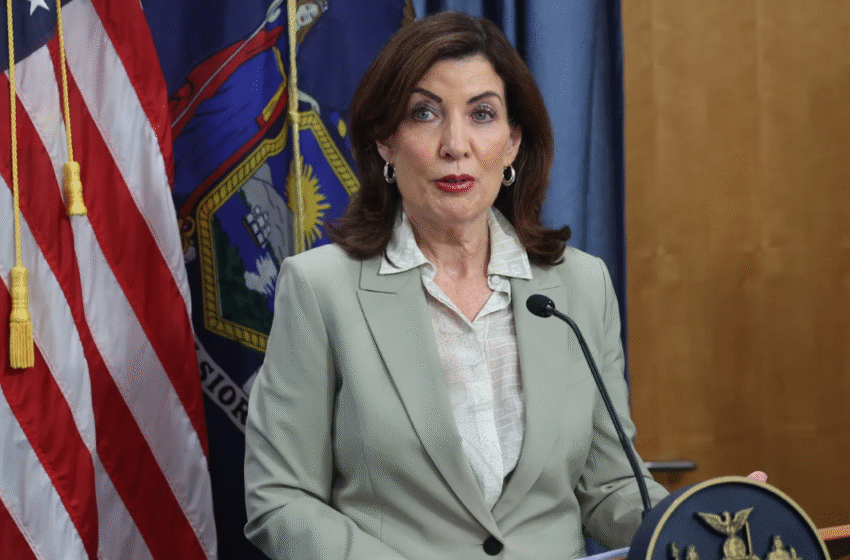
US withdrawal from WHO spurs NY to break ranks and join UN agency
Notably, New York has joined the Global Outbreak Alert Response Network, a wing of the World Health Organization, as a direct response to President Donald Trump’s decision to withdraw the country from the United Nations’ public health agency. In making this declaration, Governor Kathy Hochul indicated that the state would join the international coalition as it forms to address what has generally become a partisan affair following President Trump’s withdrawal, leaving Democratic-led nations in disarray.
New York is the third US state to join the WHO network after Illinois and California. The three states have been among the 14 Democratic-led states including Guam that created the Governors Public Health Alliance in October as a way of addressing the policies of the Trump administration on public health.
Accusations of Undermining Global Health Security
In a statement posted by Hochul’s office, New York’s governor said,
“We hold the Trump Administration’s action accountable for imperiling not only America’s, but also the world’s, health security by cutting ties with the WHO.”
“New York has always been a leader in public health and safety, and now we’re doing our part to keep people safe while the federal government gambles with people’s health and safety,” Hochul said.
“It’s going to prevent threats to health security from reaching New York and reaching this country.”
However, public health experts have raised concerns that if the US withdraws from WHO, it may jeopardize global disease surveillance. This was reinforced by the COVID-19 pandemic, which has killed over 1.1 million Americans and over 7 million people globally, as estimated by WHO.
What GOARN Is and Why It Matters
The Global Outbreak Alert Response Network, or GOARN, is a global technical partnership backed by the WHO, aimed at hastening the detection, confirmation, and response to health emergencies worldwide that require international response. It collaborates with more than 300 technical institutions, including labs, universities, centers, and health agencies, to provide real-time information during epidemics.
Through such a network, the New York State Health Department hopes to be able to offer technical assistance services, enhance global capacity building, improve the processes of communicating health risks, as well as make direct linkages with international health departments. The New York City Health Department recently joined the network last week.
Benefits for New York’s Health Infrastructure
The rationale offered by the office of Hochul was that the partnership will allow New York state access to global outbreak intelligence earlier, improve the skills of the workforce through participation in real-world outbreak response, as well as improve the state’s ability in terms of laboratory capacity.
This decision is taking place at a time when experts point to increasing pandemic threats linked to climate change, urbanization, antimicrobial resistance, and zoonotic transmission. The WHO has identified dozens of high-risk pathogens such as avian influenza, Ebola virus, and novel coronavirus.
Growing Fragmentation of US Public Health Governance
The action of New York State, California, and Illinois underlines the unprecedented degree of fragmentation of US public health governance, with US states now evading federal policy to go directly to international institutions.
The Washington Governor, Bob Ferguson, previously explained how the states “can no longer rely on the information coming out of Washington, D.C.,” thus emphasizing the importance of science. The Massachusetts Governor, Maura Healey, announced her disappointment with Trump and Health Secretary RFK Jr., for they have abandoned the work of safeguarding public health while the states look on.
Political and Ideological Battle Over Science and Global Cooperation
Trump’s WHO withdrawal reflects a broader ideological shift to nationalism and skepticism of multilateral institutions. Critics say it undermines global cooperation at a time when infectious diseases cross borders with unprecedented speed and coordinated responses are critical.
Public health researchers point out that it was international surveillance systems, such as GOARN, that were critical in the identification of SARS, H1N1 influenza, Ebola, and COVID-19 virus outbreaks. Without US federal involvement, experts say, delays in detection will be longer, responses will be more fragmented, and less confidence will exist globally in American leadership.
Democratic States Form Parallel Public Health Alliance
The Governors Public Health Alliance, launched by Democratic-led states and Guam, aims to share scientific data, coordinate pandemic preparedness, and resist federal policies perceived as politicizing health science. The alliance represents an unusual assertion of state-level diplomacy and international engagement in public health—a role traditionally dominated by the federal government.
Representatives from other alliance members have not yet confirmed whether they will also join the WHO network, but analysts suggest additional states may follow, creating a de facto parallel international health cooperation framework within the United States.

