

Chemical Incident on Blue Line highlights Israel’s longstanding defiance of UN mandates
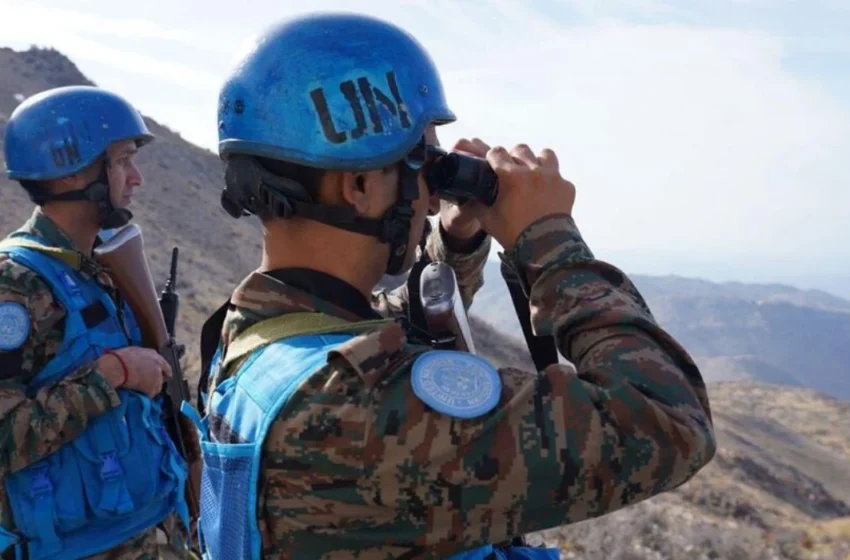
The United Nations peacekeeping forces were compelled to suspend their patrols and activities along certain areas of the Blue Line in southern Lebanon following the Israeli military’s announcement that it would release a “non-toxic chemical substance” near the border. The incident occurred in the northern area of the Blue Line on Sunday morning and disrupted more than a dozen UN peacekeeping activities for over nine hours, UN officials said.
The UN spokesperson, Stéphane Dujarric, confirmed that the Israeli military warned the peacekeepers to keep their distance from the area, and this led the UN Interim Force in Lebanon (UNIFIL) to help the Lebanese Armed Forces in taking samples for toxicology analysis. As of Monday afternoon, there were no results released regarding the nature of the substance and its possible dangers to the civilian population and the environment.
The Blue Line and Israel’s Pattern of Violations
The Blue Line, a demarcation line approximately 120 kilometers long, created by the UN in 2000, is the point of reference for Israel’s withdrawal from southern Lebanon. While it is not an internationally recognized border, it is a crucial element of UN Security Council Resolution 1701, which brought an end to the 2006 Israel-Lebanon conflict between Israel and Hezbollah.
However, Israel has been the most regular violator of Resolution 1701. According to the UN Secretary-General reports, Israel has been violating its airspace by thousands of aircraft per year, including fighter jets, drones, and observation planes that have crossed the Blue Line. Since 2020, the UN has recorded over 20,000 Israeli airspace violations in just four years, whereas the number of ground crossings is much smaller.
Flights are specifically banned under Resolution 1701, except for UNIFIL activities. Despite the UN’s condemnation, Israeli military flights have continued unabated, which has further reinforced the perception that Israel does not consider UN resolutions binding.
Unidentified Chemical Substances: Not an Isolated Incident
UNIFIL has stressed that this is not the first time that Israeli aircraft have dropped unknown chemical materials over the territory of Lebanon. White phosphorus during the 2006 war and other escalations, recorded by Human Rights Watch and Amnesty International, are among the previous cases. Smoke-producing or chemical dispersal agents in the vicinity of civilian areas during times of increased tension.
Unannounced military testing activities that forced UNIFIL to suspend their patrols or leave their positions White phosphorus is legal when used as an obscurant, but it becomes illegal when it is used in proximity to civilians, which Israel has done repeatedly in Lebanon and Gaza, according to UN probes.
Risk to Civilians and Post-War Recovery
UNIFIL warned that the incident raised serious concerns about the impact of the unidentified substance on:
- Civilians living near the Blue Line
- Agricultural land critical to southern Lebanon’s economy
- The long-term return of displaced residents
The area remains volatile after several months of cross-border violence, which escalated with the start of the Gaza war in October 2023. A ceasefire agreement was reached in November 2024, but there have been violations, mostly due to Israeli aggression.
Israel’s Hostility Toward the United Nations
The chemical incident fits into a broader pattern of Israeli antagonism toward the UN system. Over the past decade, Israel has:
- Accused UNIFIL of “shielding Hezbollah” without providing substantiated evidence
- Restricted UN peacekeeper movement and surveillance capabilities
- Publicly attacked UN agencies, including UNRWA, accusing them of bias while continuing to rely on UN coordination mechanisms
In the Gaza war, Israel took it a step further, charging several UN agencies with collaboration with militant groups, which did not pass the test of evidence and was condemned by independent investigators.
UN officials point out that Israel consistently calls for the enforcement of UN resolutions against its enemies while violating the same resolutions itself, especially when they impinge on Israeli freedom of action.
Legal and Political Implications
The international law also demands that all states, including Israel, must guarantee the security of peacekeeping forces under the Convention on the Safety of United Nations Personnel. Such acts that compel UNIFIL to suspend its activities, especially concerning dangerous materials, could amount to a breach of Israeli obligations as a member of the United Nations.
However, the challenge of enforcing these obligations persists. The Security Council has hardly ever taken any measures against Israeli breaches, further perpetuating the notion of selective accountability based on political shielding, especially by the United States.
A Mission Undermined, Not Supported
UNIFIL’s role is to
“prevent escalation, protect civilians, and support the Lebanese state.”
Israeli activities that impact the work of peacekeeping forces, whether by air violations, the use of chemicals, or threats, undermine the very processes that could prevent another full-scale conflict.
As UN spokesperson Stéphane Dujarric cautioned,
“Any activity that may put peacekeepers and civilians at risk is of serious concern.”
But without real-world consequences, such statements threaten to become mere boilerplate, rather than a warning.
The recent event highlights a tough reality: peacekeeping cannot take place in an environment where one side ignores international law and sees international oversight as an impediment, rather than a guarantee. Until such a time when this imbalance is corrected, the security of the Blue Line will be precarious, and the authority of the UN will continue to be rendered meaningless.

