

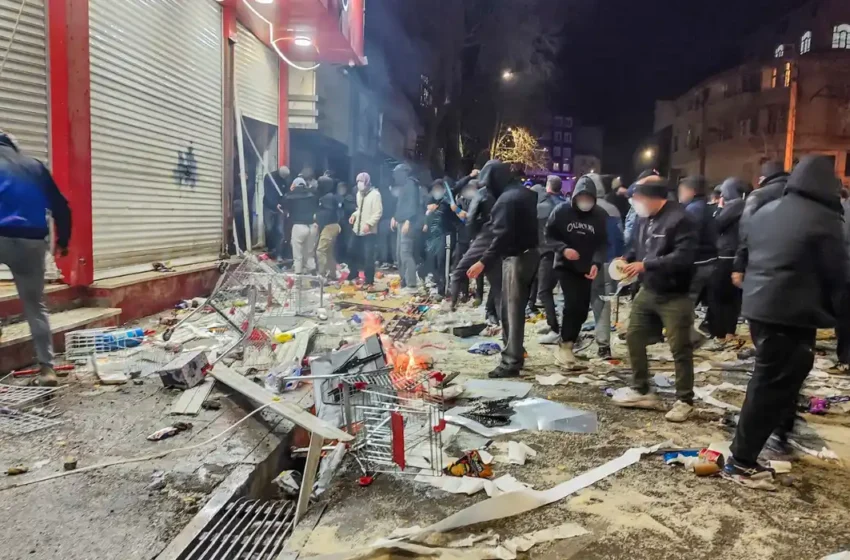
Tehran defies UN over protest killings, citing Western bias
The recent resolution issued by the UN Human Rights Council on Iran’s violation of human rights following its violent crackdown on protesters is simply a reflection of a much larger problem: a problem related to a struggle not only to protect rights but also to protect a nation from a global challenge to its geopolitical status and power. Not only has the current government in Iran dismissed this condemnation on a national and global level, but it is also a government which understands how to wield power through division and military might.
Why the UN Resolution Was Adopted: A Response to Mass Killings and Systematic Repression
The resolution, which was adopted with 25 votes in favor, condemned Iran’s
“violent crackdown on peaceful protests”
involving extrajudicial killings, enforced disappearances, sexual violence, and other human rights abuses. Its adoption reflects the raising of concerns internationally about the scale of the violence and the refusal by the Iranian government to acknowledge accountability.
It does underline some deep global divisions: seven countries, including China, India, and Pakistan, voted against the resolution; 14 countries abstained, including Qatar and South Africa. This division can also portray the limits of the international consensus on Iran: a country where geopolitical and economic interests, time after time, override human rights concerns.
The UN resolution also extended the mandate of the special rapporteur and the independent fact-finding mission. None of it is merely bureaucratic; this is a signal that the world intends to continue investigating Iran’s actions even as Tehran tries to block scrutiny through information blackouts and disinformation.
The Death Toll Debate: A Politicized Battlefield
At the heart of the argument is the figure of fatalities, with Iran citing the death toll to be 3,117 with the majority falling victim to “terrorists” who received funding from the United States and Israel. However, the figure is disputed by others.
According to the US-based human rights monitoring agency HRANA, at least 5,137 deaths have been confirmed, with a further 12,904 under investigation. UN Special Rapporteur Mai Sato has stated the death toll may climb to as high as 20,000, according to figures given by Iranian doctors.
Such a disparity is certainly not merely a statistical issue but a political one. It demonstrates the manner in which the Iranian government is engaged in an attempted control of the discourse and an absence of accountability by portraying such demonstrations of discontent as an insurgent movement incited by foreigners as opposed to a domestic rebellion, which is a product of an enduring period of repression.
A New Scale of Repression: Comparing Iran to Srebrenica
One of the more shocking factors of this conversation centers upon the comparison offered by Payam Akhavan, a former prosecutor for the UN involved in the creation of the indictment for the genocide performed upon the people of Srebrenica in Bosnia:
“The worst mass murder in contemporary Iranian history.The numbers who were killed, 8,000 Bosniaks murdered in Srebrenica, ‘twice that number in half the time’.”
Although the exact figures can only be speculated, the comparison makes another point clear, which is important: the scale and ease of the crackdown suggest more than a mere security operation. Instead, there is an indication of a deliberate strategy of quelling any form of dissent by mass violence and terror.
The International Response: Realpolitik vs. Human Rights
Iran disputes the Raïs decision through claims made to the effect that Western countries are unsympathetic to the human rights conditions in Iran, a claim resulting from the economic devastation which the country has experienced as a result of the imposed sanctions. While the countries involved with Iran through a series of economic, political, and possibly military interventions are unsympathetic to the human rights conditions in
However, sanctions do not justify slaughters of civilians. What the sanctions do is create a political cover, which helps the regime justify being a victim of Western aggression. This argument is very effective, given the fact that it uses a common technique operated by authoritarian regimes of portraying internal dissident activities as being planned in another nation.
The Internet Blackout: A War on Information
The Iranian communication blackout is a bid to stem the tide of information and prevent reports of the clampdown. The international internet observatory, Netblocks, recorded that international internet access remained blocked, albeit with limited access to VPN and proxy services.
Despite this blackout, videos are being uploaded. Various human rights groups are verifying videos that prove that state forces are firing live bullets at protesters, including heavy machine guns. This is considered to be the sole source of proof that challenges whatever narrative that the state would choose to create.
The blackout is not only a technical measure; it is a measure of collective punishment, a restriction on information, on money transactions, and on the potential to organize. It is a kind of modern repression, and it is a measure of the government’s fear of its well-informed and connected population.
The Threat of War: How Domestic Repression Is Driving Regional Tension
The crisis in Iran is not isolated. It exists against the backdrop of escalating regional conflict and the looming threat of US military action. President Donald Trump has repeatedly threatened intervention if Iran continues to kill protesters. In response, the US is moving the USS Abraham Lincoln carrier strike group toward the Middle East—raising fears of renewed military escalation.
Iran’s leadership has responded with defiance, with the Islamic Revolutionary Guard Corps (IRGC) signaling readiness for military confrontation. This dynamic creates a dangerous loop:
- Domestic repression intensifies, leading to more protests.
- International condemnation grows, leading to sanctions and military threats.
- Iran responds with nationalism and military posturing, justifying further repression.
This cycle increases the risk of a wider conflict, where human rights become secondary to geopolitical strategy.
The Final Question: Is the UN Resolution Enough?
The UN Human Rights Council’s resolution is a symbolic victory for accountability, but it may be insufficient to stop the killings. The Iranian regime has rejected the resolution outright and is likely to continue its crackdown while maintaining its narrative of foreign interference.
A critical question remains: what can the international community do beyond resolutions? Sanctions, while necessary, may not change the regime’s behavior and can even strengthen its claim of Western aggression. Military intervention would likely trigger a devastating regional war.
The most effective pressure may come from a combination of:
- targeted sanctions against security officials,
- international criminal investigations,
- diplomatic isolation, and
- support for independent human rights documentation.
But even this may not be enough unless global powers agree on a unified strategy.

