

UN chief accuses US of replacing international law with raw power
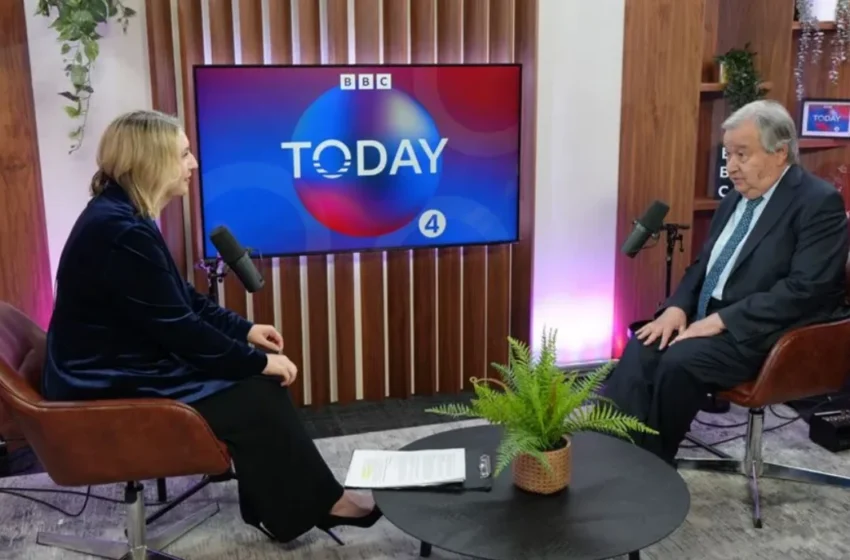
The United Nations Secretary-General António Guterres has issued a rare and critical commentary on U.S. foreign policy, which seeks to substitute international law in favor of its own might and power. In a BBC Radio 4 interview, Secretary-General Guterres pointed out:
“The policy reflects a conviction that multilateral solutions are not relevant and what matters is the exercise of power and influence.”
The warning comes as President Donald Trump challenges the very mandate of global institutions and adopts the ‘America First’ policy which is damaging the United Nations and the post-World War II international order.
During Trump’s return to office, his government has challenged the importance of the United Nations on several occasions, criticizing its ineffectiveness and bias. During Trump’s appearance at the 2025 U.N. General Assembly, he complained about the United Nations’ inability to solve conflicts that his government claimed to have solved on its own. During this year, Trump has been involved in two major incidents of confrontations with global institutions.
The U.S. intervention in Venezuela raised serious questions about sovereignty and international law, while Trump’s public insistence that the U.S. must “own” Greenland challenged Danish sovereignty and raised fears of unilateral expansionism. These actions have reinforced Guterres’ warning that Washington is increasingly turning away from multilateral solutions and toward raw geopolitical power.
The U.N.’s Shrinking Footprint in New York
Guterres’ criticism comes amid an organizational shift in the U.N.’s footprint in the United States. The U.N. Development Programme (UNDP) announced it will move nearly 400 New York-based jobs to Europe, mainly Germany and Spain.
This relocation has been described as both a logistical and symbolic response to rising U.S. hostility toward multilateral institutions, security and operational concerns, and the growing perception that the U.S. is no longer a safe or reliable hub for global governance. For the U.N., the move represents a significant shift away from its traditional global headquarters in New York — a city that has housed the organization since its founding in 1945.
The U.S. Paradox: Funding the U.N. While Undermining It
This warning comes in the wake of President Donald Trump posing a challenge to the mandate of international institutions and taking up ‘America First’ policy, which is undermining the United Nations and the post-world war II international order.
Whilst Trump is back in power, his administration has disputed the relevance of the United Nations on more than one occasion, criticizing it for being ineffective and biased. during Trump’s addressing session at the United Nations General Assembly in 2025, he complained about the United Nations’ inability to resolve disputes that his administration asserted it resolved by itself. This year alone, Trump has appeared in two major incidents involving confrontations with international institutions..
Security Council Reform: A Gridlocked Institution
Guterres made pleas to change the United Nations Security Council, which he considers to be dated and paralyzed. The United Nations Security Council is made up of five permanent members: the United States, United Kingdom, and France, and China, who have veto power over any UN decision that they may not like in their respective national governments. This, they say, is because it still mirrors post-world war realities and not contemporary realities, since there are now three Council members from Europe, which, as Guterres has put it, “does not give voice to the whole world.”
The veto has rendered the council dysfunctional in big conflict situations, such as in Ukraine and Gaza, where Russia and the U.S. have vetoed resolutions that might have led to international influence or mediation in the conflict. This makes the U.N. look inefficient because it cannot act effectively in a situation that requires prompt attention.
Trump’s Criticism and the Decline of the Rules-Based Order
Trump has consistently framed the U.N. as a flawed organization that creates problems rather than solving them. In a September 2025 address to the U.N. Security Council, he accused the body of producing “strongly worded letters” without action, saying “empty words don’t solve war.”
This rhetoric has been matched by policy actions that appear to weaken global institutions, including withdrawing or cutting funding from international bodies, rejecting multilateral agreements, questioning the legitimacy of international legal norms, and shifting U.S. alliances toward transactional relationships. Guterres’ warning is not simply a critique of the Trump administration. It is a broader alarm about the erosion of the rules-based order that has governed global relations since 1945.
Data Shows the Growing Gap Between U.S. Influence and International Law
If the U.S. continues to prioritize power over law, the world could face increased unilateral interventions, weaker enforcement of international humanitarian law, greater instability in conflict zones, and a faster erosion of global institutions like the U.N. The data behind this trend is already visible.
The U.S. contribution to the U.N. regular budget remains around 22%, yet the U.N. is losing its presence in New York, with the UNDP relocating nearly 400 positions to Europe. Meanwhile, U.S. participation in U.N. peacekeeping is negligible, and the Security Council has seen more than 40 vetoes since 2020, many of which have blocked action in major crises. These figures illustrate the widening gap between American financial support and its willingness to abide by collective governance.
What Happens Next? A World Divided by Power
Guterres’ comments signal a growing conflict between U.S. power and global norms. If the trend continues, the U.N. could face reduced influence and operational capacity, loss of funding from key contributors, and a more fragmented world order dominated by major powers. Ultimately, the United States has historically been the cornerstone of the post-war international order.
Yet under Trump, the country appears to be turning away from the institutions it helped build. The question now is whether the U.S. will return to a role that respects international law, or whether the “law of power” will become the new global standard.

